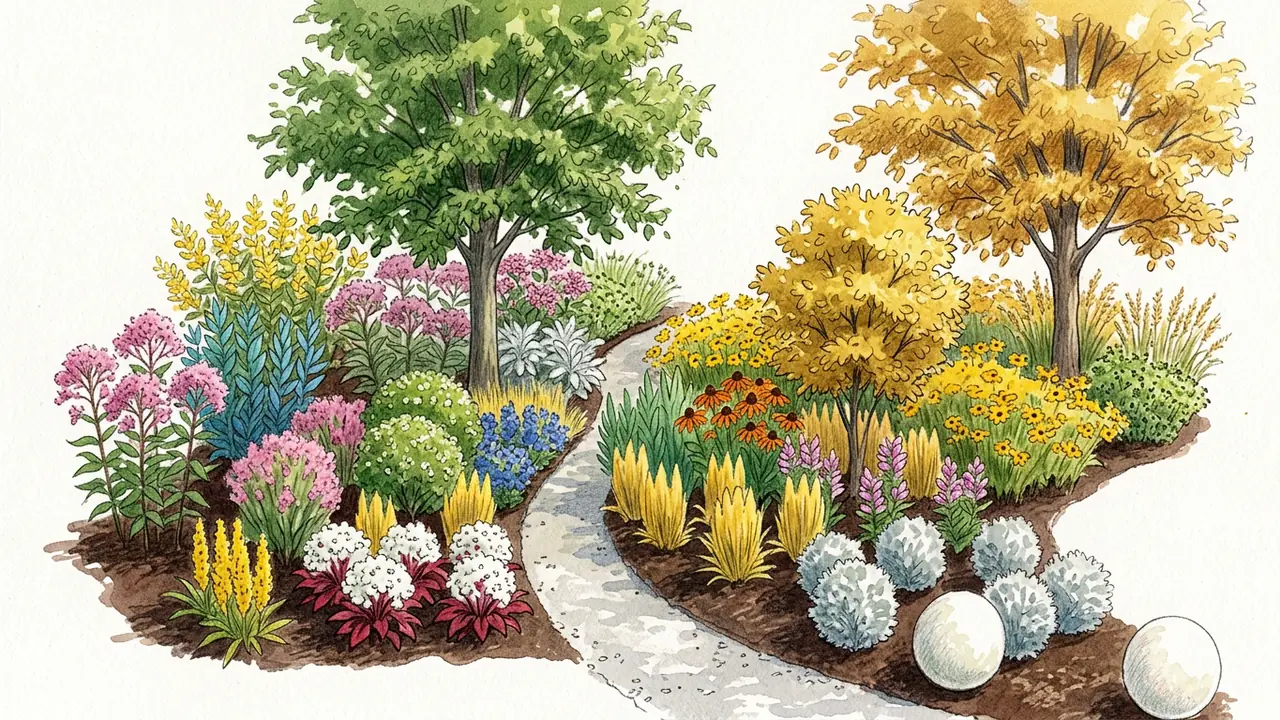
This is a real design built in Plantyd: a backyard in USDA zone 7a with two island beds, a curved stone path, and 151 plants across 26 species, most of them native to eastern North America. We'll use it to walk through the two features that do the most work when you're planning a garden from scratch: the growth timeline, which shows your beds at five points across fifteen years, and the sun analysis, which shows what all that growth does to the light.
Why those two? Because a garden takes about a decade to look like its plan. You plant quart pots and whips, then wait while the picture fills in. Most design tools draw that picture as one finished frame, so every decision gets made against a version of the yard that won't exist for years. Plantyd draws the years in between. By the end of this post you'll know how to run both checks on your own yard, and what to do with what they show you.
What's growing here: 26 species, color from April to frost
First, the layout. Two kidney-shaped beds sit off the lawn with a three-foot stone path threading between them. The far bed is the tall, loose one: Joe-Pye weed at seven feet, swamp milkweed for the monarchs, blueflag iris in spring, and three prairie dock whose ten-foot flower stalks periscope over everything in September. The near bed is calmer, with columbine, rose-pink alumroot, and turtlehead under a dwarf chestnut oak, and a rim of purple and orange coneflowers where the sun hits.
The bloom relay runs from redbud and columbine in April through coreopsis, coneflower, and milkweed in summer, into goldenrod, turtlehead, and prairie dock in September, with aromatic aster holding the flowers until frost while the blackgum turns the back corner scarlet. Every month from April to November has something in bloom.
Watch it grow: the same beds at years 1, 3, 5, 10, and 15
Plantyd's growth timeline redraws every plant in the design at five time steps: years 1, 3, 5, 10, and 15. Here is this garden played through all five, captured straight from the canvas:

Plantyd grows each plant on its own curve, set by its lifeform and its growth rate. The lanceleaf coreopsis is rated fast, so it hits full size by year 3, which is why the gold drifts arrive early in the animation. 'Solar Flare' false indigo is rated slow, true to baptisia's reputation, and doesn't fill its circle until around year 10. The trees never stop: at year 15 the blackgum is still a young tree on its way to a 35-foot canopy.
Year 1 deserves its own look, because it's the version of the garden you actually plant:
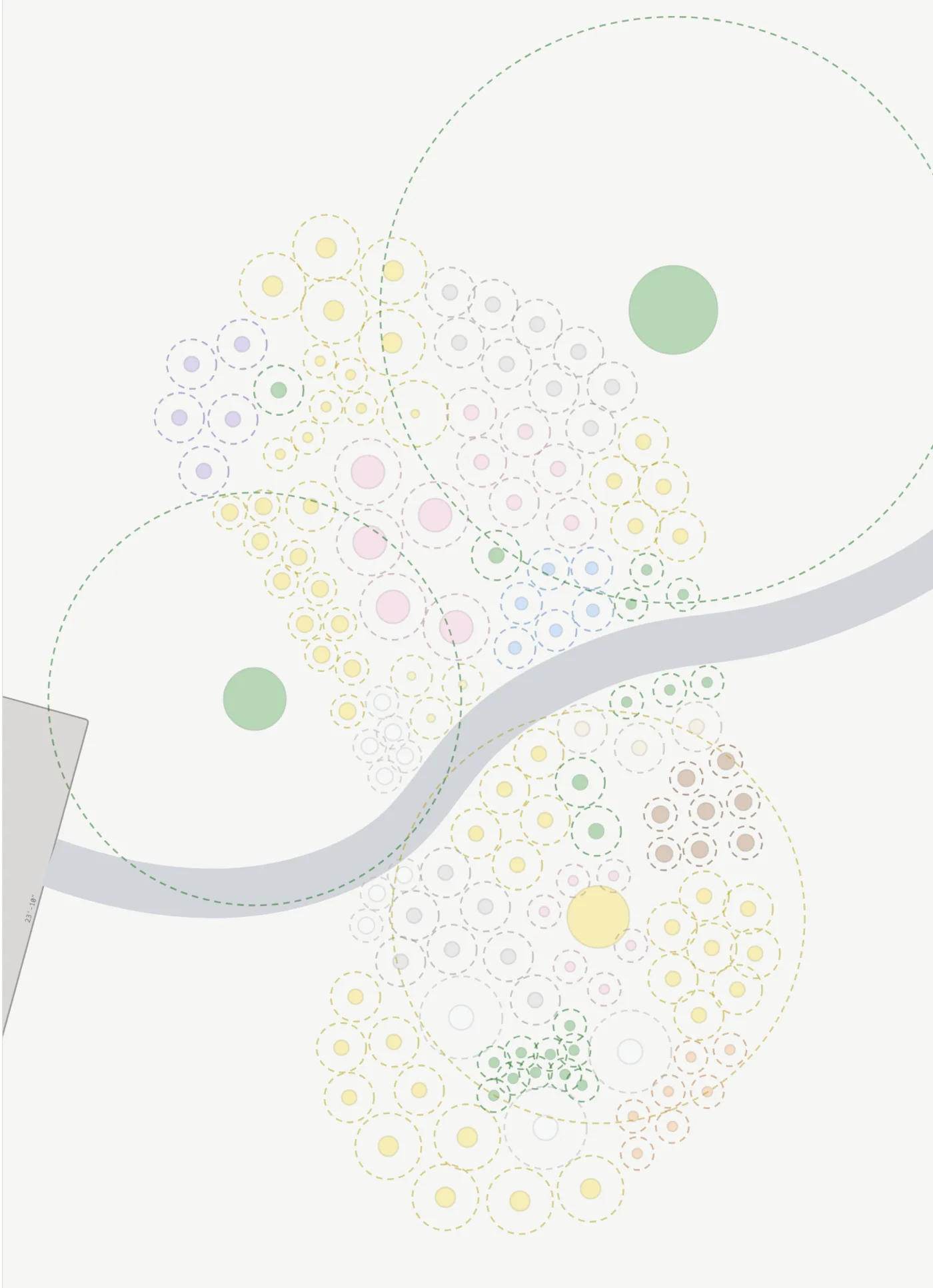
Those dashed rings matter more than they look. Each one marks a plant's mature footprint, so the gaps between the year-one dots are space the plants will claim on their own. The most common beginner mistake in a perennial bed is planting to make year one look full, then ripping half of it out in year four. The rings let you catch that before you've bought anything.
Now watch the light change
As the plants fill in, they also cast shade, and shade is the part almost nobody plans for. Plantyd's sun analysis simulates sun positions for the project's actual location and season, then adds up effective sun hours for every square of the yard: 6 or more hours counts as full sun, 4 to 6 as part sun, 2 to 4 as part shade, and under 2 as full shade. It runs against the canopy sizes of whatever growth year you've selected.
Same beds, same summer day, fourteen years apart:
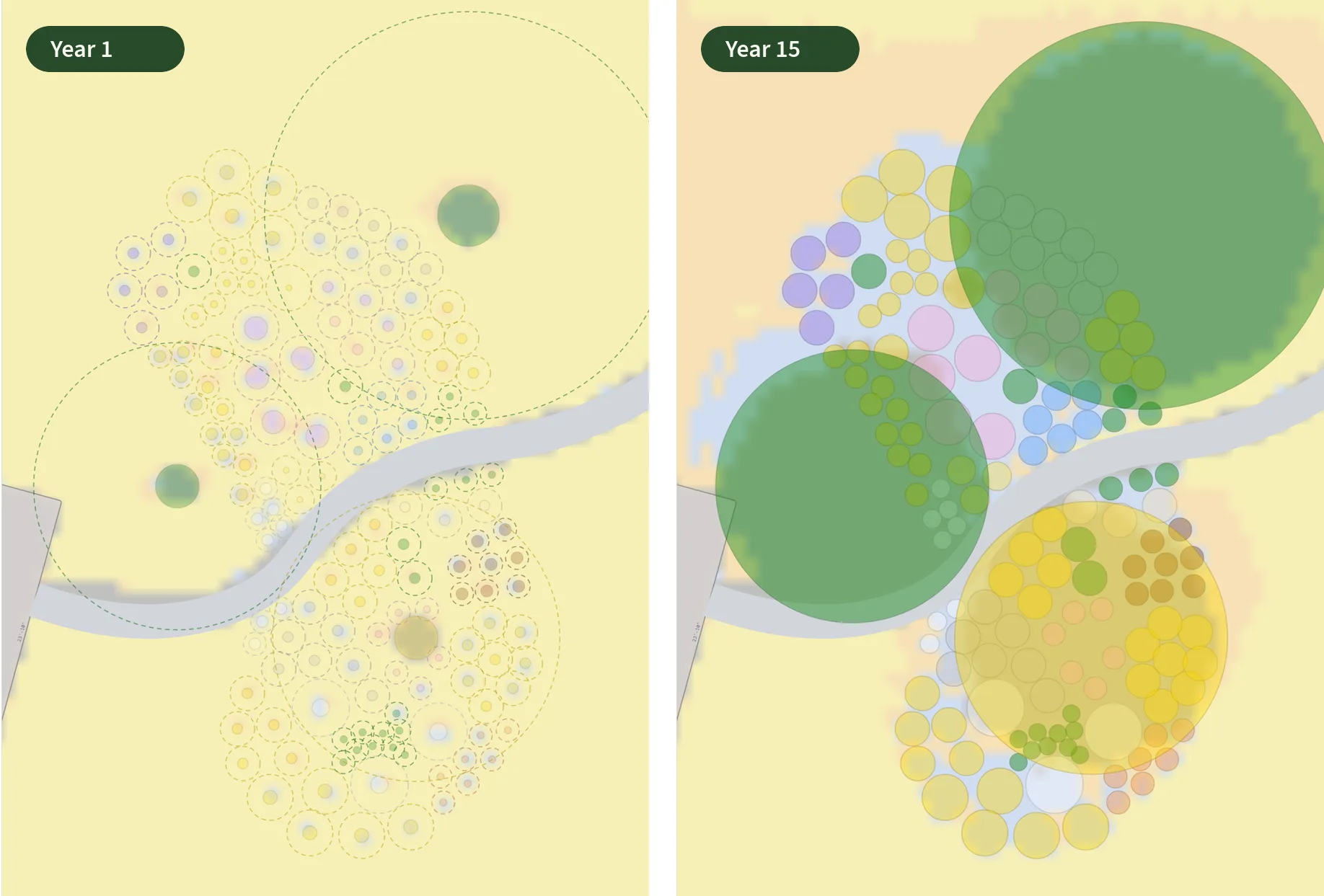
At year 1 the analysis says what your eyes would: the whole planting area is full sun, because the trees are saplings. Stand in that yard with a sun calculator app and it will cheerfully tell you to plant echinacea anywhere you like.
By year 15 the blackgum, the redbud, and the oak have rewritten the map. A pool of part shade spreads across the far bed and along the path, and a band of part sun pushes even further out. Several hundred square feet of full sun are gone, and nobody touched the design. The trees just grew, on the schedule the plan predicted.
Try it on your own design
Both features live in the editor toolbar. Drag the growth timeline to any of the five year marks and the whole canvas redraws. Open the Sun panel and hit Recalculate, and it builds the shade map for whichever year you're looking at. Checking year 1 and year 15 takes about a minute and usually changes at least one planting decision.
Planting year one for year fifteen
Look back at where the year-15 shade lands, then look at what this design put there. Clustered around the redbud and the oak, right in the future shade pools, are the natives that want it: Canadian columbine, alumroot, false goatsbeard, rose turtlehead, and the Annabelle hydrangeas. Out in the open ground between the canopies, where the map stays yellow through year 15, live the unapologetic sun lovers: coreopsis, goldenrod, coneflowers, prairie dock.
That placement comes straight from the year-15 light map. The columbine will tolerate its sunny first few summers; woodland-edge plants handle open light fine while they wait for the canopy. The reverse plan, putting coneflowers under a future canopy because the spot is sunny today, fails slowly and expensively, one leggier summer at a time.
There's a second valid strategy worth naming: plant for today's sun and treat the eventual shade as a scheduled renovation, moving the sun lovers out as the canopy closes. Plenty of good gardeners work that way. Either way, you need to know where the shade is going to land, and this garden answered that before the first hole was dug.
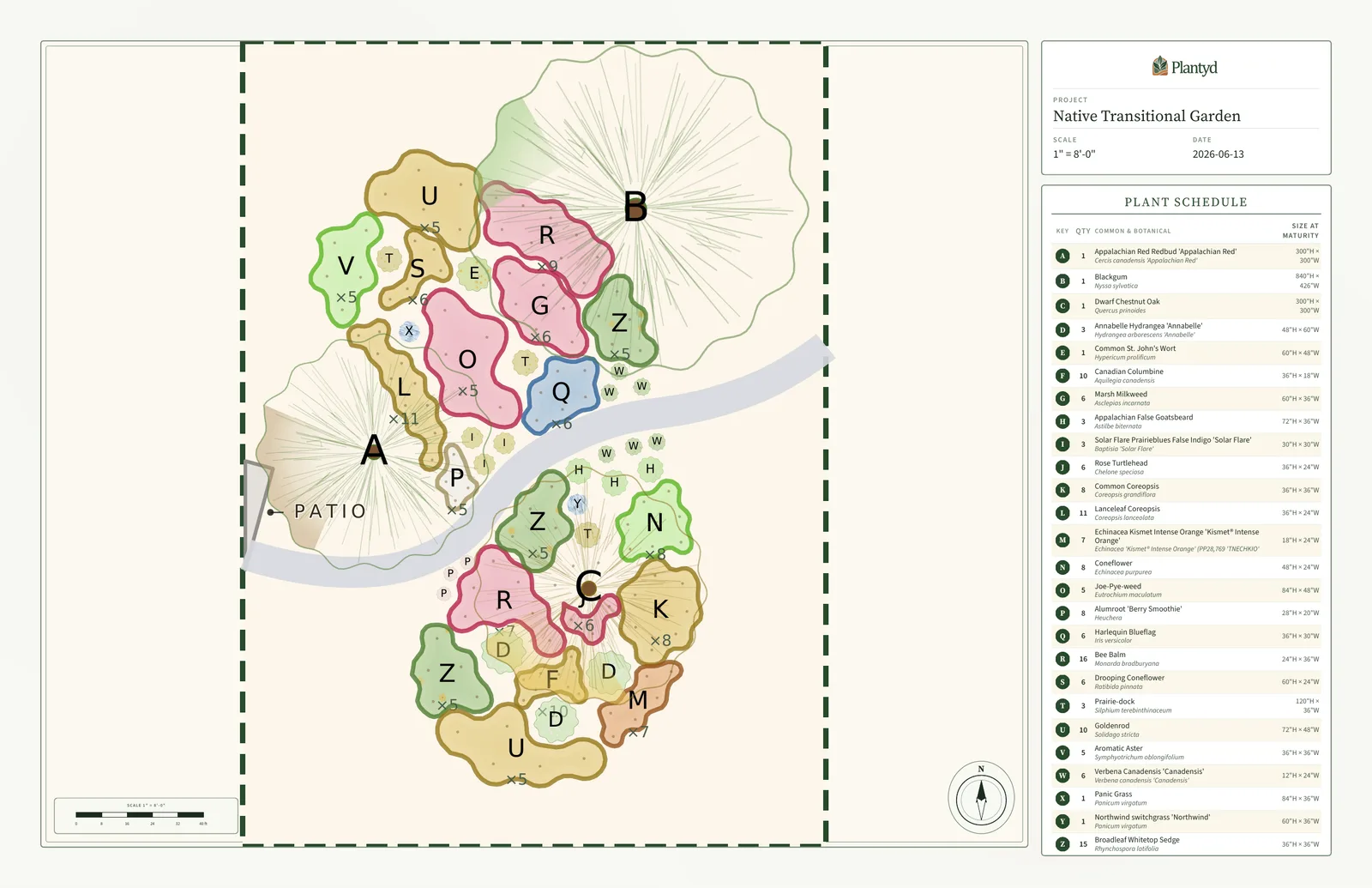
The full plant schedule
The complete list as it appears on the exported plan, real quantities included:
| Plant | Botanical name | Qty | Role in the design |
|---|---|---|---|
| Blackgum | Nyssa sylvatica | 1 | Tree — fall color anchor |
| Appalachian Red redbud | Cercis canadensis 'Appalachian Red' | 1 | Tree — spring bloom at the path |
| Dwarf chestnut oak | Quercus prinoides | 1 | Small native oak |
| Annabelle hydrangea | Hydrangea arborescens 'Annabelle' | 3 | Shrub — white summer mopheads |
| Shrubby St. John's wort | Hypericum prolificum | 1 | Shrub — gold midsummer bloom |
| Bee balm | Monarda bradburyana | 16 | Spring — pink, hummingbird magnet |
| Broadleaf whitetop sedge | Rhynchospora latifolia | 15 | Summer — white star bracts |
| Lanceleaf coreopsis | Coreopsis lanceolata | 11 | Spring–summer — gold daisies |
| Canadian columbine | Aquilegia canadensis | 10 | Spring — red-and-gold nodding bells |
| Wand goldenrod | Solidago stricta | 10 | Late summer–fall — gold spires |
| Purple coneflower | Echinacea purpurea | 8 | Summer — classic prairie daisy |
| Large-flowered coreopsis | Coreopsis grandiflora | 8 | Spring–summer — gold, part shade |
| Alumroot 'Berry Smoothie' | Heuchera | 8 | Foliage — rose-pink leaves for shade |
| Echinacea 'Kismet Intense Orange' | Echinacea hybrid | 7 | Summer–fall — saturated orange |
| Rose verbena | Verbena canadensis | 6 | Summer–fall — low weaver |
| Rose turtlehead | Chelone speciosa | 6 | Late summer–fall — pink hoods |
| Gray-headed coneflower | Ratibida pinnata | 6 | Summer — drooping gold rays |
| Swamp milkweed | Asclepias incarnata | 6 | Summer — monarch host plant |
| Harlequin blueflag iris | Iris versicolor | 6 | Spring — violet-blue flags |
| Joe-Pye weed | Eutrochium maculatum | 5 | Late summer — 7-ft butterfly towers |
| Aromatic aster | Symphyotrichum oblongifolium | 5 | Fall — purple finale |
| Appalachian false goatsbeard | Astilbe biternata | 3 | Early summer — creamy plumes |
| False indigo 'Solar Flare' | Baptisia hybrid | 3 | Spring–fall — yellow lupine-like spikes |
| Prairie dock | Silphium terebinthinaceum | 3 | Fall — 10-ft gold periscopes |
| Switchgrass (straight species) | Panicum virgatum | 1 | Grass — winter structure |
| Switchgrass 'Northwind' | Panicum virgatum 'Northwind' | 1 | Grass — strict vertical accent |
What to take home
- Design in years, not weekends. The garden you plant and the garden you get are a decade apart, and scrubbing through the growth years costs nothing compared to redoing a bed.
- Trust the dashed rings. Empty space at year one means the plan is working.
- Run the sun analysis twice: at year 1 to match plants to the light they'll get now, and at year 15 for the light they'll get from then on.
- Put the shade lovers under the future shade. Most woodland natives can handle a few sunny establishment years while the canopy grows in. Prairie plants stuck in new shade just get leggier every summer.
This post stuck to two beds. To see how a whole property comes together in Plantyd, butterfly garden, raised beds, orchard row and all, have a look at the backyard master plan walkthrough.
Common questions
How long do native perennials take to fill in?
Two to four growing seasons for most of the species in this plan. Fast growers like lanceleaf coreopsis reach their mature spread around year 3, while slow ones like 'Solar Flare' false indigo can take until year 10. Trees keep going long past that: the blackgum here is still widening at year 15. Plantyd's growth timeline draws each plant at its own rate, so you can see which parts of a bed fill in first.
How far apart should I space plants if the bed looks empty in year one?
Space them at their mature spread, not the size of the nursery pot. On the Plantyd canvas, the dashed ring around each plant shows that mature footprint. A bed planted this way looks sparse in year one, and that's normal. Mulch the gaps, or drop in inexpensive annuals while the perennials grow into their rings.
How do I know where shade will fall as my trees grow?
Run Plantyd's sun analysis at two growth years and compare. It simulates the sun's path for your project's location and season, then maps every square of the yard as full sun, part sun, part shade, or full shade using the tree canopies of whichever year you've selected. In this design, that comparison is the difference between a nearly all-yellow map at year 1 and large shade pools at year 15.
Will this plant list work outside zone 7a?
The approach works anywhere; the plant list is regional. Many of these species, purple coneflower and swamp milkweed among them, are hardy far north of zone 7a, but a few lean southern. Check each plant against the USDA hardiness zone map before you buy, and let the layout ideas carry over as they are.
See your garden at year fifteen
Place your plants once, then scrub through fifteen years of growth and shade before you commit a single dollar at the nursery.
Start designing freeNo credit card required · Free tier is free forever