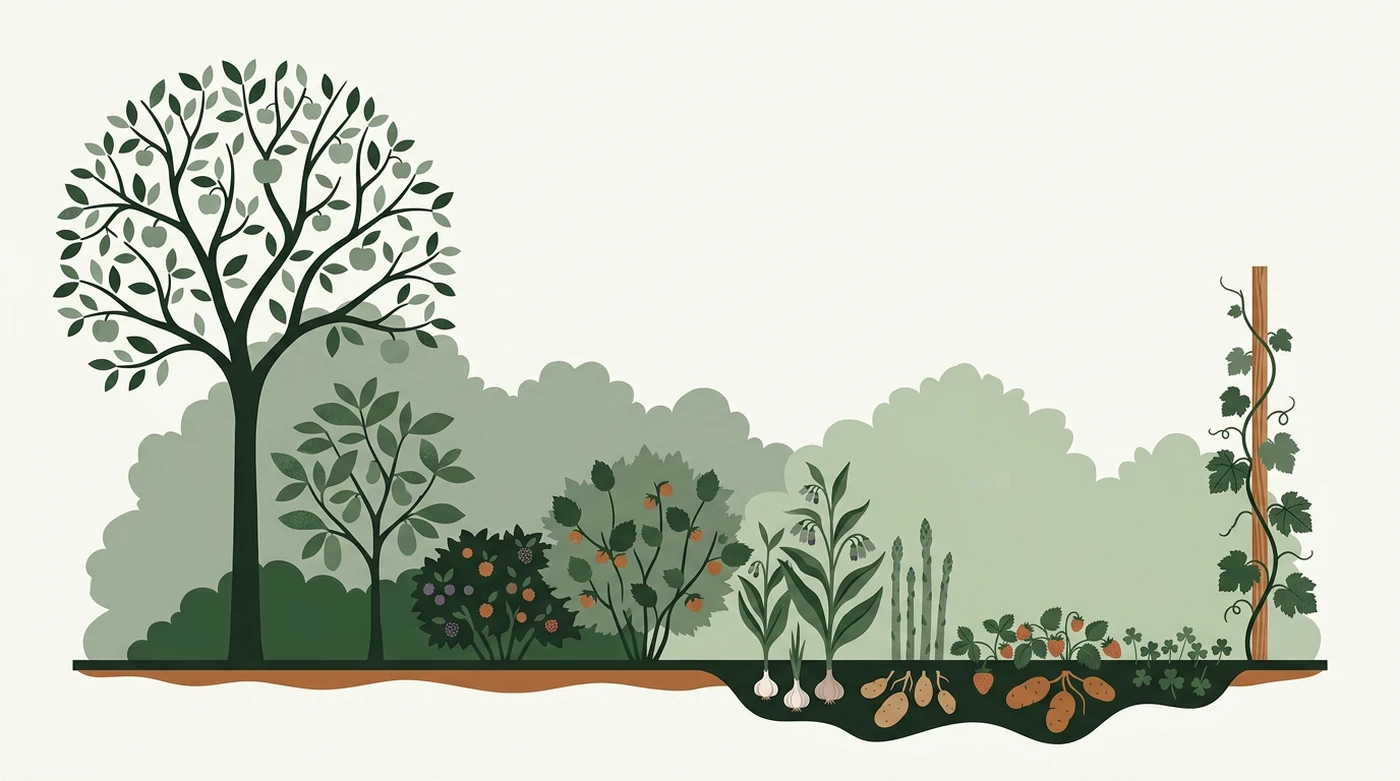
A food forest is a garden built in tiers. A fruit tree at the top, a smaller tree beside it, berry bushes underneath, rhubarb and herbs at knee height, strawberries running across the soil, garlic and onions below the soil line, and a grape climbing anything vertical. Seven layers, packed into roughly the ground one apple tree would otherwise have to itself. The cross-section drawing of those seven is permaculture's most reproduced image, and the promise attached to it is a great deal of food off a small yard, from a planting that largely looks after itself once it is established.
The promise is real. The catch is in the drawing. Six of the seven layers sit underneath the trees, and Charles Canham and his colleagues at the Institute of Ecosystem Studies, who put light sensors on the floor of closed forest stands, found that one to two percent of the sunlight hitting the treetops made it all the way down. Nothing on that list of seven fruits on one percent. A food forest works for exactly as long as its canopy stays open, and every layer in it is living on light the layer above declined to take.
So the diagram gets taught as a planting list, seven slots waiting to be filled, and it works far better read as a budget. That is what decides how far apart you put the trees, which is the one choice in a forest garden that is genuinely expensive to reverse. What follows is what belongs in each layer, the rule that decides which layer can sit under which, and one worked yard with the shade measured fifteen years out.
Where the food forest layers came from
The seven belong to Robert Hart, who spent decades turning a tenth-acre smallholding on Wenlock Edge in Shropshire into a forest garden. He described the plot as having seven storeys and published the scheme in Forest Gardening in 1991. Toby Hemenway's Gaia's Garden is where most American home gardeners meet it, and the layout further down is built on an arrangement he describes there. Hart's case for the seven storeys was that a garden should imitate a young natural woodland, on the reasoning that a system copied from a self-maintaining one will need less maintaining. That is a serious position and most of the permaculture tradition stands behind it. But a natural woodland is optimized for its trees, and the trees win. The understory of a mature wood is not a productive system. It is the list of things that survived one. Martin Crawford, who has run a forest garden at the Agroforestry Research Trust in Devon since the 1990s, argues that a temperate forest garden needs an open, broken canopy, which is not what the diagram draws.
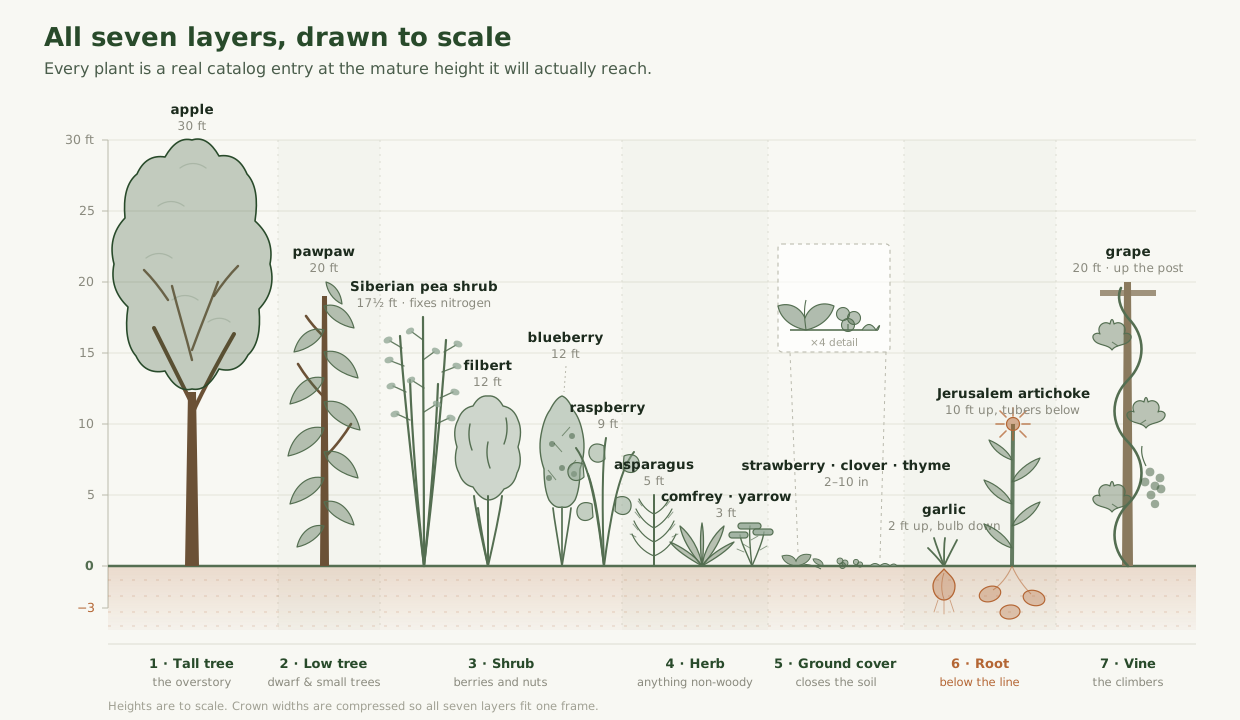
What goes in each food forest layer
1. The tall-tree layer
The overstory, with real gaps between the crowns: standard apples and pears, cherries, European plums, chestnut if you have the room. Skip the classic shade trees, since beech and hemlock came out at five percent of full sun in Canham's nine-species comparison and give you nothing to eat for it. One standard apple at thirty feet across is the entire overstory a sixty-foot garden needs, and the urge to give it a neighbor is how people lose the four layers underneath.
2. The low-tree layer
The same fruit on dwarf and semi-dwarf rootstocks, plus apricot, peach, nectarine, almond, medlar, mulberry and persimmon. In a small garden these are the canopy, and every foot of height you decline to plant is light you keep. Pawpaw changes sides on you, being shade-tolerant when young and a heavy shade caster once grown.
3. The shrub layer
Blueberry, hazelnut, currant, gooseberry, raspberry, serviceberry, rose. Siberian pea shrub fixes nitrogen and feeds birds while it does it. Be careful with the Elaeagnus recommended constantly for the same job, because autumn olive and Russian olive are listed as invasive across large parts of the United States, and check your state on Ribes too: several still regulate currants and gooseberries as an alternate host for white pine blister rust. Running from ankle-high blueberries to hazelnuts that are nearly trees, this is the layer that fits into edges, gaps and awkward corners better than anything else you will plant.
4. The herb layer
Non-woody in the old botanical sense, so your vegetables and flowers belong here as much as the culinary herbs: yarrow, borage, rhubarb, asparagus, mint if you can keep it in a corner. Plant comfrey even though you should not eat it (the pyrrolizidine alkaloids in the leaves are hard on the liver, and the FDA asked manufacturers to pull oral comfrey products in 2001). What it is for is mulch. Cut it four or five times a season and drop it where it falls.
5. The ground-cover layer
Strawberry, clover, creeping thyme, ajuga, nasturtium, the prostrate phloxes. Their real job is prevention, because bare soil grows whatever blows in. This layer gets last claim on the light, which is why the shade-tolerant ones are the ones still there in a decade.
6. The root layer
Garlic, onions, potatoes, Jerusalem artichokes. Keep to the shallow rooted and the easy to lift, because deep crops like carrots need digging, and digging here means cutting through the roots of everything nearby.
7. The vine layer
Grapes, kiwi, hops, passionflower, and the annual climbers too. This is the layer most gardens skip, and the reason is always the same. A vine needs something to climb, and if you have not built it, the vine goes up your youngest fruit tree and takes the light that tree needed. So find the structure first. A boundary fence, a shed wall, an arbor over a path you already walk.
How food forest layers share sunlight
The diagram is drawn as a stack of heights, and that drawing causes a costly misreading. Two plants are compatible when they differ in how much light each one needs, and height only sometimes tracks that. Put two sun-demanding plants one above the other and they compete, whatever the diagram implies about tiers. The lower one loses, slowly enough that nobody connects the loss to the planting decision that caused it.
Survival is the wrong test to apply. Plant physiologists call the break-even illumination the light compensation point, and shade-tolerant species clear it on well under one percent of full sun. A plant sitting near that point is alive and nothing else. It makes no surplus, so it lays down no wood, sets no flowers and ripens no fruit. Almost nothing in a shaded garden is genuinely below break-even, which is exactly why shaded plants persist for years looking healthy and yielding nothing, and why their owners blame the soil. So the test for an understory plant is how much carbon it has left after paying for itself, because fruit is built out of the surplus.
Highbush blueberry makes the case. It holds no starch reserve to ripen a crop from, so every berry comes out of that week's sunlight. North Carolina State's extension service says blueberries will accept up to about half shade, and it says in the same breath that yield falls as shade rises. Both are true, and for someone who planted a blueberry in order to get blueberries, only the second half matters. Currants and gooseberries are the genuinely useful shade fruit, and even there the reason is partly that they are cool-climate crops: part shade spares them heat about as much as it costs them sun.
Layers can also share the same ground by taking turns, and in a deciduous system the bare-canopy window runs for months. Currants leaf out early, rhubarb is up and cropping in April, autumn-planted garlic makes its frame while the branches above it are still bare sticks. That part of stacking costs nothing at all.
Overlap between layers, never within one
Two apples with thirty-foot spreads want thirty feet between trunks, and no amount of enthusiasm for stacking changes that. Treat it as a floor rather than a target: crowns that just touch on a grid still shade about four-fifths of the ground, which is roughly double what a forest garden can afford. What stacking buys you is the right to put a hazelnut, a comfrey and a strawberry mat inside that same thirty feet, because they are drinking from different parts of the light. The arithmetic still applies inside a layer. It stops applying between them.
A food forest layout for an ordinary back yard
Most yards are a rectangle behind a house, and the rectangle decides more than people expect. Keep the trees on the shaded side and put the herb and vegetable beds along the sunward edge. The tall layers should be casting their shadows off the property, not across it.
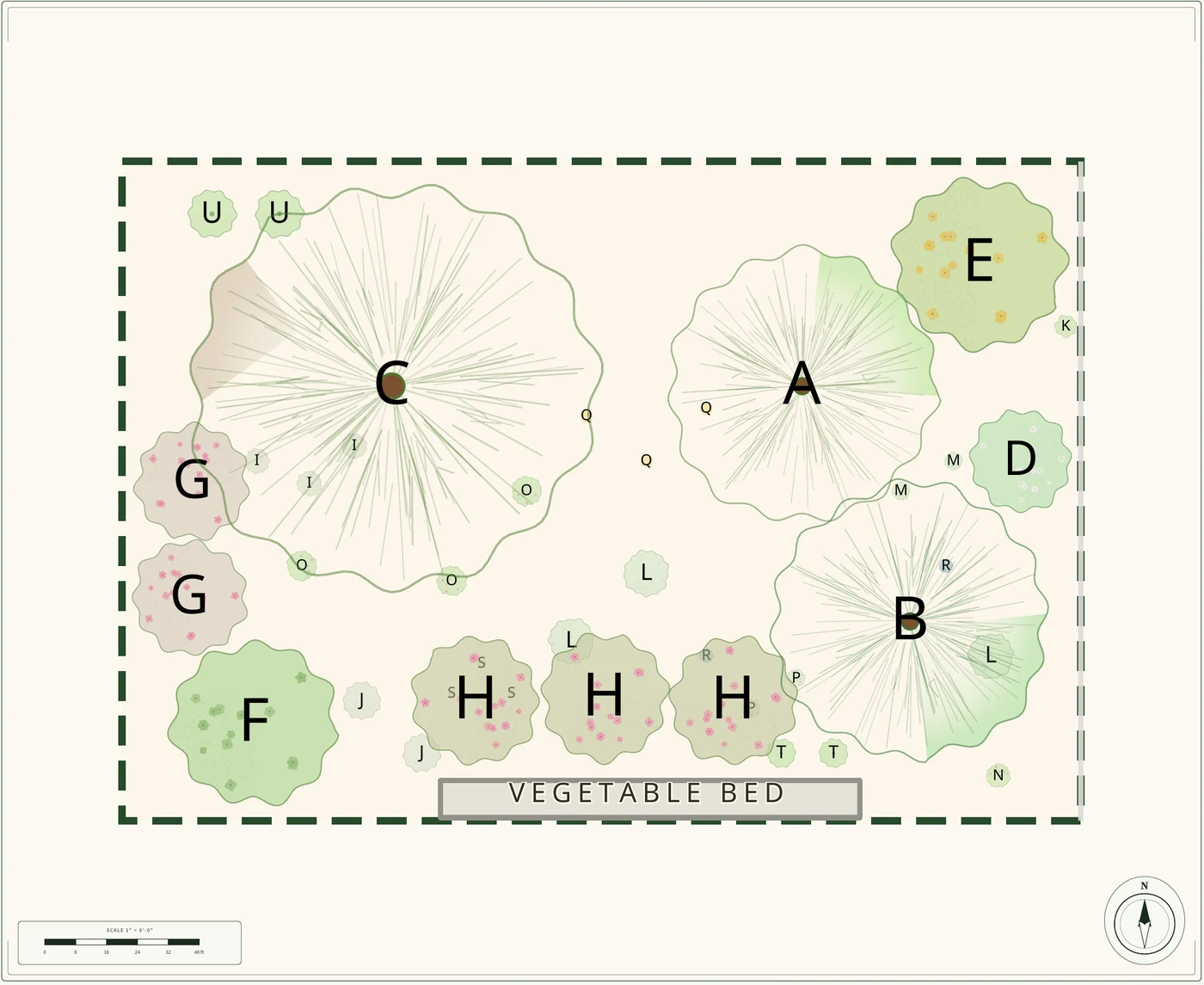
Notice how much empty ground surrounds that apple. Even at thirty feet across it covers about a quarter of this plot, and the open three-quarters is what the six layers underneath are living on. The first instinct of nearly every gardener who sees the plan is to fill that space with a second tree. Ten years later the blueberries are leggy and the vegetable bed has stopped producing, and both failures get blamed on the soil.
The blueberries sit in that open middle instead of under the canopy, because a blueberry in half shade will keep making leaves and stop making a crop worth picking. The filbert down the left side will take the tree shade and still set nuts, fewer than it would in the open. That is the honest version of stacking. Not a free lunch, a discount, and the discount is worth taking on a nut you were not going to fit anywhere else.
How the light budget shrinks as the trees grow
Every layer spends what the layer above it leaves, and the layer above keeps growing. The ground under a young apple is nearly full sun, so whatever you plant there thrives and you conclude you chose well. A decade on, the same ground is part shade and the sun-lovers have thinned to nothing. The mistake was never the plant. It was reading a light level that had an expiration date on it. Here is the garden above with Plantyd's sun analysis run against the tree sizes fifteen years out, on a plot that read full sun almost everywhere the day it was planted.
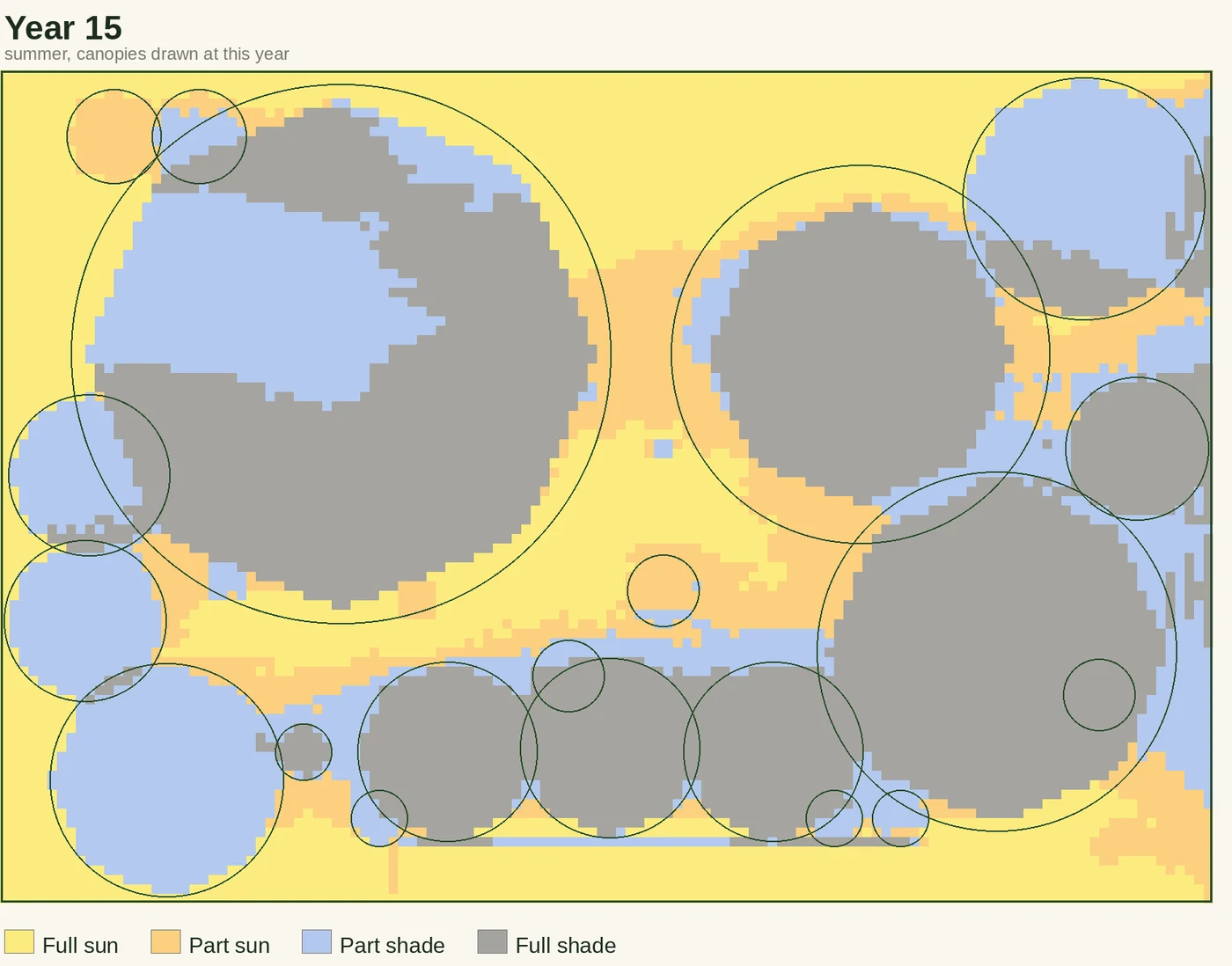
The apple alone has put a full-shade pool across the middle left of the plot, and the pawpaw and fig have done the same on the right. Anything sun-loving planted under those in year one is standing in the grey now, and it will not die there. Full shade on this map means under two hours of direct sun, usually with bright indirect light for the rest of the day, which is plenty to live on. The plant will simply stop setting fruit.
Then look at where the yellow survives, because that is the useful part. A full-sun channel runs up the middle between the canopies. A strip has held along the sunward bottom edge where the vegetable bed went, and so have the corners. Those bands are canopy edge, where a plant gets direct sun for part of the day and open sky for most of it, and they are where anything that still needs sun at maturity belongs.
The same exercise on an ornamental planting is laid out year by year in our sun and shade analysis of a zone 7a native garden, which maps the light across that yard at year 1 and again at year 15. Several hundred square feet of full sun there turn to part shade as two trees fill in, and the twenty-six-species planting was chosen around the shade that was coming rather than the sun that was there. Different plants, same arithmetic.
A wood's understory is a list of plants that gave up on brightness. A forest garden is the argument that nothing in it has to.
Common food forest design mistakes
- Two big trees where there is room for one. The most expensive mistake available, and the hardest to undo.
- Stacking by height instead of by light demand. A tier diagram is not a permission slip. Two sun-lovers on top of each other are an argument that takes years to settle.
- Designing for survival instead of surplus. Almost anything will live in shade. The question is what it will ripen there.
- Spacing at nursery size. A bed that looks full in year one is a thicket by year six, and the plants you paid most for are the ones that lose.
- Choosing the understory for today's light. Pick for the shade that is coming, not the sun that is there now.
- Planting a vine with nothing to climb. It will find your fruit tree. Build the structure first.
Common questions
What are the seven layers of a food forest?
Tall trees, low trees, shrubs, herbs, ground covers, roots, and vines. The tall trees are the overstory, spaced wide enough to let light through. Low trees are the dwarf and naturally small fruit, and shrubs bring the berries and nuts. The herb layer means anything non-woody, vegetables and flowers included. Ground covers close the soil, roots work below it, and vines climb everything else. Robert Hart published the model in 1991, and Toby Hemenway's Gaia's Garden is where most American gardeners meet it.
How do the layers of a food forest share sunlight?
By differing in how much light each one needs, which height only sometimes tracks. Two sun-demanding plants stacked one above the other compete, and the lower one loses. A sun-demanding canopy above a shade-tolerant understory works, because the understory can still turn a profit on what the canopy declines to absorb. Survival is not the bar: shaded plants persist for years and simply stop fruiting, so what matters is whether enough surplus is left to build a crop out of. Layers also share light across time, since currants leaf out early and autumn-planted garlic does its first growing while the canopy overhead is bare.
How do you fit seven layers into a small yard?
Spread the tall trees out and let everything else share the gaps. One standard apple with a 30-foot spread is the entire overstory a 60-foot garden needs, and the open ground around it is what the other six layers live on. Crowd in a second big tree and you lose the shrub and herb layers to shade. In a genuinely small garden the low-tree layer becomes the canopy and you skip the tall trees entirely.
Do you need all seven layers?
No. Three will feed you: trees, shrubs, and ground plants. The other four are there for people who want to use every planting opportunity, and the vine layer is the one most gardens skip because a climber needs something to climb. If you have a fence, a shed wall, or an arbor over a path, you already have somewhere to put a grape and no reason to skip it.
How far apart should food forest trees be planted?
The standard rule is half of one mature spread plus half of the other, so the crowns just meet. Two apples with 30-foot spreads want 30 feet between trunks. Treat that as the minimum rather than the target, because crowns that touch on a grid shade about four-fifths of the ground, and a forest garden needs a canopy far more broken than that. Plants in different layers ignore the arithmetic entirely: a strawberry mat under an apple is not competing with it. Overlap between layers, never within one.
Which plants fix nitrogen in a food forest?
Siberian pea shrub is the usual pick in the shrub layer, clover does the same job down in the ground covers, and black locust and alder are the classics among trees. Check your state list before you buy any of them: autumn olive and Russian olive, the two Elaeagnus species most often recommended for this, are invasive across much of the United States, and black locust is aggressive well outside its native range. One nitrogen fixer per planting group is a reasonable target.
Draw your layers before you buy them
Place a tree in Plantyd and it appears at the size it will actually become, so you can see which layers stack and which collide while the fix is still free. Then run the sun fifteen years out and pick the understory for the shade that is coming.
Start designing freeNo credit card required · Free tier is free forever