On the coldest night of an average winter, St. Cloud, Minnesota, falls to somewhere between 20 and 25 degrees below zero. That range is what the U.S. Department of Agriculture means when its 2023 plant hardiness map puts the city in zone 4b. Sacramento's coldest night bottoms out between 25 and 30 degrees above zero, which makes it zone 9b. Few of the plants that thrive at one of those numbers will thrive at the other, and that matters for permaculture garden design more than most of its plant lists admit.
Those lists come from good places. Toby Hemenway's Gaia's Garden lays out an apple-tree guild with a ring of bulbs at the drip line to hold back grass, flowers to bring in predatory insects, and plants that build the soil, all arranged around one tree. Guild articles and nursery handouts repeat lists like it, and copying one is a reasonable shortcut. A guild that someone has planted and watched is a better bet than one invented on the spot.
But a guild is a list of jobs, and which plant can do each job depends on the hardiness zone. The jobs travel. The plant list mostly does not. So here are three beds, built to scale in Plantyd at real addresses in three zones. The Minnesota bed is organized around sun and shade, the Philadelphia bed around edges and time, and the Sacramento bed around water.
What a guild has to do, wherever it is
A guild is companion planting with a structure. You pick a central plant, usually a fruit or nut tree, and surround it with plants chosen for what they do for it and for each other. Four jobs come up in every climate. Something has to fix nitrogen. Something has to flower early and something else late, so the predatory insects that eat aphids have a reason to stay all season. Something has to cover the soil. And something besides the tree has to be worth eating, because a guild that yields one crop is an orchard with extra weeding. Each plant also has to suit the light where it lands, which in a small yard is decided by buildings more than by compass direction. (Plantyd's sun categories run from full sun, six or more hours of direct light, down to full shade, under two; the details are in how much sun your yard gets.)
David Holmgren, who co-founded permaculture with Bill Mollison, distilled the method into twelve design principles. Four of them carry the beds below. Observe and interact comes first, because you cannot place a fruit tree until you know where the shade falls. Use edges and value the marginal, and creatively use and respond to change, explain the pawpaw patch. Catch and store energy, with water as the energy, is the logic of the pomegranate basin.
Bed one: an apple guild in zone 4b, St. Cloud, Minnesota
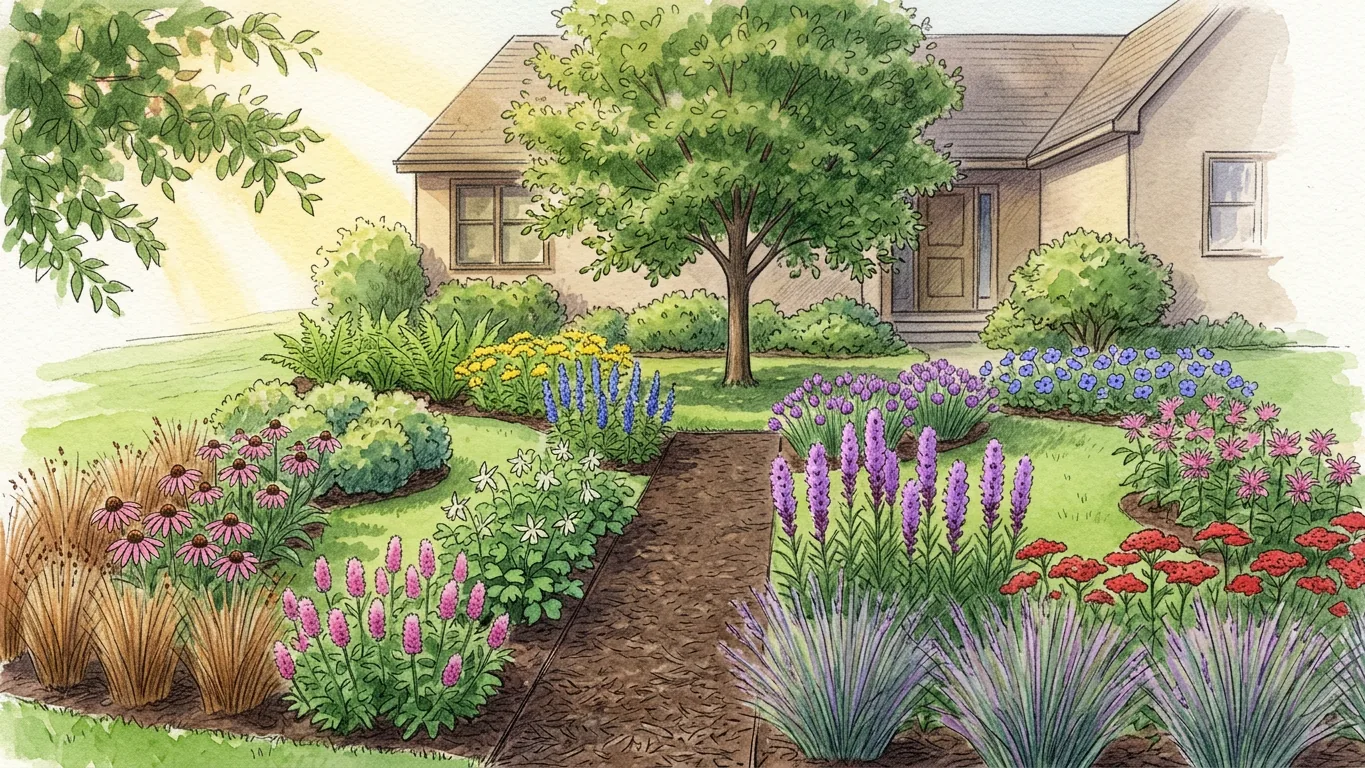
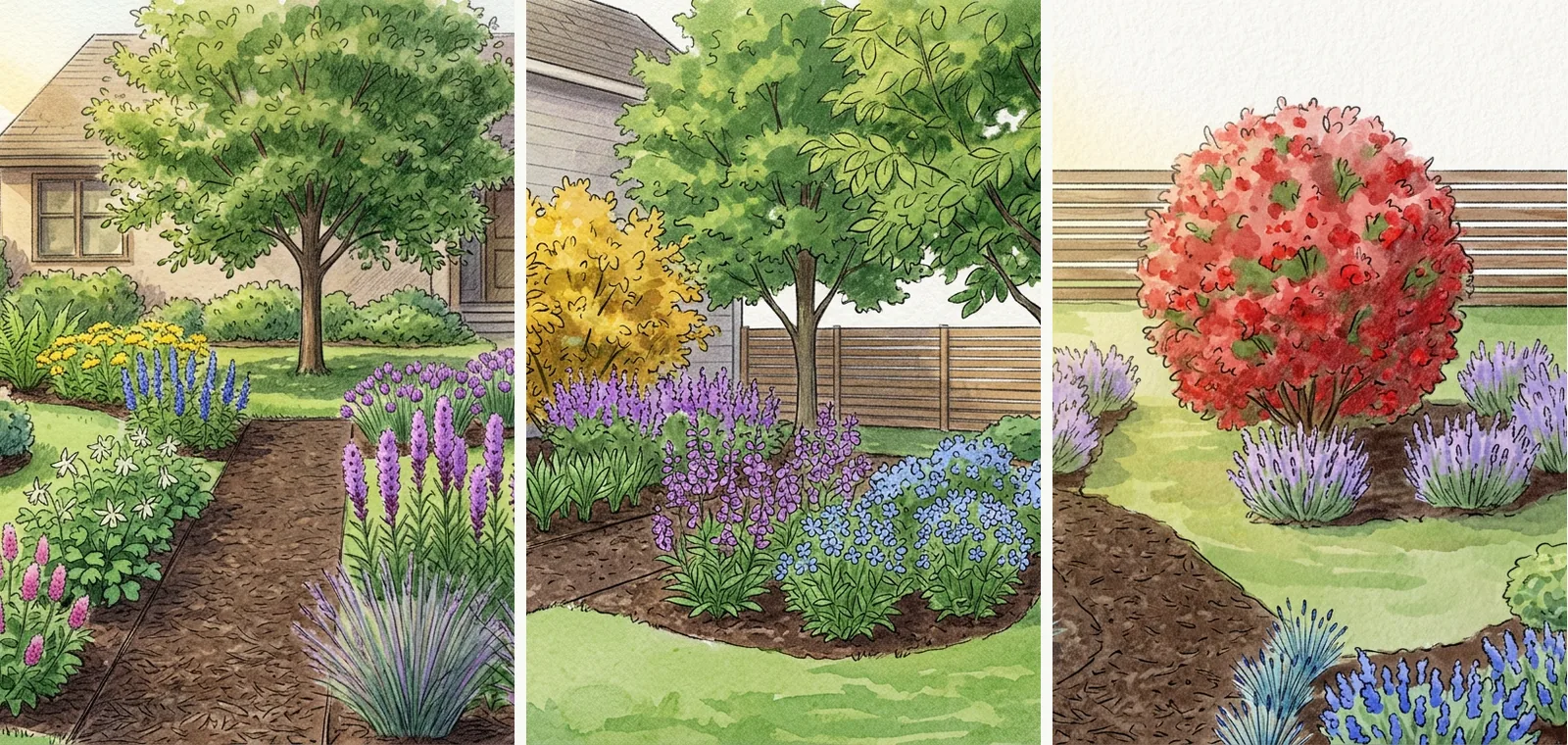
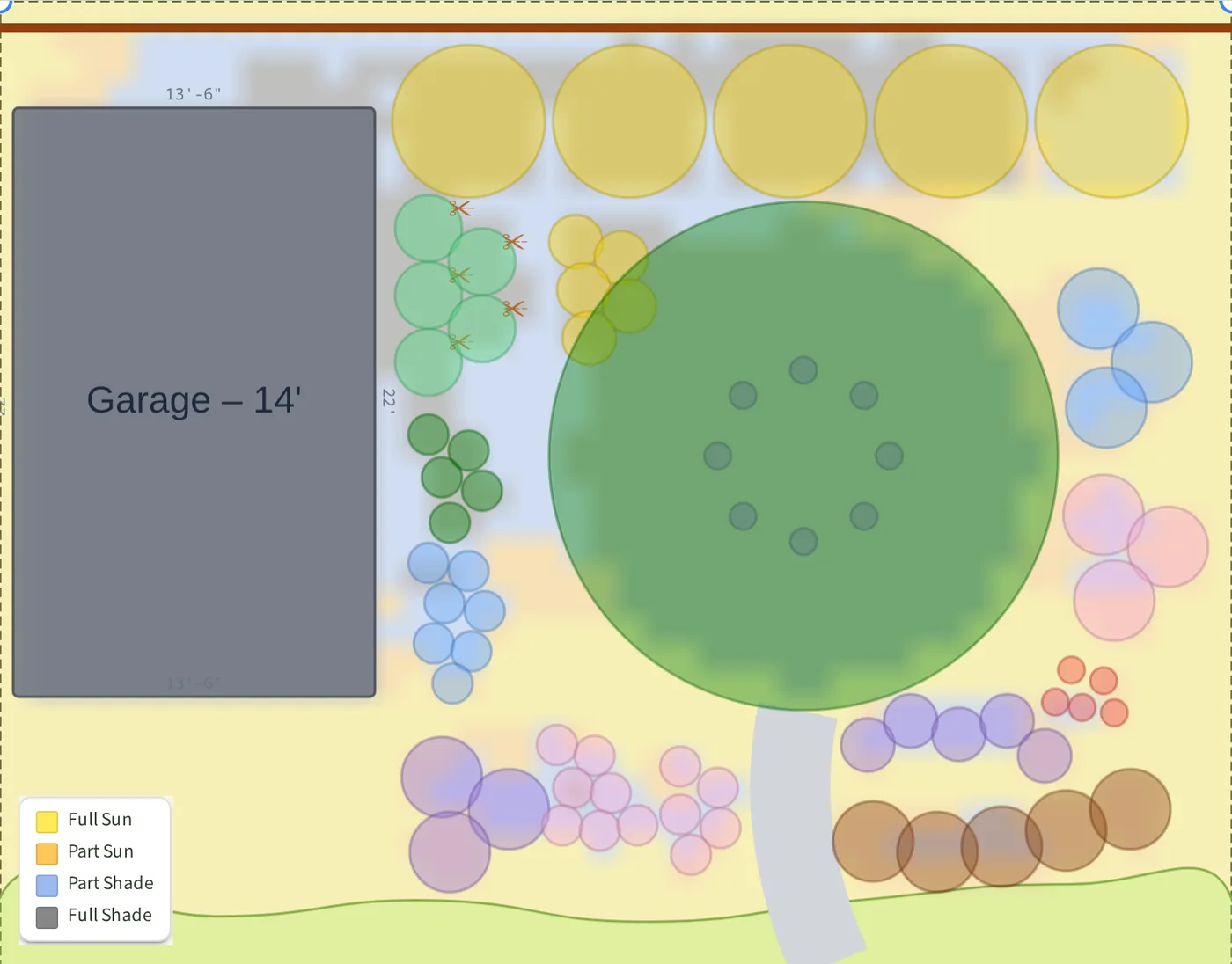
The site is the corner of a St. Cloud backyard, 46 feet wide, with a detached garage 14 feet tall along its west side and a six-foot fence on the north to break the winter wind. The first thing the plan needed was a sun map, and it changed where everything went. Plantyd's sun and shade analysis, run for summer, puts a strip about six feet wide along the garage's east wall in part shade, two to four hours of direct sun, because the building takes the whole afternoon. East of that strip the map turns to full sun, and the apple's trunk went in about 16 feet from the wall, far enough that its mature canopy stays out of the shadow. The strip in the shadow is where the ostrich ferns, red columbine and wild geranium go, in drifts down the wall.
Try it on your own yard
Plantyd draws this map for your property. Find your address, trace the yard over the satellite view, give the house and garage their real heights, and the app shows which ground gets full sun and which sits in an afternoon shadow. Map the sun on your own yard before you decide where a fruit tree goes.
| Plant | Botanical name | Qty | Its job |
|---|---|---|---|
| Honeycrisp apple | Malus 'Honeycrisp' | 1 | The centerpiece, in full sun |
| Black chokeberry | Aronia melanocarpa | 5 | Hedge along the north fence; second fruit |
| Ostrich fern | Matteuccia struthiopteris | 5 | Spring fiddleheads, in the garage's shadow |
| Red columbine | Aquilegia canadensis | 5 | Early hummingbird flowers in the shadow |
| Wild geranium | Geranium maculatum | 7 | Ground cover for the shaded strip |
| Chives | Allium schoenoprasum | 8 | Edible ring under the canopy |
| Golden alexanders | Zizia aurea | 5 | Early nectar at the canopy edge |
| Anise hyssop | Agastache foeniculum | 3 | Late-summer nectar |
| Wild bergamot | Monarda fistulosa | 3 | Midsummer nectar; leaves for tea |
| Red yarrow | Achillea millefolium 'New Vintage Red' | 5 | Small flowers for predatory wasps, past the canopy |
| Purple prairie clover | Dalea purpurea | 7 | Nitrogen fixer, in the sunny front border |
| Narrow-leaved coneflower | Echinacea angustifolia | 5 | Front border; seed heads for finches |
| Meadow blazing star | Liatris ligulistylis | 5 | Late-summer spikes for butterflies |
| Prairie dropseed | Sporobolus heterolepis | 5 | Fine-textured edging along the lawn |
| Little bluestem | Schizachyrium scoparium | 3 | Structure, and rust color in fall |
Every plant here is rated for zone 4 or colder. Honeycrisp came out of the University of Minnesota's breeding program. It needs pollen from a different apple or crabapple in bloom at the same time, and the university's extension service says that tree should be within 100 feet. Plenty of Minnesota neighbors grow one, but check before you rely on it. The nitrogen fixer is purple prairie clover, a native legume of the tallgrass prairie that wants the same full sun the apple does, so it sits in the front border on the bed's south side. Yarrow wants full sun too, so it sits past the edge of the apple's mature canopy instead of under it. Golden alexanders open in late spring, anise hyssop carries the bees through late summer, and the chives ring the trunk because they tolerate the tree's shade and are the thing you will pick twice a week. The rest is laid out the way you would lay out any border: a hedge of black chokeberry along the north fence as the backdrop, the apple in the middle, and a prairie border along the lawn in drifts of five and seven, purple prairie clover, coneflower and meadow blazing star, edged with prairie dropseed and anchored at the corner by little bluestem. A path comes in from the lawn to the apple for picking. The ostrich ferns in the shaded strip give a spring crop of fiddleheads, and the University of Maine's extension service says to boil them for 15 minutes (or steam for ten to twelve) before eating, because undercooked fiddleheads have been linked to food-borne illness.
Bed two: a pawpaw patch in zone 7b, Philadelphia
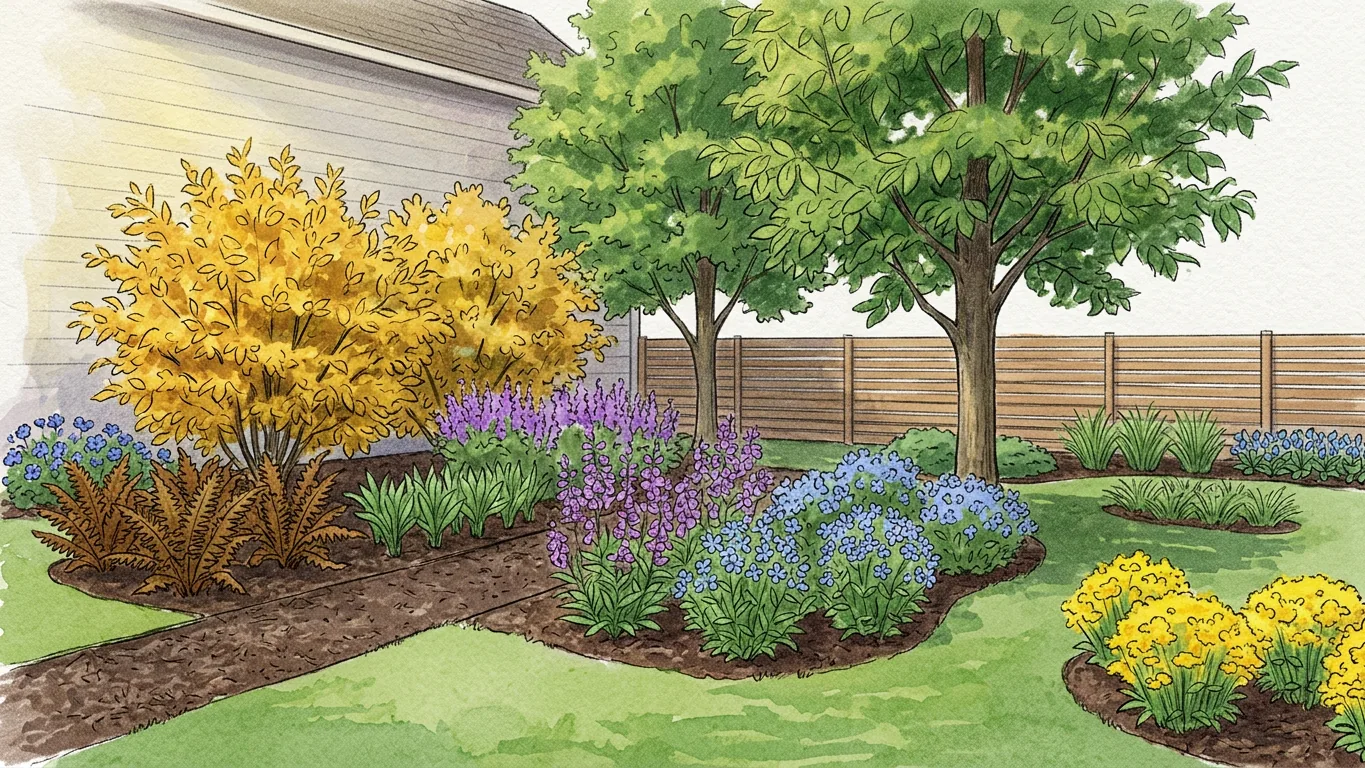
Pawpaw is, in the words of Clemson University's extension service, "the largest edible tree fruit native to the United States," and an understory tree in the wild, the kind that grows along the shaded edge of a Mid-Atlantic woodland. That makes it a good fit for a city yard, which is mostly edges. This bed sits against the east-facing wall of a Philadelphia rowhouse, 24 feet tall, so it gets morning sun and loses the afternoon. That suits young pawpaws. Purdue University's extension service warns that seedlings do not survive full sun and need shade for the first year, sometimes the second. The same publication says established trees perform best in full sun, so a bed that loses the afternoon trades some harvest for an easy start. There are two trees because pawpaws need pollen from a genetically different tree, Purdue says, and two grafts of one cultivar are the same tree. This bed pairs Shenandoah with Susquehanna.
The bed also runs on a calendar. Virginia bluebells and ramps are spring ephemerals. They leaf out and store energy in the weeks before the pawpaws close overhead, and their leaves are gone by midsummer. (Ramps flower after that, on a bare stalk in July.) Plantyd draws them as dashed outlines in summer, because by then their leaves are gone. Woodland phlox, wild geranium and oak sedge carry on in the ground they leave, the Christmas ferns keep the wall green all year, and yellow wild indigo, golden alexanders and blue wood aster hold the open south and east edges, where the sun still reaches. Seen from the lawn it is planted as a woodland edge: ferns and ramps against the wall, drifts under the trees, the sunny edge in drifts of five, and white foxglove beardtongue repeated on both sides of a path that runs in between the two trunks for the late-summer harvest.
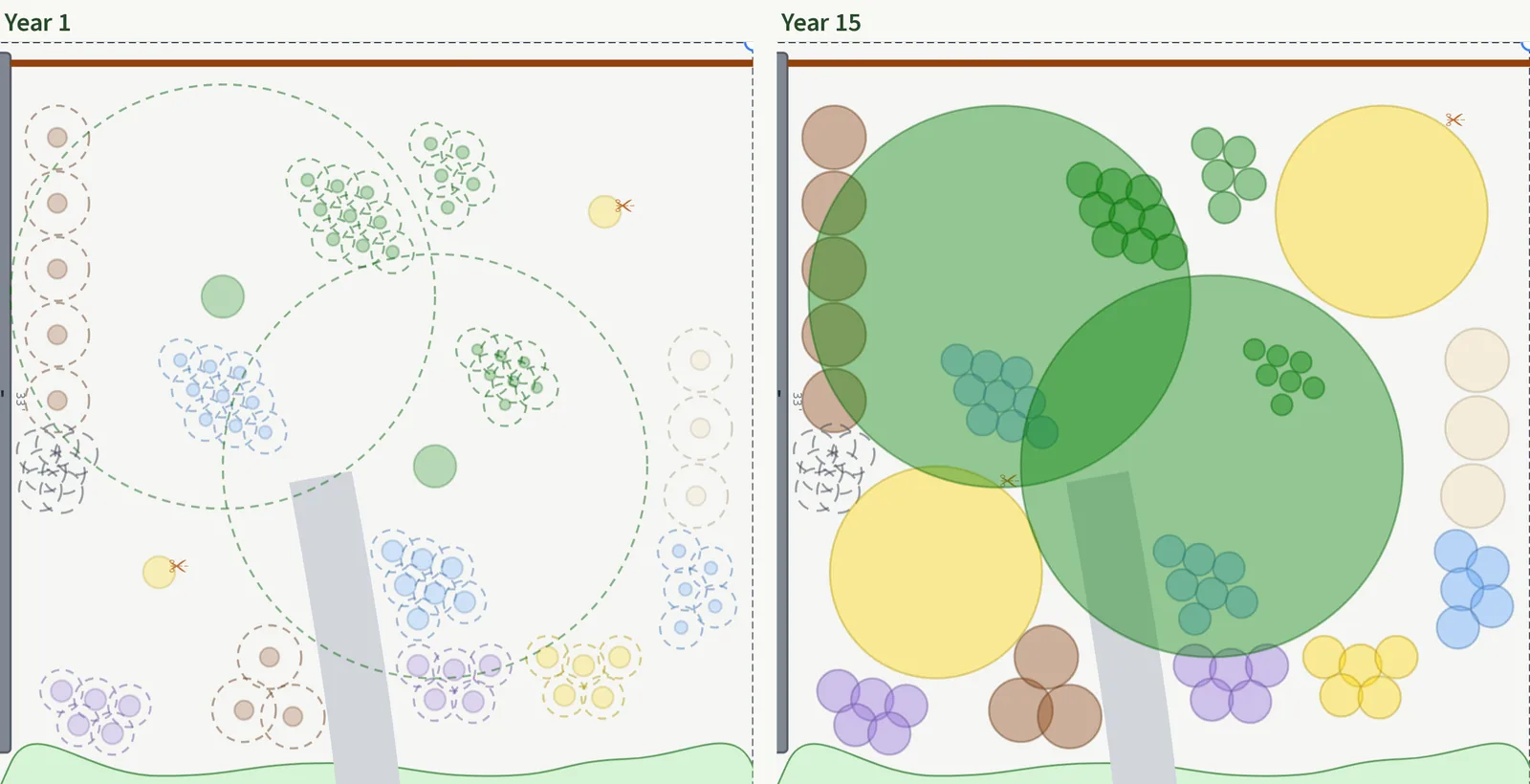
In Plantyd's growth timeline, by year fifteen the two canopies have merged into one patch, which is how pawpaws grow in the wild. The shade has crept out to the foxglove beardtongue on the south edge. It was planted knowing that. It marks the edge of a bed that is still moving, and once the canopy reaches it, it will either be divided out toward the lawn or give way to more phlox. Knowing it before you plant means putting perennials you can lift and divide on that edge, and nothing you would mind losing.
| Plant | Botanical name | Qty | Its job |
|---|---|---|---|
| Shenandoah pawpaw | Asimina triloba 'Shenandoah' | 1 | Fruit; pollen partner for the other |
| Susquehanna pawpaw | Asimina triloba 'Susquehanna' | 1 | Fruit; pollen partner for the other |
| Spicebush | Lindera benzoin | 2 | Shrub layer; buy one male, one female |
| Christmas fern | Polystichum acrostichoides | 8 | Evergreen texture along the wall and the path |
| Ramps | Allium tricoccum | 7 | Edible spring ephemeral by the wall |
| Virginia bluebells | Mertensia virginica | 9 | Spring ephemeral under the pawpaws |
| Woodland phlox | Phlox divaricata | 9 | Spring flowers in part shade |
| Red columbine | Aquilegia canadensis | 5 | Spring flowers in the gap by the fence |
| Wild geranium | Geranium maculatum | 7 | Ground cover under the second pawpaw |
| Oak sedge | Carex pensylvanica | 7 | Fine ground cover that takes dry shade |
| Yellow wild indigo | Baptisia tinctoria | 3 | Nitrogen fixer, on the sunny east edge |
| Blue wood aster | Symphyotrichum cordifolium | 5 | Fall nectar on the open edge |
| Golden alexanders | Zizia aurea | 5 | Spring nectar on the open edge |
| Foxglove beardtongue | Penstemon digitalis | 10 | White early-summer flowers on both sides of the path |
Spicebush is the shrub layer. Like hollies it comes as separate male and female plants, so buy one of each if you want the red berries. It is also the caterpillar host of the spicebush swallowtail, while pawpaw is the only host of the zebra swallowtail, according to Penn State's butterfly host plant list. Buy ramps as nursery-grown bulbs, never dug from the woods. Lincoln University's extension service notes that plants grown from seed take seven to ten years to mature, which is why wild patches recover so slowly from digging. The nitrogen fixer is yellow wild indigo, which grows wild in southeast Pennsylvania, rather than the more familiar blue false indigo. The wild Pennsylvania form of blue false indigo is state-threatened, known from a few western rivers.
Bed three: a pomegranate basin in zone 9b, Sacramento
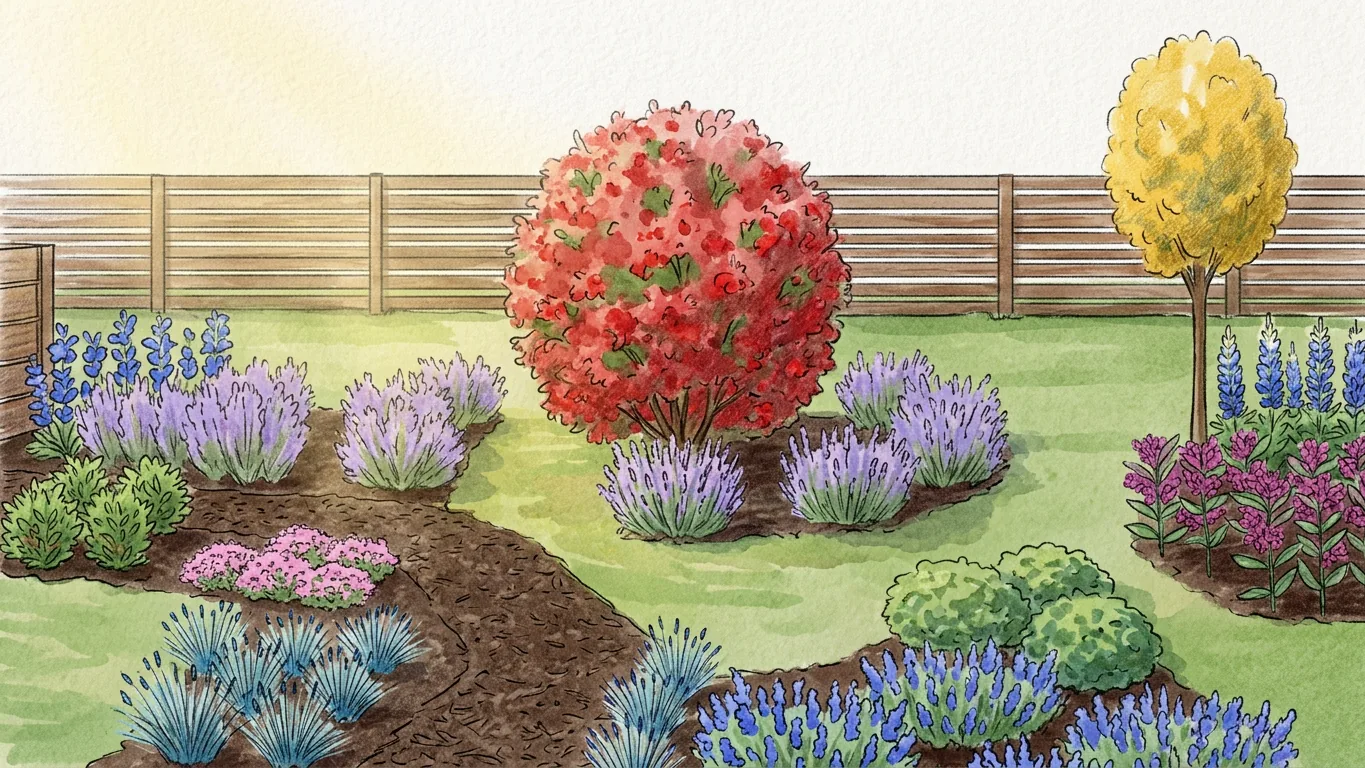
In Sacramento the rain arrives in the wrong season. The National Weather Service's climate summary for Sacramento puts more than half the year's precipitation between November and February, and summers are close to rainless. So this bed is organized around water. The pomegranate stands on a slightly raised crown, with the mulch pulled back from the trunk, and a shallow ring-shaped basin circles it at the drip line and a little beyond. The trunk stays dry; the University of California's pest management program advises against watering near the trunk, because it encourages root and crown disease. Winter rain and the downspout from the house fill the ring, with an overflow toward the street for storms the clay cannot absorb. The trunk is 16 feet from the house wall, which keeps the ponded water about ten feet from the foundation. As the tree grows, the ring moves out with its drip line.
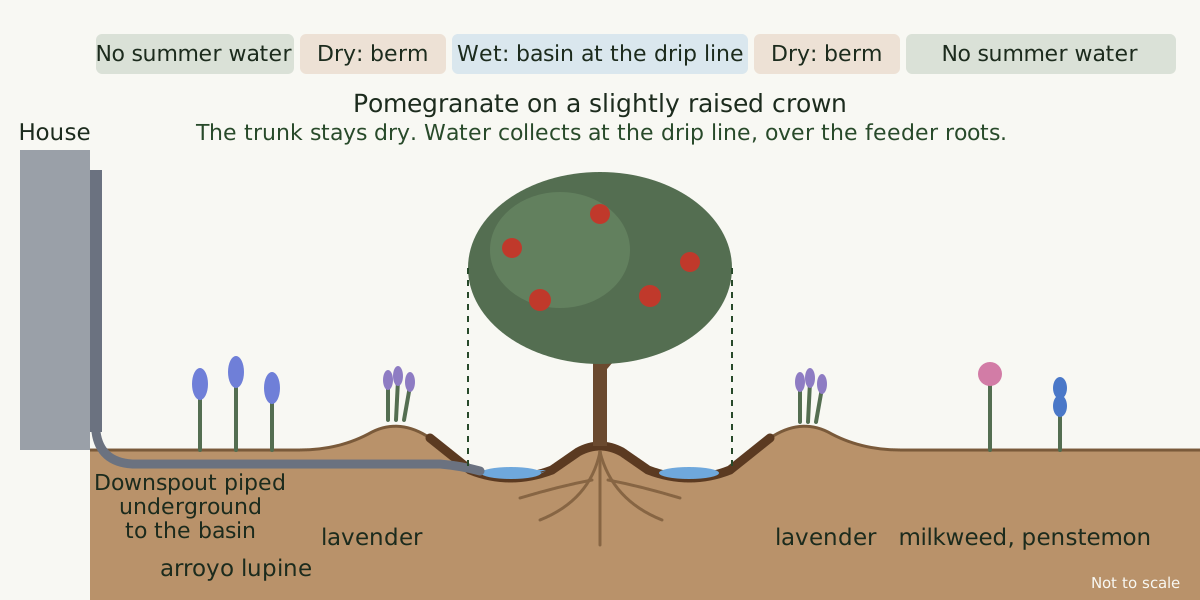
Everything else is placed by how much water it wants, which is called hydrozoning. A pomegranate tolerates drought, but its fruit splits when watering swings between dry and soaked, as New Mexico State University's extension service explains. Winter rain cannot carry it through a rainless summer, so the ring also gets the bed's only summer drip line, on a schedule that does not swing. Lavender wants the opposite and rots in wet clay, so it sits up on the berm, above the basin, where water drains away from its crowns. Past the berm is ground that never gets summer irrigation. The nitrogen fixer lives there: arroyo lupine, a California native annual sown in fall that grows on winter rain, flowers in spring and is gone by the time the summer water starts. Showy milkweed, foothill penstemon and yarrow share that dry outer ring with Russian sage, autumn sage, catmint and blue fescue. The one exception is the pineapple guava along the house. It survives a dry summer, but the California Rare Fruit Growers note that lack of water will cause the fruit to drop, so the back row gets its own drip line while it flowers and sets fruit.
A bed planned on water logic alone tends to look like plants dropped on mulch, so this one adds ordinary garden design on top. It is layered as you see it from the lawn: an evergreen screen of pineapple guava and silver artemisia against the house, the pomegranate in the middle, low drifts at the front. Plants are set in odd-numbered drifts instead of ones and twos, the Russian sage is mirrored on either side of the tree, and the silver artemisia repeats at all four corners. The palette is held to silver, blue and purple, with one red, the autumn sage, picking up the color of the pomegranate's flowers. The lavender is planted as two crescents that frame the tree, and the gravel path from the lawn comes in through the gap between them, which is also the way to the fruit at harvest.
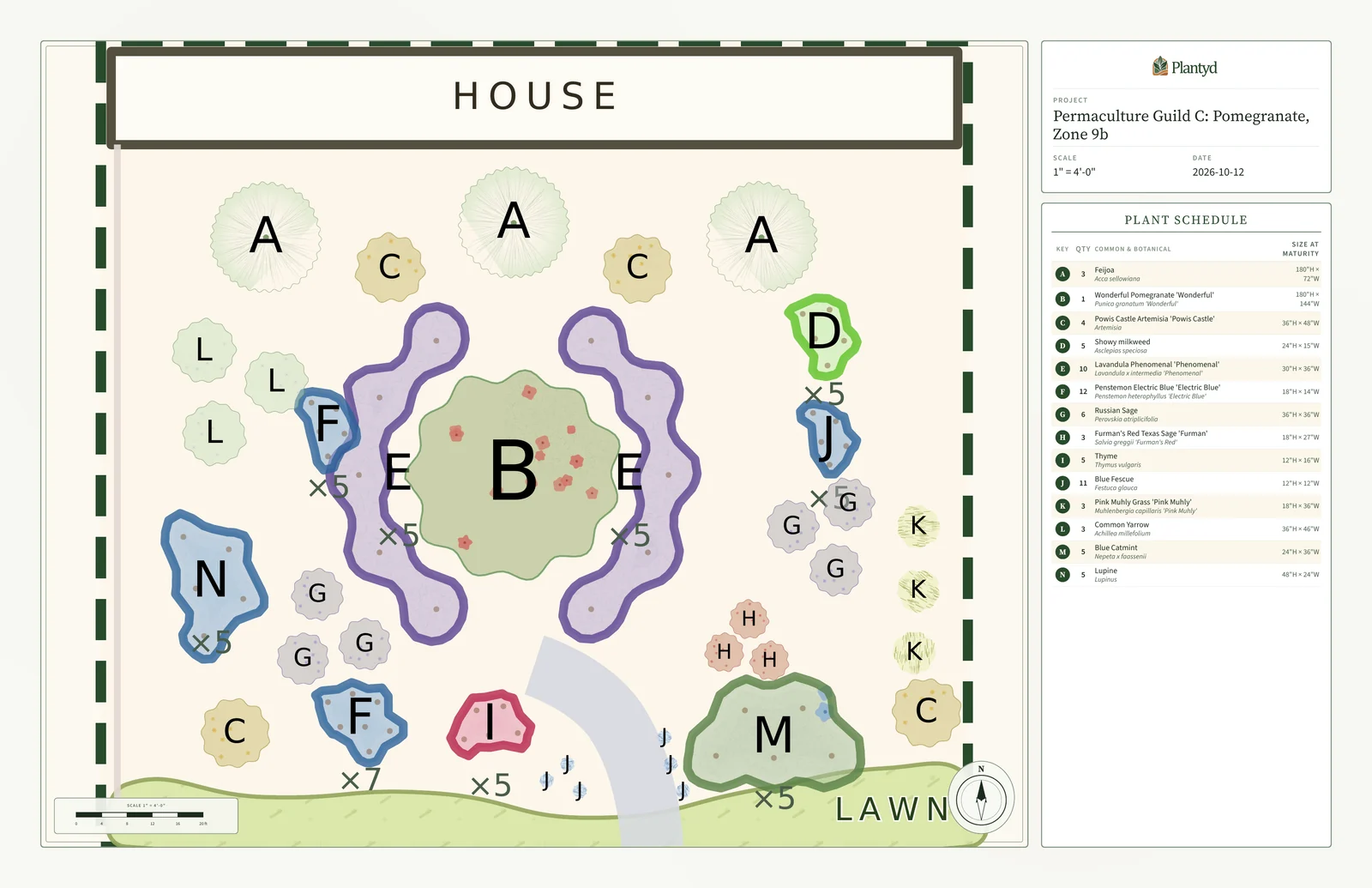
That sheet is the part you take with you. Draw a guild for your own yard in Plantyd and the export gives you the same page: every plant keyed on a drawing to scale, a north arrow and scale bar for laying it out on the ground, and a schedule that tells the nursery how many of each you need and how big each one will get. Draw your own guild and print the sheet before you buy a single plant.
| Plant | Botanical name | Qty | Its job |
|---|---|---|---|
| Wonderful pomegranate | Punica granatum 'Wonderful' | 1 | The centerpiece, on a raised crown in the basin |
| Pineapple guava | Acca sellowiana | 3 | Evergreen screen on the house wall; edible petals and fruit |
| Powis Castle artemisia | Artemisia 'Powis Castle' | 4 | Silver anchors at the back and front corners |
| Phenomenal lavandin | Lavandula x intermedia 'Phenomenal' | 10 | Two crescents on the dry berm |
| Arroyo lupine | Lupinus succulentus | 5 | Nitrogen fixer; sown in fall, gone by summer |
| Foothill penstemon | Penstemon heterophyllus 'Electric Blue' | 12 | Native spring flowers, in two drifts |
| Russian sage | Perovskia atriplicifolia | 6 | Height and late color, mirrored east and west |
| Autumn sage | Salvia greggii 'Furman's Red' | 3 | Red that echoes the pomegranate; hummingbirds |
| Catmint | Nepeta x faassenii | 5 | Soft blue front edge |
| Pink muhly | Muhlenbergia capillaris | 3 | A pink haze on the east edge in fall |
| Showy milkweed | Asclepias speciosa | 5 | Native nectar and monarch host |
| Yarrow | Achillea millefolium | 3 | Summer flowers; chop for mulch |
| Blue fescue | Festuca glauca | 11 | Edges the path and repeats the blue |
| Thyme | Thymus vulgaris | 5 | Edible drift beside the path |
What changed and what did not
Set side by side, the three beds have the same skeleton.
| Job | Zone 4b, Minnesota | Zone 7b, Philadelphia | Zone 9b, Sacramento |
|---|---|---|---|
| Main harvest | Honeycrisp apple | Two pawpaws | Pomegranate |
| Nitrogen fixer | Purple prairie clover | Yellow wild indigo | Arroyo lupine |
| Early flowers | Golden alexanders | Bluebells, golden alexanders | Lupine, penstemon |
| Late flowers | Blazing star, anise hyssop, bergamot | Blue wood aster | Lavender, Russian sage, muhly |
| Ground layer | Chives, wild geranium | Phlox, wild geranium, oak sedge | Thyme, blue fescue |
| Second harvest | Chokeberry, fiddleheads | Ramps, spicebush berries | Pineapple guava, thyme |
| What organized the bed | The garage's shade | The wall, and time | Winter rain |
Every row but the last is a job any guild needs, and what fills it changed in every column. No plant appears in all three columns, and only golden alexanders and wild geranium appear in two. Every bed was also drawn at mature size before anything else was decided, which is what showed whether the apple's canopy cleared the garage shadow in Minnesota and where the canopy would close in Philadelphia, while both were still free to fix. (For how far apart those mature sizes put each plant, see how far apart to plant trees and shrubs; for the full seven-layer version of the same idea, see the layers of a food forest.)
Hemenway's guild was always a set of relationships with plant names attached. Keep the relationships. Then pick plants that can live through your own coldest night.
Common mistakes
- Copying the plant list along with the idea. A guild list written for one climate can lose members to a Minnesota winter or a Sacramento August.
- Putting the tree where it is convenient. Map the sun first. In the zone 4b bed the garage's afternoon shadow ruled out the six feet nearest its wall.
- Planting one pawpaw and waiting. Two genetically different trees are the minimum, and Purdue notes that the flies and beetles that pollinate pawpaw are "neither efficient nor dependable," so a small paintbrush at bloom time can be the difference between a crop and none.
- Watering a dry-climate guild evenly. Even irrigation underwaters the tree and drowns the lavender and thyme at the same time.
- Forgetting the canopy is still growing. The sun-lovers at the edge of a young guild are in the tree's shade fifteen years later.
What to take home
- Write the guild's jobs down before you choose a single plant.
- Fill each job with something hardy where you live, and native to your state where you can.
- Map the shade, the edges and the water before you place the tree.
Common questions
What is permaculture garden design?
A way of laying out a garden so its plants and structures do work for each other instead of each needing its own inputs. In practice that means reading the site first (where the sun lands, where the wind and water come from), putting what needs you most closest to the door, and giving each plant more than one job. The method is the same everywhere. The plants that carry it out change with the climate.
What is a guild in permaculture?
A group of plants arranged around one central plant, usually a fruit or nut tree, so that each member does a job for the others: fixing nitrogen, feeding the predatory insects that eat pests, covering the soil, or adding a second harvest. Toby Hemenway's Gaia's Garden sets out the idea at length.
Can you grow a permaculture garden in a cold climate?
Yes, with plants chosen for the cold. The zone 4b bed in this post is an apple guild built for St. Cloud, Minnesota, where the coldest night of an average winter falls to between 20 and 25 degrees below zero. It uses Honeycrisp, a University of Minnesota apple, with purple prairie clover as the nitrogen fixer and natives like golden alexanders and anise hyssop for insects.
Does permaculture work in a dry climate like California?
It works, but water becomes the organizing idea. Sacramento gets most of its rain in winter and almost none in summer, so the zone 9b bed here catches winter water in a ring-shaped basin at the pomegranate's drip line, keeps lavender up on a dry berm, and puts natives that need no summer water, like arroyo lupine and showy milkweed, out where irrigation never reaches.
What are good nitrogen-fixing plants for a guild?
It depends on the hardiness zone. Purple prairie clover works in a Minnesota apple guild. The nitrogen fixer in a Philadelphia pawpaw patch is yellow wild indigo, and the Sacramento bed uses arroyo lupine, an annual that grows on winter rain. All three are native to the state they are planted in. Treat the nitrogen they add as a slow contribution through their own leaves and roots, not a substitute for mulch.
How big does a permaculture guild need to be?
About as wide as the central tree's mature canopy, plus a ring of a few feet around it. Each of the three plans in this post fits inside about 46 by 37 feet, buildings included, and the Honeycrisp alone is drawn at a mature spread of 20 feet. Draw the tree at its mature size first and the rest of the guild has a shape to fill.
Build the guild for your own zone
Plantyd sets your hardiness zone from your address, maps the sun on your actual yard, and draws every plant at its mature size, so the guild you plan is one that can grow where you live.
Start designing freeNo credit card required · Free tier is free forever