You are standing in the nursery lot with three shrubs in three-gallon pots. Each one is maybe a foot across. The bed you dug looks enormous and the plants look ridiculous in it, so you buy a fourth, get them home, and set them two feet apart because that is what looks right.
Five years later the bed is a hedge you did not order. The shrub in the middle has gone bald on both sides, one has died out entirely, and the arching shape you liked at the nursery is somewhere inside a green wall. So how far apart should you plant trees and shrubs? The answer is not a number someone can hand you. It is a small piece of arithmetic, and everything you need for it is printed on the tag.
The only number that matters is mature spread
Every tag has two size numbers. Height gets read; spread gets skipped. Spread is how wide the plant ends up when it is finished growing, and it is the number that decides where the plant goes. A hydrangea that matures at five feet wide is going to occupy a five-foot circle whether or not you gave it one.
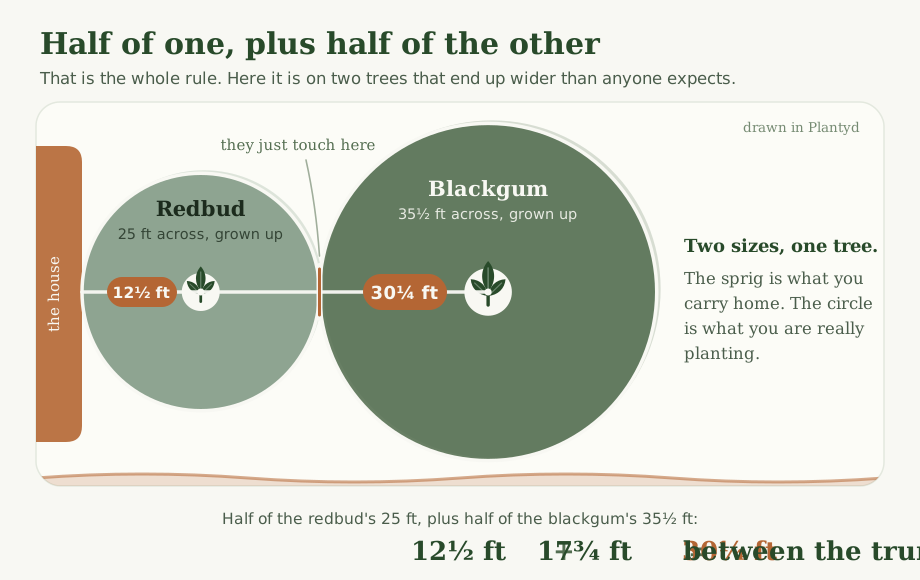
The rule is simple enough to do in the parking lot. Take half of one plant's mature spread, add half of the other's, and that is the minimum distance between the two trunks. WSU Extension's spacing guide puts it the same way in its landscape plant spacing publication: placement from a house or a like shrub is about half the ultimate spread, and for two different plants it is half the total of both. Their example is an eight-foot shrub sitting about seven feet from a six-foot shrub.
The same arithmetic on a real garden
Here is the woody layer of a zone 7a native garden we have written about before. Three trees, all of them wider than people expect:
| Tree | Botanical name | Mature spread |
|---|---|---|
| Blackgum | Nyssa sylvatica | 35 ft 6 in |
| Appalachian Red redbud | Cercis canadensis | 25 ft |
| Dwarf chestnut oak | Quercus prinoides | 25 ft |
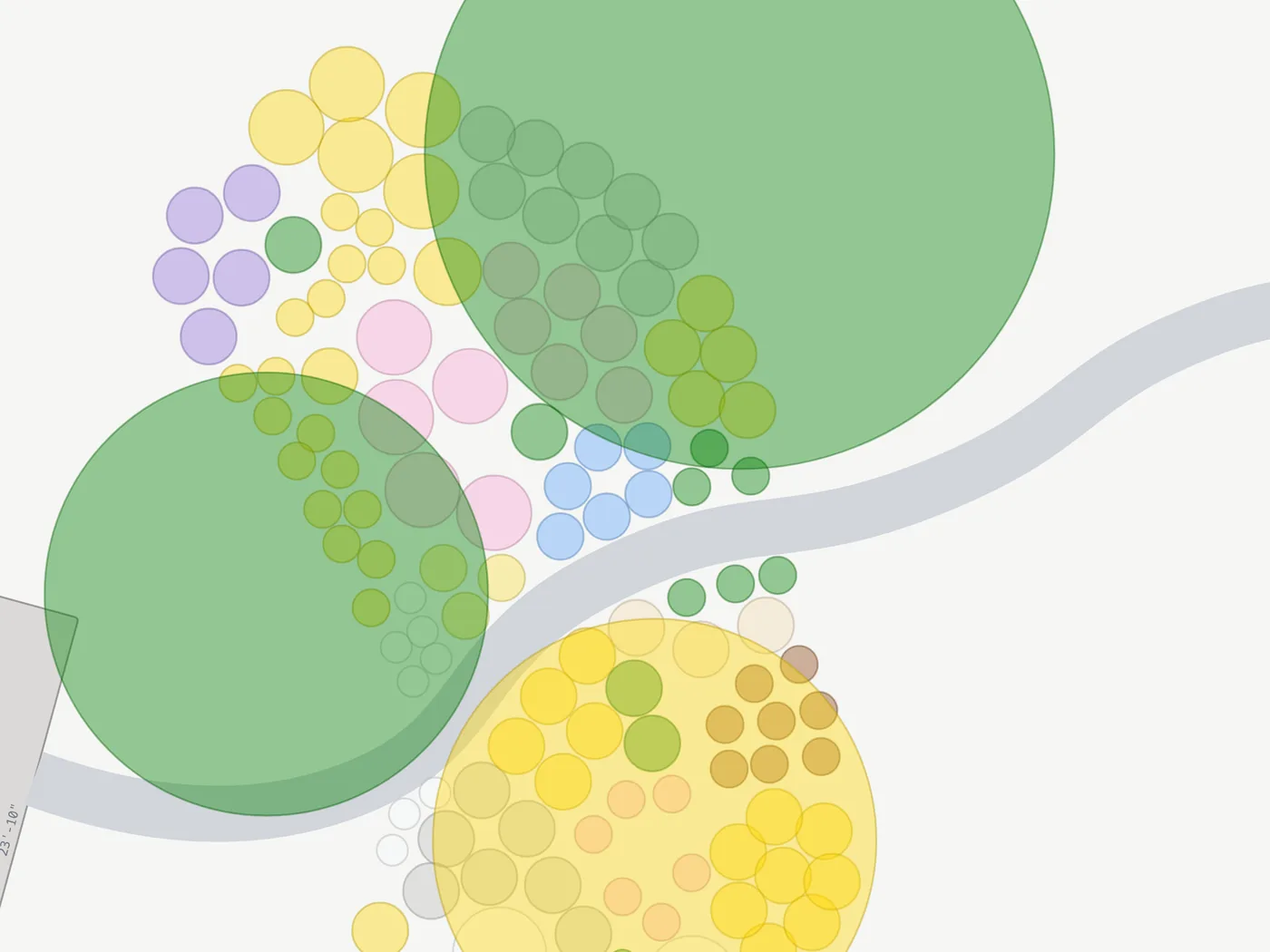
Run the numbers. The blackgum and the redbud need about 30 feet between them and they got just under 35. The blackgum and the oak need the same 30 and they got 37. Both pairs clear each other with room to spare, which is why the hero image at the top of this post shows three separate crowns instead of one continuous mass.
The oak and the redbud are the interesting pair. Two 25-foot spreads want 25 feet between the trunks, and they are planted 24 and a half feet apart. They meet in the year they finish growing. In a woodland edge that is not a mistake, it is the point: you want the two small trees to read as one canopy over the shade planting underneath. Spacing that tight is a decision, and the decision is only available to you if you know the numbers before you dig.
Why a correctly spaced bed looks wrong for five years
This is the part that makes people plant too close. A well-spaced bed is mostly mulch in year one, and staring at it is genuinely discouraging. Woody plants take their time:
| Age | Slow grower | Medium | Fast |
|---|---|---|---|
| Year 1 | 10% | 15% | 30% |
| Year 3 | 25% | 40% | 60% |
| Year 5 | 45% | 65% | 85% |
| Year 10 | 70% | 85% | 95% |
| Year 15 | 90% | 95% | 100% |
Those are percentages of mature spread, and they are the curves Plantyd uses to draw a plan at any age. For the redbud above, a medium grower at 25 feet wide, that means about 3 ft 9 in across after one year, 16 feet at year five, and 21 feet at year ten. It is two thirds of the way there at year five and still not done at fifteen.
The fix for the thin years is annuals, a wider mulch ring, or a few cheap perennials you are willing to pull later. The fix is not a fourth shrub. A fourth shrub is a decision you make once and pay for every spring after that.
See the collision before you dig
Doing this arithmetic in your head for one pair of shrubs is easy. Doing it for a bed of thirty plants, some of which triple in width, is not. So Plantyd draws it for you: every plant on the canvas gets a dashed ring at its mature spread, sitting around the solid circle of its current size. Where two dashed rings overlap, those two plants are going to be touching, and you can see it in the first minute of the design instead of the eighth summer.
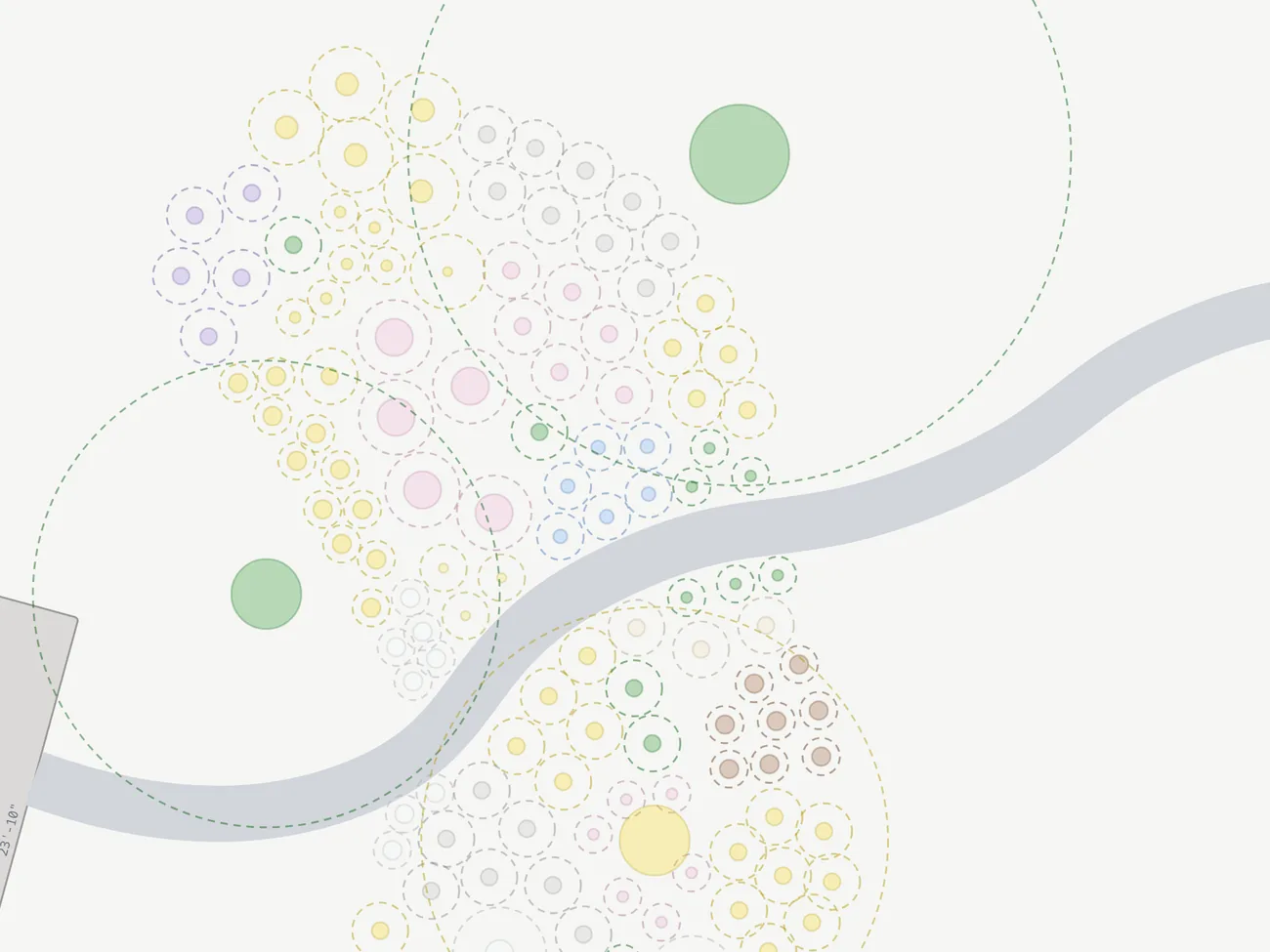
The growth timeline is the other half of it. You can set the plan to year 1, 3, 5, 10, or 15 and watch each plant grow along the curves in the table above, so a bed that reads as empty today and crowded at year ten shows you both, before anything is in the ground. The dashed ring disappears at year 15 for the simple reason that the plant has arrived: the ring and the plant are the same circle.
Do this before the nursery run
Draw the bed, drop in the plants you are considering, and scrub the growth timeline out to year 10. If rings you did not intend to overlap are overlapping, drag a plant, delete one, or swap it for a narrower cultivar. It is a two-minute edit on a plan and a $180 mistake in a truck bed.
What if you plan to keep it pruned?
Fair. Plenty of good gardens hold plants below their natural size on purpose. Just be honest with yourself about the commitment, because a plant kept small is a plant you prune every single year, and a loose arching shrub sheared into a meatball has lost the reason you bought it.
If that is the plan, say so in the plan. Plantyd lets you set a maintained height and spread on any individual plant, and from then on the drawing grows it up to that cap and stops. The dashed mature ring vanishes, because the cap you set is now this plant's final size. A row of yews held at four feet is a legitimate design; a row of yews you forgot are eventually twenty feet wide is a fence problem.
When overlap is exactly what you want
The arithmetic gives you a minimum for plants you want to read separately. Half of good planting design breaks it deliberately:
- Hedges and screens. You want one wall, not nine shrubs, so plant tight. WSU suggests roughly 18 inches apart for a low hedge of three to four foot plants, and three to four feet for tall hedge plants.
- Drifts of perennials. A drift should knit into a single patch of color by the second or third summer, so spacing at two thirds of the mature spread is normal.
- Groundcover. The whole job is to close over. Space it for how fast you want coverage and how much you want to spend.
- A closed canopy overhead. The University of Florida's spacing notes for landscape trees make the tradeoff plain: trees planted 20 to 30 feet apart grow tall and upright with a cathedral canopy, while trees at 40 to 60 feet keep their wide natural crowns. Neither is wrong. They are different gardens.
How far from the house, the fence, and the driveway
The same half-the-spread rule works against anything that does not move. A shrub that matures at eight feet wide sits at least four feet off the wall, and then you add a foot or two so you can get behind it with a pruner and so the siding can dry out. WSU's floors are two feet for small shrubs, about three for medium, and four to five for tall ones.
Trees need the same treatment plus a look upward and downward. Half the mature spread keeps the crown off the roof; the gutters, the eaves, and the branch structure decide whether that is enough. And before any tree hole gets dug, call 811 and get the utilities marked. Roots and spread are the slow problem. A gas line is the fast one.
One more thing that spacing alone will not tell you: as those crowns close in, the light underneath changes. The bed you spaced correctly for size can still fail because it is now in shade. That is worth checking on the same plan, and it is why we wrote about how much sun your yard actually gets and mapped it out year by year in the sun and shade analysis of this same zone 7a garden.
Common spacing mistakes
- Spacing to the pot. The pot is a shipping container. The tag has the number you want.
- Reading height and ignoring spread. Spread is what spacing is made of.
- Trusting the cultivar name. "Dwarf" and "compact" are marketing on a spectrum. Dwarf compared to what? Look up the actual numbers for the actual cultivar.
- Filling the empty look. The bed is supposed to look sparse for a few years. Fill it with things you can pull.
- Forgetting maintenance access. If you cannot walk behind it, you will not prune it, and if the mower cannot get past it you will hit it.
- Planting a fast grower where a slow one belongs. A fast tree at 30 percent of its width in year one is already claiming the space. Two of them planted close never sort themselves out.
What to take home
- Half of one mature spread plus half of the other is the minimum distance between two plants. Half the spread is the minimum off a wall.
- Overlap is allowed when you mean it. Hedges, drifts, and groundcover are supposed to close up; specimens are not.
- A properly spaced bed looks thin for about five years. Plan for that with annuals and mulch instead of extra shrubs.
- Draw the mature size before you buy. A dashed ring on a plan costs nothing; a tree in the wrong place costs a decade.
If you want to see spacing decisions made across a whole property at once, from a spruce screen planted tight to specimen trees given their full width, the whole home master plan walkthrough goes through it bed by bed.
Common questions
How far apart should I plant trees?
Add half of one tree's mature spread to half of the other's, and that's the minimum distance between the trunks. A redbud that matures at 25 feet wide and a blackgum that matures at 35 feet wide need about 30 feet between them. Plant them closer and they grow into each other, which is fine for a screen and not fine for two specimen trees you wanted to see the shape of.
How far from the house should I plant a tree or shrub?
Half the mature spread is the floor, and a little more is better. WSU Extension puts small shrubs at least two feet off a foundation, medium shrubs about three feet, and tall shrubs four to five feet. A tree that matures at 30 feet wide wants at least 15 feet, and if it is a soft-wooded fast grower over a patio or a sewer line, give it more. Leave yourself room to walk behind the plant with a pruner.
What does mature spread mean on a plant tag?
Spread is how wide the plant gets when it is done growing, not how wide it is in the pot. It is the number that decides spacing, and it is usually the number people skip. Mature height tells you what you will see; mature spread tells you how much ground the plant is going to claim.
Can I plant closer together and just prune?
You can, as long as you mean it. A plant held below its natural size needs pruning every year for as long as you own it, and shearing a loose, arching shrub into a ball costs you the form you bought it for. In Plantyd you can set a maintained size on a plant so the plan holds it at the size you intend to keep it, rather than at the size the species wants to reach.
How far apart should I plant shrubs for a privacy hedge?
Closer than you would space the same shrub as a specimen, because you want the plants to grow into one wall. WSU Extension suggests roughly 18 inches apart for a low hedge of three to four foot plants and three to four feet apart for tall hedge plants. Overlap is the goal here, so the arithmetic above is the one rule you deliberately break.
How many years until a tree reaches its mature spread?
Longer than most plans assume. A medium-rate tree or shrub is around 15 percent of its mature width after one year, 65 percent at year five, and 85 percent at year ten. A slow grower is at 45 percent by year five. That's why a correctly spaced bed looks thin for the first few seasons, and why the fix is annuals or mulch rather than a fourth shrub.
What should I do about trees that are already planted too close?
Decide which one you would keep, and move or remove the other while it is still small enough to move. A young shrub transplants in a weekend. Two trees left to fight it out for fifteen years give you two half trees, each leaning away from the other, and by then removal means a chainsaw and a stump grinder.
Draw it at full size first
Trace your yard, drop in the plants you are considering, and let Plantyd draw every mature spread as you go. Then run the timeline out to year 15 and see which of your beds is a garden and which one is a hedge.
Start designing freeNo credit card required · Free tier is free forever