You put the table out on the patio in April, and by May you know which window it is. The house behind yours has two stories, and from its upstairs back room someone can see what you're having for dinner. The fence you priced last weekend, the usual answer, would hide their lawn from yours and leave the window where it is.
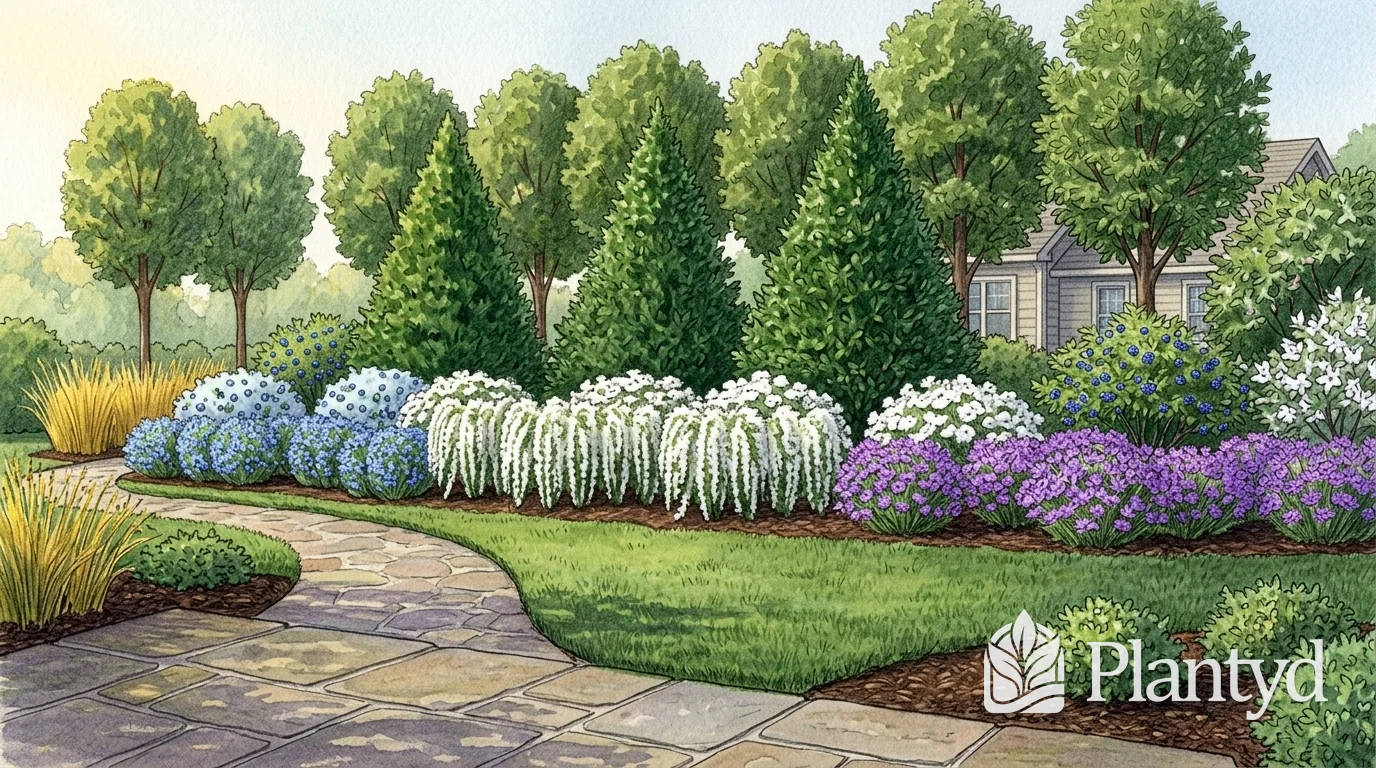
This privacy landscaping plan is for a lot in Marietta, Georgia, in zone 8a. The yard is 84 feet wide and 60 feet deep, and a brick patio off the back door faces west toward the neighbor's house. Instead of a fence, two staggered rows of evergreens, wax myrtle and Savannah holly, stand across the stretch of yard that the two upstairs windows can see. Everywhere else, the back border is lower and mostly deciduous, with plants that flower or fruit from early spring into November.
Someone at that window has eyes about 16 feet up, and yours, in a patio chair, are about 4 feet up. A line between them crosses the back property line about 12 feet up, so a six-foot fence misses it by half. We built the plan in Plantyd and checked its sun at year one and year fifteen. The grown screen takes only the last of the evening sun off the patio, and every plant in front of it stays in the sun it needs. You can download the plan sheet near the bottom of the page.
| Yard | 84 feet wide, 60 feet from the back of the house to the back property line, no fence |
|---|---|
| The view to block | Two upstairs windows on the back of the two-story house behind, 79 and 86 feet from the patio table |
| Where | Marietta, Georgia, USDA zone 8a |
| Patio | 14 by 18 feet, brick, off the back door, facing west toward the neighbor |
| Plants | 9 kinds, 63 plants. Eight are Southeast natives, and the ninth is a hybrid of two |
| Evergreen | Wax myrtle and Savannah holly, in the stretch the windows look across |
| Screens by | Mostly by year 3, completely by year 5 |
| Upkeep | No shearing. Cut the flowers and grass back in late winter, top up the pine straw, and water for the first two summers |
Measure the sightline before you buy a tree
Most backyard landscaping privacy ideas start at the property line, because that is where a fence would go. Start at your patio chair instead, and measure from there to the window. The sightline keeps dropping as it comes toward you. On this lot, 18 feet in from the property line, it is down to 9 or 10 feet.
To work out the height a screen needs at any spot, take the drop from their eyes to yours, which is 12 feet here. Multiply it by how far the screen stands along the way from your chair to the window, then add back your own 4 feet. A third of the way out, that comes to 8 feet. At the property line on this lot, about two-thirds of the way, it comes to 12.
The nearer the screen is to you, the shorter it can be, but the more of the yard it takes up. Here the bed is 36 feet deep where the sightlines cross it, which leaves about 10 feet of lawn between the bed and the patio.
Two evergreen rows block the window: a fast one and a lasting one
The back row is six wax myrtles, set 5 to 8 feet in from the property line and zigzagged about 9 feet apart. Wax myrtle is a fast native evergreen. About 11 feet in front of it stand three Savannah hollies, staggered 10 feet apart. They spread about 15 feet, so their crowns grow into each other.
The wax myrtles screen the window first. The slower hollies are the backup: wax myrtle's brittle stems break under heavy ice, and if one breaks, the holly row still blocks the window.
Leyland cypress is the usual fast screen in Georgia. We left it out, though it isn't invasive. The University of Georgia calls Seiridium canker probably the most destructive disease of Leyland cypress in the landscape, and drought makes it worse. In a single row, one dead tree leaves a gap the neighbors can see through.
The evergreens stand only where the windows can see you
Only the middle of the back line sits between those windows and the patio. The north end is out of the sightlines, so it has three Piedmont azaleas instead. They lose their leaves in winter, grow to about 15 feet, and open fragrant pink flowers on bare branches in early spring. Beautyberries and a block of aromatic asters fill in front of them.
In front of the hollies, six 'Henry's Garnet' sweetspires grow into one low mass that turns red in November. Along the lawn edge, eastern bluestar flowers pale blue in April, and white phlox takes over from July into September. South of the path, out of the windows' line, two more wax myrtles keep that corner green in winter, with switchgrass and beautyberry in front of them.
A bark path cuts through the bed on a slant, so you can get in to prune the back of the screen, and there is room for a compost bin at its end. The path crosses the bed south of every sightline from the windows to the patio, so the windows can't see through the gap it opens.
Expect most of the cover by year three, and all of it by year five
Nothing in this plan screens the window on planting day. Plantyd's growth view draws the wax myrtles at about 7 and a half feet tall in their first year and the hollies at about 3 feet.
On our plant library's growth rates, the wax myrtles are tall enough by year three but not yet wide enough, so from a few seats you can still see the window through the gaps. By year five the hollies are about 13 feet tall and close those gaps on their own.
Bigger hollies give you a head start. Planting the wax myrtles closer together would close the year-three gaps sooner, but they would crowd each other by year ten, and the hollies close the gaps by year five anyway. For more on spacing, see how far apart to plant trees and shrubs.
The grown screen takes the evening sun off the patio
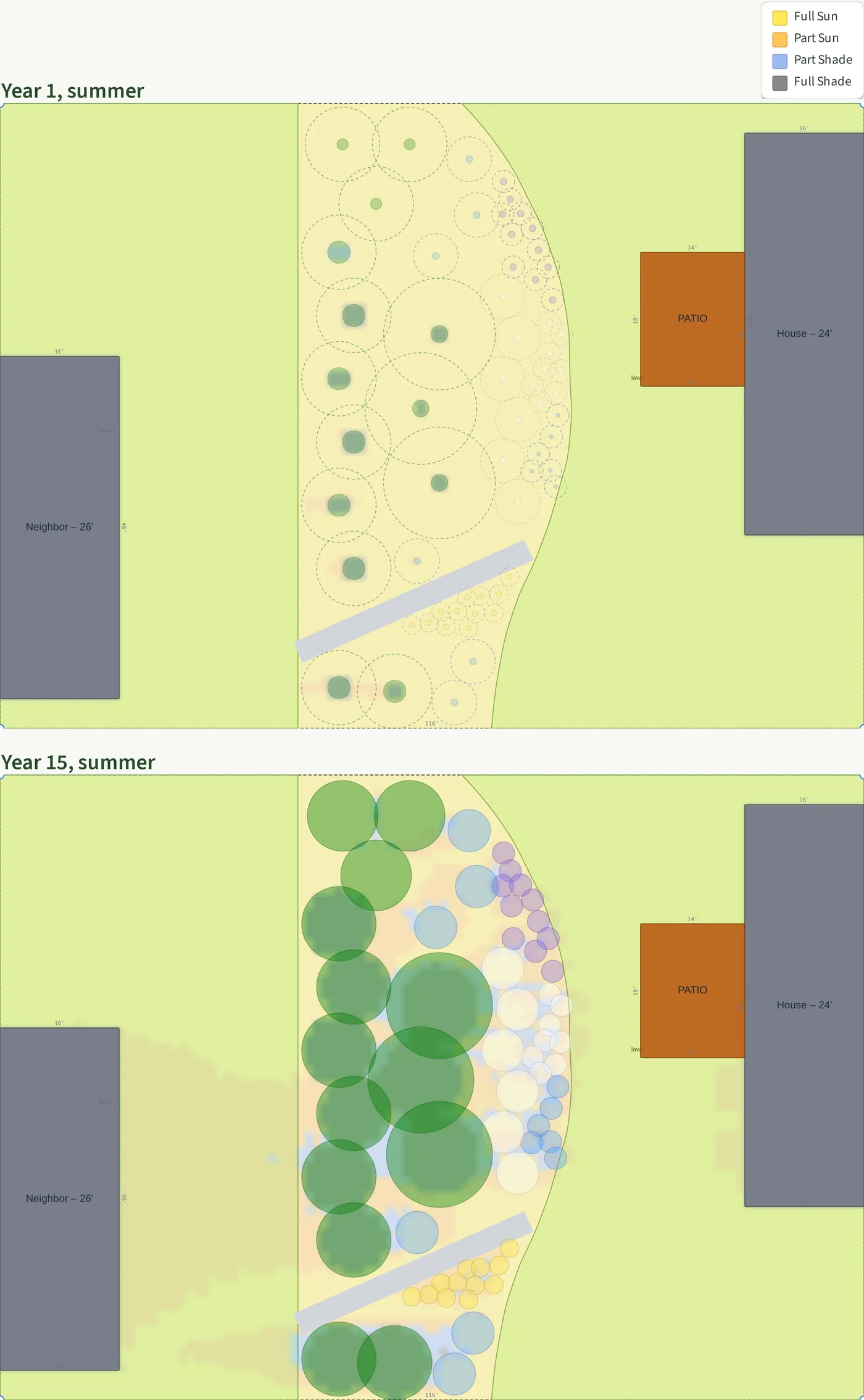
By year fifteen, the hollies and wax myrtles cast long shadows east every afternoon. In the first year, the phlox, bluestar and sweetspire in front of them get nine to eleven hours of summer sun. By year fifteen they get five to seven. Each of them is rated for part shade as well as sun, which is why we chose them, and Plantyd's sun check found no plant outside its range in either year.
The patio loses some sun too, from about 8 summer hours in the first year to about 6 and a half. When we read the same model half-hour by half-hour, the hours it loses are the last ones of the evening. The sun leaves the table around seven instead of eight thirty, and in a Georgia July that shade is welcome.
You can't judge that trade from the patio in October. That is the job we built Plantyd's sun map to do. Draw the screen at full size, then compare the first summer with the fifteenth to see which beds lose their afternoon sun. If your yard faces another way, start with how much sun your yard gets.
Work out the height for your own yard
If the house behind you is closer, or its windows are higher, the screen has to be taller at every spot, so bring it nearer your chair. If the window is so close that only a wall would block it, put a small tree or a pergola right by the seat, so something overhead blocks the steep view down.
Our plant library rates every plant here for zones 7a through 8b, from a full zone colder than Marietta to half a zone warmer. At 7a the wax myrtles are at the cold edge of their range, and a hard winter can brown them. The phlox and aromatic aster top out at 8b, so south of that, plant more bluestar in their place.
If deer visit your yard, the University of Georgia's list of plants deer avoid puts wax myrtle and switchgrass among those deer rarely browse. It puts rhododendrons, the group azaleas belong to, among those they browse occasionally or often, along with beautyberry and sweetspire. NC State Extension says deer browse garden phlox too. Where deer are common, protect the azaleas for their first few years, and swap the phlox for more bluestar, which deer tend to leave alone.
Buy a male holly if you want berries
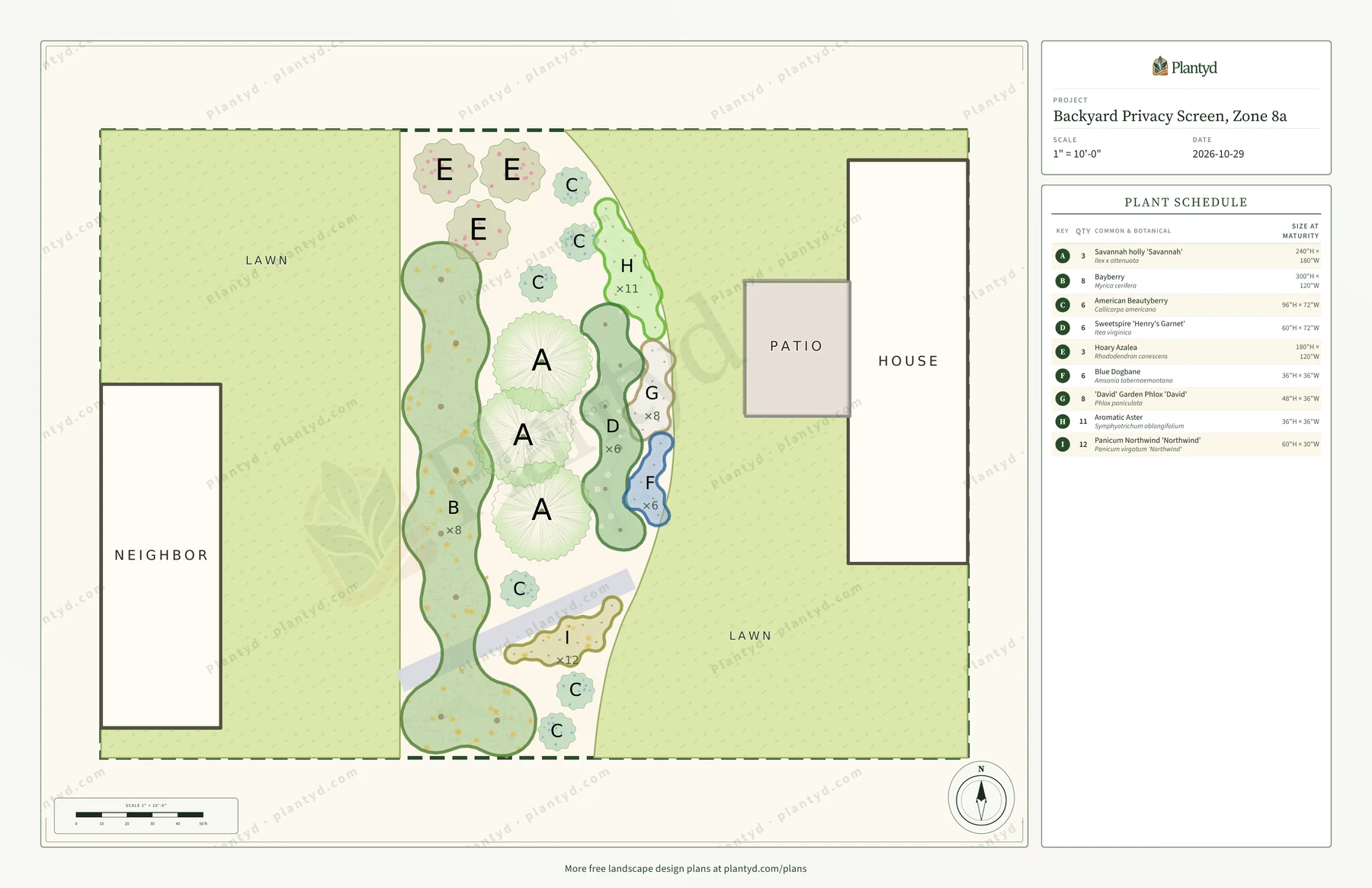
Each letter matches the plan sheet. Savannah holly is female, so its red berries need a male holly close enough for bees to carry the pollen. Wild American hollies nearby can do the job, and the screen works the same either way.
Wax myrtle also comes as separate male and female plants, and only the females carry the gray berries that yellow-rumped warblers eat. Ask for both if you want berries.
| Key | Qty | Plant | Size at maturity | Its job in the plan |
|---|---|---|---|---|
| A | 3 | Savannah holly Ilex x attenuata 'Savannah' | 20 ft tall, 15 ft wide | The front evergreen row, where the sightlines cross. Red winter berries |
| B | 8 | Wax myrtle Morella cerifera (sold as Myrica cerifera) | 25 ft tall, 10 ft wide | The fast evergreen back row along the property line |
| C | 6 | American beautyberry Callicarpa americana | 8 ft tall, 6 ft wide | Violet berry clusters in September and October |
| D | 6 | Virginia sweetspire 'Henry's Garnet' Itea virginica | 5 ft tall, 6 ft wide | In front of the hollies. White May flowers, red November leaves |
| E | 3 | Piedmont azalea Rhododendron canescens | 15 ft tall, 10 ft wide | North end. Fragrant pink flowers on bare branches in early spring |
| F | 6 | Eastern bluestar Amsonia tabernaemontana | 3 ft tall, 3 ft wide | Front edge. Pale blue in April, yellow in fall |
| G | 8 | Garden phlox 'David' Phlox paniculata | 4 ft tall, 3 ft wide | Front edge. Fragrant white flowers from July into September |
| H | 11 | Aromatic aster Symphyotrichum oblongifolium | 3 ft tall, 3 ft wide | North end. Violet-blue asters in October and November |
| I | 12 | Switchgrass 'Northwind' Panicum virgatum 'Northwind' | 5 ft tall, 2.5 ft wide | South of the path. Upright blue-green blades, straw-gold all winter |
Planted only across the stretch of yard the window can see, 12 feet of evergreen gives you a private patio and leaves the rest of the back border free for flowers.
Common questions
How tall does a privacy screen need to be?
It depends on where you put it. Picture a string from the window you want to block down to your eyes in a patio chair. The screen has to reach that string, which is high near the window and lower as it gets closer to you. For a second-story window and your eyes in a chair, that's about 10 feet halfway between the window and your chair, and 12 feet two-thirds of the way out.
What are the best landscaping trees for privacy in Georgia?
Evergreens that stay dense at 10 to 12 feet, the height where the sightline crosses. Wax myrtle is native and grows fast. Savannah holly grows more slowly into a solid pyramid. If you plant both, one disease or one ice storm can't open a hole in the screen.
How far apart should you plant privacy trees?
Closer than you would plant a single tree on its own, so the crowns grow together. This plan sets hollies that spread 15 feet about 10 feet apart, which is about two-thirds of their width, in a staggered row. Two staggered rows block more of the view than one straight row of the same plants.
More plans like this
 Pollinator Garden Plan: An Island Bed That Flowers From April to November
 Prairie Garden Design: A Backyard Meadow You Plant in Modules
 Rain Garden Design: Sized to One Downspout
Check what your screen will shade
Draw your patio, your house and the screen you have in mind over a satellite photo of your yard, then compare its summer sun in the first year and the fifteenth.
Start designing freeNo credit card required · Free tier is free forever