Gardening is about more than getting plants in the ground. The planning is part of the fun, and most of the difference between a bed that works and one that disappoints. It is what you do at the kitchen table with a catalog and a tape measure, before you have spent anything. Landscape design software is for that, and the question to ask of any of it is which year the picture is of.
Yard plans tend to die of the same three things. The plants turn out bigger than the drawing said. The whole bed flowers in one three week burst in May and then sits green until frost. And year one looks so sparse that somebody buys another flat of coneflowers and jams them into the gaps, which is how a bed ends up overplanted.
Scale, color, time. A planting scheme is a bet on all three at once, and the drawing you make on planting day shows you none of them.
What a planting scheme is
A planting scheme is the part of a landscape plan that decides which plants go where, how many of each, and how they sit next to one another. A plant list is a record of what you bought. A scheme is a claim about what the bed will look like in June of year twelve.
Professionals draw it because drawing forces the three decisions into the open. You cannot draw a shrub at its mature spread and also fit eleven of them along a ten foot wall. You cannot draw a bed in fall and pretend the June flowers are still there. A drawing has those arguments with you in an afternoon. A bed has them over seasons, and it charges for them.
Scale is the size you will not see for years
The nursery is a scale illusion. A redbud and a coneflower sit on the same bench in pots you can carry with one hand, and one of them finishes at 25 to 35 feet across. That is NC State Extension's width for eastern redbud, which is wider than most two car garages.
University of Maryland Extension puts the consequence plainly in its perennial guidance: "Do not rely on trimming to keep a large-maturing plant smaller, which may affect its health, stunt growth, or reduce blooming." The shrub you planned to keep at four feet is going to be a four foot shrub with a haircut, and it will look like one.
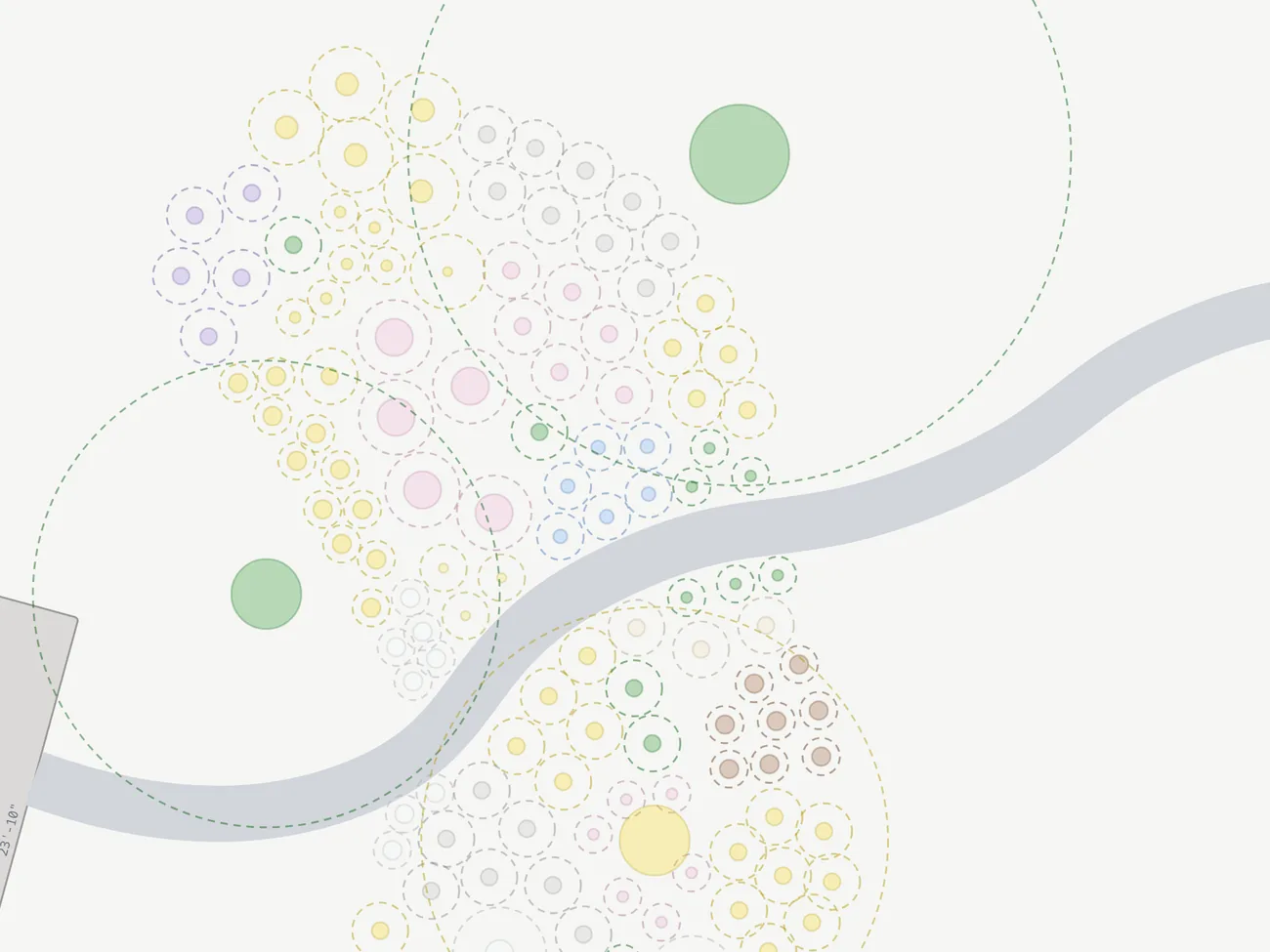
Scale is the one dimension most landscape design software already handles, as long as you draw at mature sizes and not at pot sizes. The error compounds, because a bed holds area rather than width: a perennial that ships a foot across and finishes at three takes nine times the ground it came in. Every color and timing decision after that is being made about a garden that does not exist. The arithmetic for the gaps between them is in our guide to how far apart to plant trees and shrubs.
Color is a schedule
Gertrude Jekyll's Colour in the Flower Garden came out in 1908, and two sentences into the introduction she concedes the difficulty and names her fix in the same breath: "To plant and maintain a flower-border, with a good scheme for colour, is by no means the easy thing that is commonly supposed. I believe that the only way in which it can be made successful is to devote certain borders to certain times of year; each border or garden region to be bright for from one to three months."
She was right. She was also working at Munstead Wood, with staff, and with room for a spring garden, a June garden and a September garden as separate places. You have a front bed twenty feet long that has to be all three. The succession has to happen inside one planting, which turns color from a palette question into a scheduling question.
The scheduling version has a test, and the unit to run it in is the season. Sort every candidate into the seasons it flowers, then count each pile. The Xerces Society's habitat assessment guide for yards and gardens scores a garden exactly that way, counting the species in bloom in spring, summer and fall as three separate tallies of up to ten each. A garden can score well on one and badly on another, and the gardener standing in it in September is the last to find out.
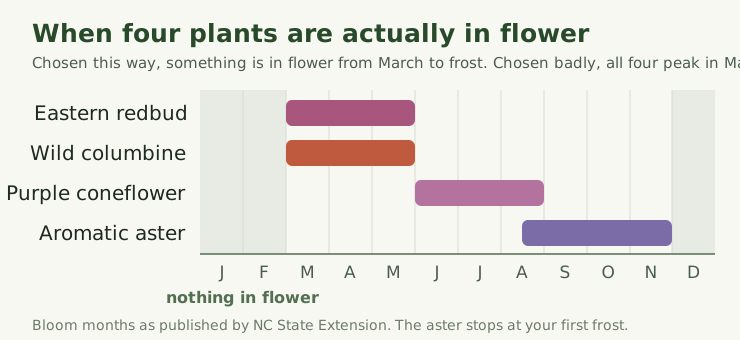
Months are the finer version of the same check, and a shortlist is short enough to chart by hand. Two plants can share a season and still miss each other by six weeks. The more common problem is the opposite, and it is in the chart below.
Foliage is doing more of this work than flowers are. UMD Extension's advice for building a border is to "incorporate a range of plants for a variety of leaf textures, growth habits, and flower traits (color, shape, season)." Flowers come last on that list. Foliage is on the plant from leaf-out to leaf drop, seven months of the year in zone 7a. Any one plant's flowers get a slice of that and then hand the bed back to the leaves.
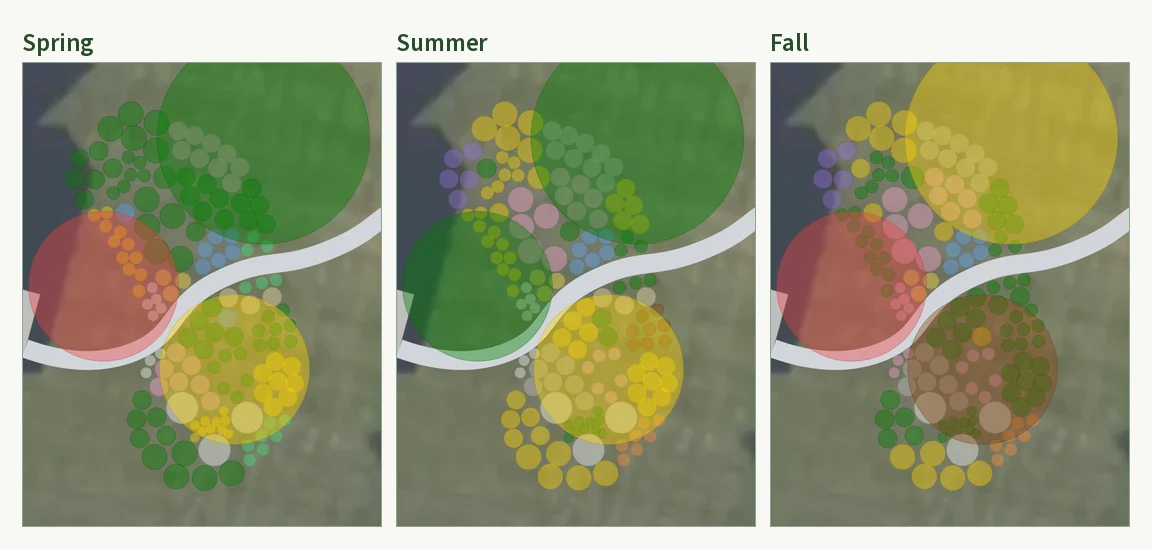
The three frames at the top of this post are one bed from a zone 7a native garden at year 15, drawn three times in Plantyd. A season control repaints every plant from its own record: bloom color in the seasons it flowers, fall color in fall, and a dashed ring at mature size for anything that is out of leaf or out of season. Spring is red and orange and green. Summer is green and gold. Fall turns the blackgum gold and darkens the drift under it to brown and purple. Free accounts see the summer view; the other three seasons are part of Pro.
Time is what the drawing leaves out
Take the blackgum that goes gold in that fall frame. NC State Extension's plant toolbox puts it at 40 to 70 feet tall, says it usually stops at 20 to 30 in a yard, and calls it slow-growing, about 12 to 15 feet in ten years. A decade in, that tree is roughly half the height it will ever reach on your property. The shade you are planting under has not arrived yet, and everything you put beneath the tree is being placed for light it will lose.
The same arithmetic explains the expensive version of impatience: planting for year one, deciding the bed looks thin, filling the gaps, and paying somebody a decade later to take half of it back out. The gaps were the plan.
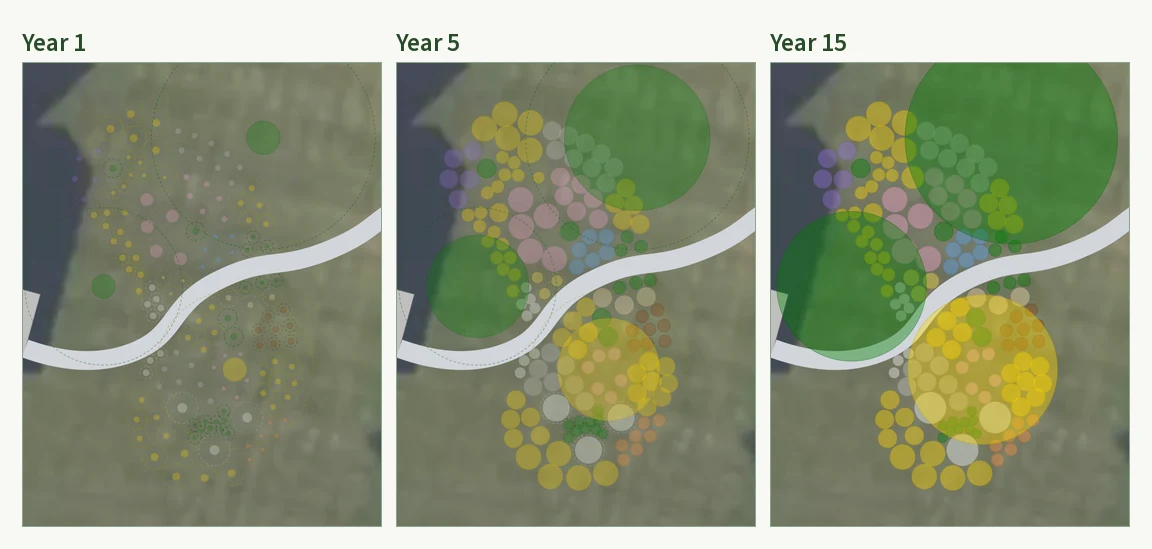
Growth also moves the light, which moves everything else. In the zone 7a garden above, several hundred square feet of full sun become part shade as those canopies fill in, and the shade perennials planted underneath were chosen for the light they will have rather than the light they start with. We walked through that whole planting in the sun and shade analysis for a zone 7a native garden, and the method for measuring your own light is in how much sun does my yard get.
What to ask of the software
Every program in this category will produce a picture. The three questions worth asking are whether it draws your yard at a real scale, whether it will show you the planting in a season other than the one you are drawing in, and whether it will move the clock.
Run the three checks before you buy
Draw the bed to scale at mature spread. Step the season control through spring, summer, fall and winter, and find the one with nothing in it. Then push the growth timeline out to year 15 and see which plant has eaten its neighbor. Three passes, about ten minutes, and they happen before the nursery run, not after it.
The case for the other kind of tool is real and worth putting at full strength. Neighborbrite and Gardenly take a photograph of your front yard and hand back a picture of it redesigned. iScape stands the same idea up in augmented reality on a phone. A plan view cannot do what those do. Nobody was ever talked into a project by an overhead drawing of circles, and if the decision in front of you is the paving material or where the fence runs, seeing it from eye level is the honest way to decide.
But a render answers for the day you look at it. Ask it how wide that shrub is in year ten and it has nothing to say, because there is no shrub in it, only pixels arranged to look like one. A photorealistic render of a garden that cannot be built is a mood board with better lighting.
Plantyd is built around the three questions. You trace your property from a satellite view so the canvas is to scale from the start, every plant is drawn at the mature spread on its record, the season control repaints the plan through the year, and the growth timeline steps the whole planting through years 1, 3, 5, 10 and 15. Free accounts get years 1 and 15, newly planted and fully grown; the in-between steps come with Pro. If you would rather see the output than the argument, the zone 6a whole home master plan is a finished example with its plant list attached.
None of this makes the first summer look like anything. A correctly spaced bed in year one is a stick in a pot, then another stick in a pot, with a lot of mulch in between. That is what the planning is for. It is the only picture you get of the year the sticks stop being sticks.
Common mistakes
- Drawing at pot size. The bed holds more plants on paper than it ever will in life, and every other decision inherits the error.
- Buying the whole scheme in May. Everything in flower at the garden center in May flowers in May. Shop in September at least once and see what is missing.
- Putting the biggest thing against the house. A tree that finishes 30 feet across, planted eight feet off the foundation, is a future removal invoice with leaves on it.
- No winter plan. Deciduous everything means months of bare stems. Evergreen mass, seedheads and bark are the answer, and they have to be designed in from the start.
What to take home
- Scale comes first, because everything else is measured against it. Draw at mature spread, on a plan with a stated scale.
- Color is a schedule. Count what flowers in each season, find the season with nothing in it, and let foliage and structure carry the rest.
- Get one of the three wrong and the other two are wasted work. A bed spaced for maturity and scheduled for four seasons still fails if you cannot stand how it looks in year two.
Common questions
What is a planting scheme?
A planting scheme is the part of a landscape plan that decides which plants go where, how many of each, and how they sit next to one another. A plant list tells you what you bought. A planting scheme tells you what the bed will look like in June of year twelve, which is a harder question and the one that decides whether the design works.
What should landscape design software do for a planting plan?
Three things, and most programs do the first one. It should draw your yard to scale so a plant occupies its real mature footprint instead of a symbol. It should show the planting in more than one season, because a scheme that looks full in June can be bare in September. And it should let you move the clock forward, so you see the bed at year ten and not only on planting day.
How do I plan a planting scheme for year-round color?
Work season by season before you buy anything. Sort every candidate plant into the seasons it flowers, count each pile, and look for the season with nothing in it. The Xerces Society scores a pollinator garden the same way, counting the species in bloom in spring, summer and fall separately. In Plantyd the plant record carries those bloom seasons and the season control repaints the plan from them, so the empty season shows up on the drawing. Winter runs on structure: evergreen mass, seedheads left standing, bark, and the shape of the beds.
How far apart should plants go in a planting scheme?
Space them off mature spread, not the size of the pot they come in. For two plants that means half of one mature spread plus half of the other, so a shrub that finishes eight feet across and one that finishes four go at least six feet apart. Groundcover is the exception and gets planted tighter, because closing over is the job you hired it for.
How long does a new planting take to fill in?
The nursery trade's rule of thumb is sleep, creep, leap: a perennial spends year one on roots and reads as full in its second or third season. Shrubs take longer, and trees run on a different clock entirely. NC State Extension calls blackgum slow-growing, about 12 to 15 feet in ten years, on its way to the 20 to 30 feet it usually reaches in cultivation. A bed designed for its mature size looks thin at first, and that thin period is the price of it not being crowded later.
Do I need to draw my planting plan to scale?
Yes. It is the cheapest change you can make, and it catches the two errors that cost the most money: buying more plants than the bed can hold at maturity, and putting something against the house that finishes thirty feet across. On a drawing at a stated scale, both are visible before you spend anything.
Can I see what my garden will look like in each season?
In Plantyd, yes. A season control repaints the whole plan from each plant's own record: bloom color in the seasons it flowers, fall color in fall, and a dashed ring at mature size for a deciduous plant in winter or for a plant whose season it is not. Free accounts see the summer view, and the other three seasons come with Pro.
Draw the scheme, then check all three
Trace your yard, place the planting at mature spread, and step it through the seasons and the years before you spend a dollar at the nursery.
Start designing freeNo credit card required · Free tier is free forever