Most raised beds end up against the back fence. It's tidy, it's out of the way, and it lines up with the property line. Then you sow spinach along the front edge in March, because that's the easy reach, and wonder why it sulks.
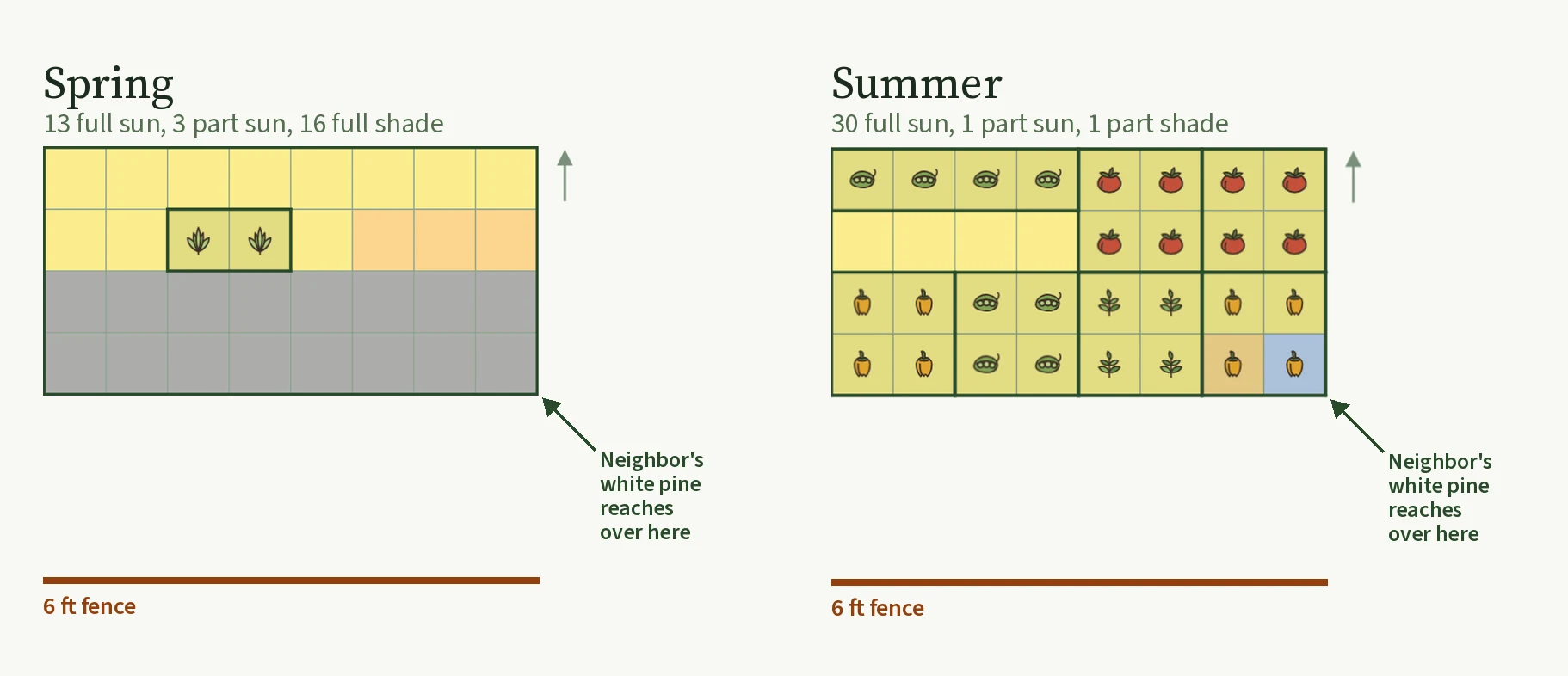
It sulks because it's sitting in the dark. The bed in the picture above is four feet by eight, three feet north of a six-foot fence in central Maryland. In early spring its front half gets about an hour of direct sun a day. The back half, two feet away, gets six or seven, a little less at the east end. Same bed, same soil. Different shade.
That's the trouble with planning a raised garden bed plant layout from a rule of thumb. "Tall plants in the back" is good advice, and this bed follows it. But it only handles the shade your crops make. The shade that runs your layout comes from the fence, the house and the trees around the bed, and it moves all year. Draw that first.
Draw the shade before the crops
Shade is hard to see ahead of time. The sun runs low in March and high in June, so a fence that blankets half your bed in spring can miss it entirely by midsummer. Standing in the yard won't tell you much. You'd have to stand there in every season, at every hour.
That's the job we built Plantyd to do. You draw the bed, the fence, the house and the trees on your plan. Plantyd works out how many hours of direct sun each square of the bed gets in each season, for your exact spot on the map. Then it colors them: yellow for full sun (six hours or more), orange for part sun (four to six), blue for part shade (two to four) and gray for full shade (under two). Hover over a square and it tells you the hours.
Here's what it found for this bed. In early spring the fence's shadow holds its distance all day, so it covers the front two rows from morning to evening. By midsummer the sun is high enough that the same fence throws a noon shadow under two feet long, and the whole bed comes out of it. Nothing in the yard moved. The sun did.
Then there's the neighbor's white pine. It stands just past the fence, fifty-five feet tall, and its branches reach back over the fence and over the southeast end of the bed. It's an evergreen, so it shades the bed all year.
In spring it takes about five hours off every square in the back rows, enough to tip their east end into part sun. In summer it still takes two or three hours off every square in the back rows, and one square in the southeast corner gets less than three hours all day.
Size it for your arms, space it for the sun
Build the bed four feet wide and no wider. From either side, two feet is about as far as most arms reach. If it backs onto a wall and you can only work it from the front, make it two feet deep. Leave aisles about three feet wide. Narrower feels fine until you try to kneel in one with a bucket.
Then give the fence some room. In central Maryland, a bed five feet off a six-foot fence stays clear of its shadow from late March on. The farther north you live, the longer that shadow gets: in Minneapolis it's about six feet. This bed sits at three, which is why its front half needs a plan of its own. If you're still choosing where the bed goes at all, start with how much sun your yard gets.
Tall crops go north. Every time.
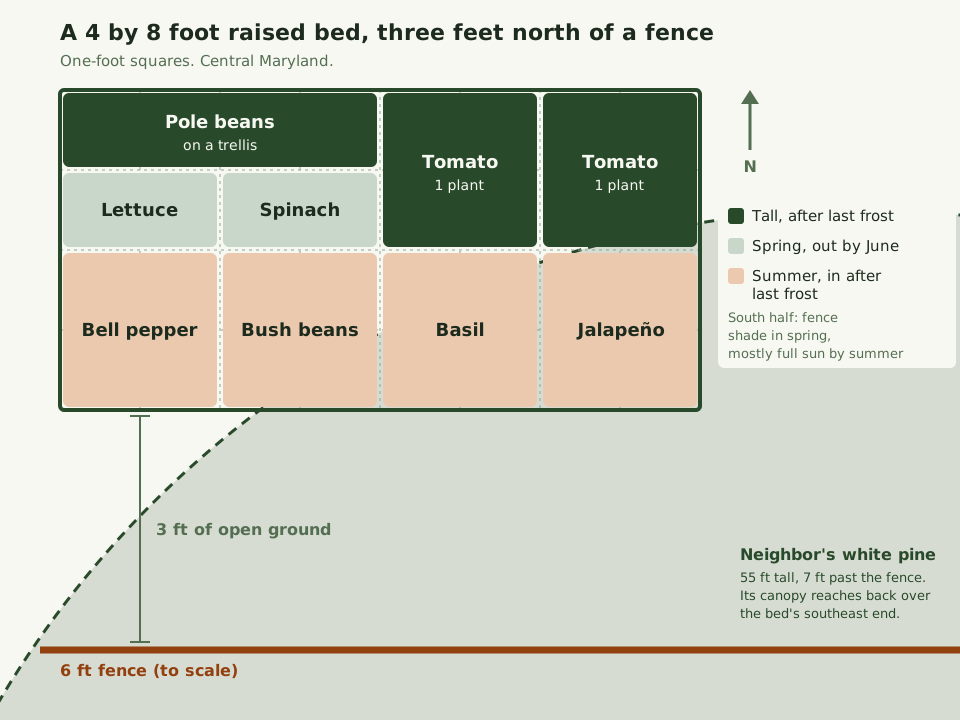
The old rule holds. Shadows fall north, so anything tall goes on the north edge, where its shade drops off the back of the bed instead of onto your lettuce. Here, pole beans climb a trellis along the west half of the north row, and two caged tomatoes take the east half of both back rows, a two-by-two block each.
The catch is that those back rows are also the sunniest ground in spring. Two kinds of crop want them at once: the tall ones, for where their shadows land, and the early ones, for the light.
Greens go where the spring sun lands
The lettuce and spinach go in front of the pole beans, at the west end of the second row. Even with the pine, those squares get close to seven hours in early spring, which is plenty. The east end of that row is the part-sun stretch the pine creates, and it belongs to the tomatoes. They don't go in until after the last frost, in late April or early May, so nothing planted there goes short.
The front half waits. An hour of sun is too little for anything, greens included. By the end of April the fence's noon shadow is down to about three feet, right at the bed's edge. That's your signal. Bush beans go in at the end of April, basil and peppers in early May.
Keep the two plantings in separate squares. Spinach sown in mid-March is in the ground until late May, and a pepper due in early May would spend more than a week waiting on it. When the greens do come out, don't leave their squares empty. By then they're some of the sunniest in the bed, and a second sowing of bush beans fits right in.
In summer the jalapeño's block straddles the pine's corner. The two northern squares get plenty, but the corner square gets under three hours. The pepper will cope. But if you grow something that likes a little afternoon relief, that corner is its spot.
And the fence isn't done with you. By mid-October its noon shadow is nearly seven feet long, long enough to reach the tomatoes at the back. Any fruit still ripening then is ripening in shade.
Count by the square, then trust the packet
Square-foot charts split the bed into one-foot squares and set a number for each crop: four lettuce, nine bush beans, sixteen radishes. They're a good start, but they're wrong about anything that sprawls. Many charts give a tomato one square. That works for a plant tied to a stake and pruned hard. A caged 'Better Boy', an indeterminate that keeps growing all season, wants two feet each way, so it gets four squares. Peppers want about eighteen inches, more than one square can give, so each one here gets a two-by-two block.
When the chart and the seed packet disagree, the packet wins. It knows the variety. It's the same math as spacing trees and shrubs, just smaller.
Next year, slide everything along
A layout lasts one season. Tomatoes and peppers are both nightshades, so they share pests and diseases. The usual advice is to keep a plant family out of the same spot for three or four years. In one small bed that's hard. Even switching every year helps.
The tall crops are stuck on the north edge, so swap them along it. Next year the tomatoes take the west end, the pole beans move east, and the greens follow them into the pine's part-sun stretch. That's fine for greens, which can get by on three or four hours of sun, according to Iowa State's extension service. The peppers shift to the middle of the front half. With only two spots on the north edge, the tomatoes are back where they started in the third year, short of the advice. Plantyd flags it when they return. In one bed, that's as good as it gets.
You'll spend the season fussing over the crops. But a fence and a neighbor's tree decided this layout. Draw them first.
Common questions
How do you lay out a raised garden bed?
Start with the shade, not the crops. Draw the fences, buildings and trees around the bed and find out which squares get sun in spring and which get it in summer. Then put tall crops on the north edge, spring crops in the squares that are sunny early, and summer crops in the squares that open up once the sun climbs.
Where should tall plants go in a raised bed?
On the north side. The sun comes from the south, so a trellis or a caged tomato on the north edge throws its shadow onto the path, not your lettuce.
Can I put a raised bed against a fence?
You can, but a fence on the south side will shade the front of the bed through early spring. In central Maryland a six-foot fence's noon shadow is about five feet long by late March, so a bed five feet off it stays clear from then on. A fence on the north side costs you no sun.
Will a tree shade my raised bed?
If it stands to the south, east or west, yes. It will shade part of each day, and more in spring and fall when the sun is low. A deciduous tree is bare in early spring and shades much less than it will in summer. An evergreen shades all year, though which squares it hits shifts with the season, and a neighbor's tree counts as much as your own.
How the bed planner works
Every number in this post came out of Plantyd's bed planner: the sun hours for each square, the planting dates, the warning when the tomatoes come back to their old spot. If you want to see how it does that before you draw anything, the raised bed planner page walks through it piece by piece.
Find the sun on your own bed
Sign up, draw your bed where it really sits, with the fence and the trees around it, and see how many hours of sun each square gets. Plantyd dates every sowing from your nearest weather station's frost record, so you know when each square is ready to plant.
Start designing freeNo credit card required · Free tier is free forever