Ask for a quote to redo a front yard, and it often starts with tearing out the walk. Then come new pavers, a new bed line, a truckload of soil and a row of shrubs that arrive already four feet tall. The total at the bottom usually ends the conversation. Much of that money goes to things that already work. The concrete walk gets you to the door, and the lawn is fine where it is. What the yard is missing is planting, and planting is the cheap part if you are patient.
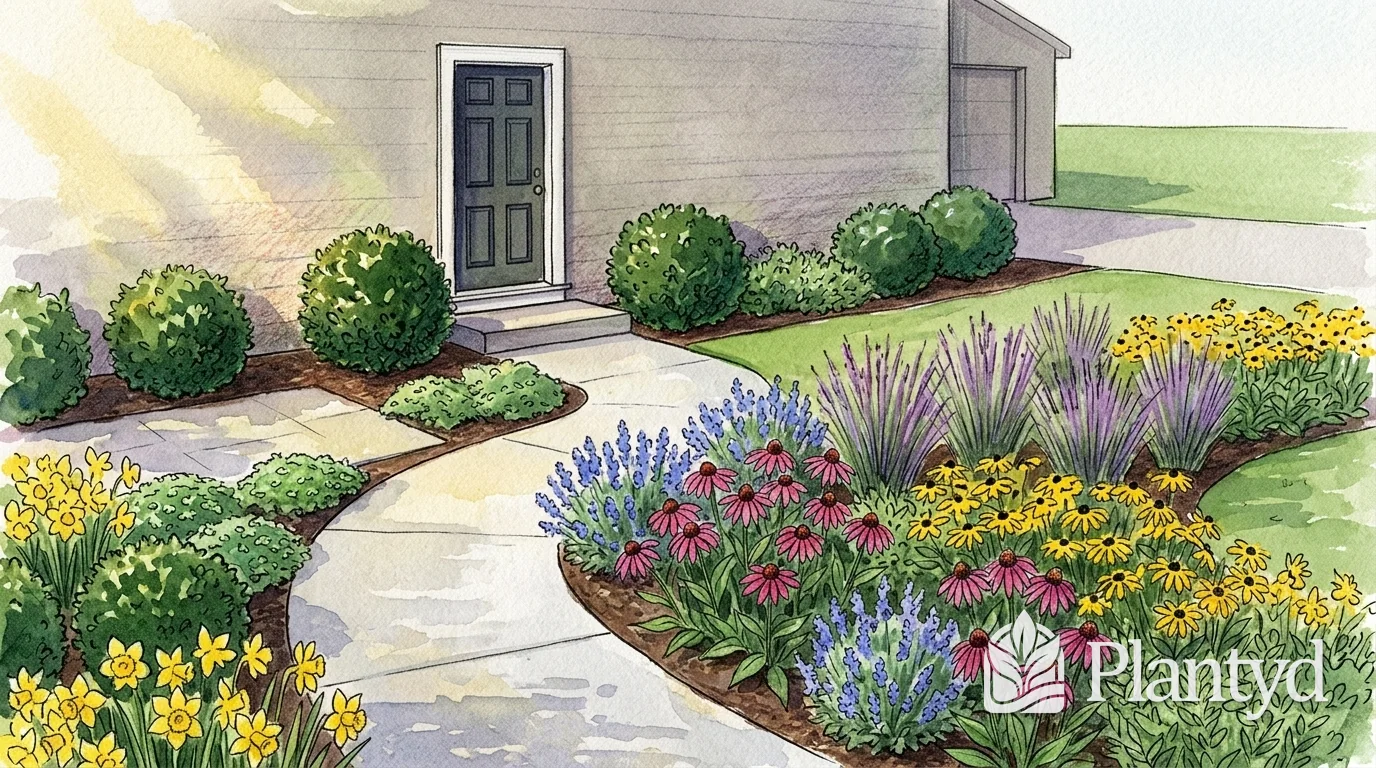
This cheap, simple front yard landscaping plan is for a 1960s ranch in Columbus, Ohio, zone 6b, with a front yard that faces south into full sun. It keeps the lawn, the walk, the stoop and the driveway, and adds three beds and nothing else. One small serviceberry stands off the west end of the house, and six evergreen inkberries sit under the window and at the garage corner. Around them go sixty-four perennials, grasses and ferns bought as plugs and quarts, plus a drift of daffodils, for ten kinds of plants in all. The beds flower from the daffodils in March to the asters in October, and the grasses and seed heads carry them through winter.
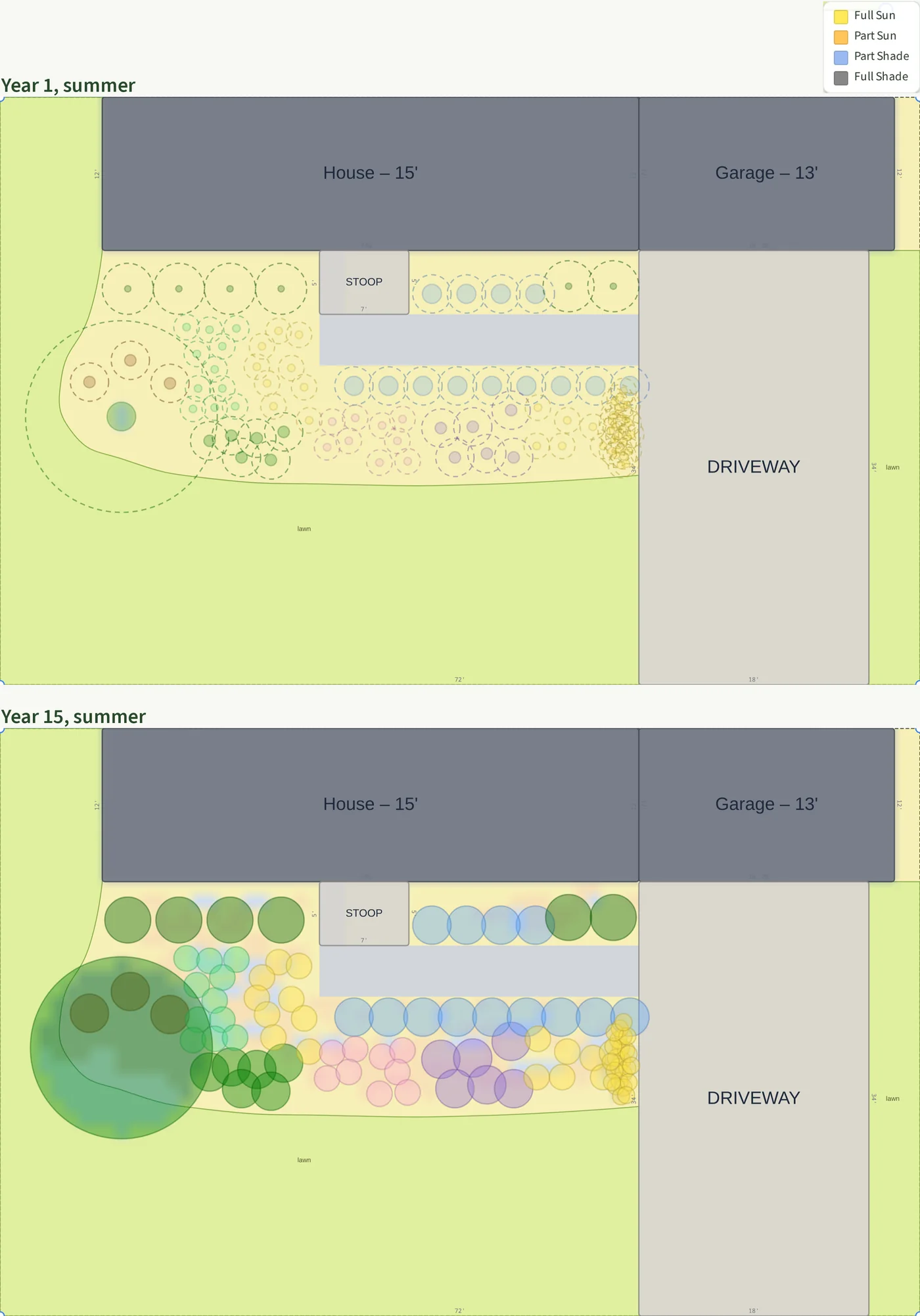
We drew the plan in Plantyd, and its sun analysis showed one more saving. The shade plants can wait years for the tree to grow, so you don't need to buy them yet. You can download the plan sheet, drawn to scale, further down the page.
| Yard | 50 feet wide and 34 feet deep, beside an 18-foot driveway |
|---|---|
| House | 1960s one-story ranch with an attached garage |
| Where | Columbus, Ohio, USDA zone 6b |
| Faces | South: full sun across the front |
| Kept | Most of the lawn, the concrete walk, the stoop and the driveway |
| New | Three beds, about 650 square feet, edged and mulched |
| Plants | 10 kinds, 96 plants: 1 small tree, 6 shrubs, 64 plugs and quarts, 25 bulbs |
| Upkeep | Shear the catmint once, cut back in early spring, top up the mulch |
The old walk stays, with catmint on both sides
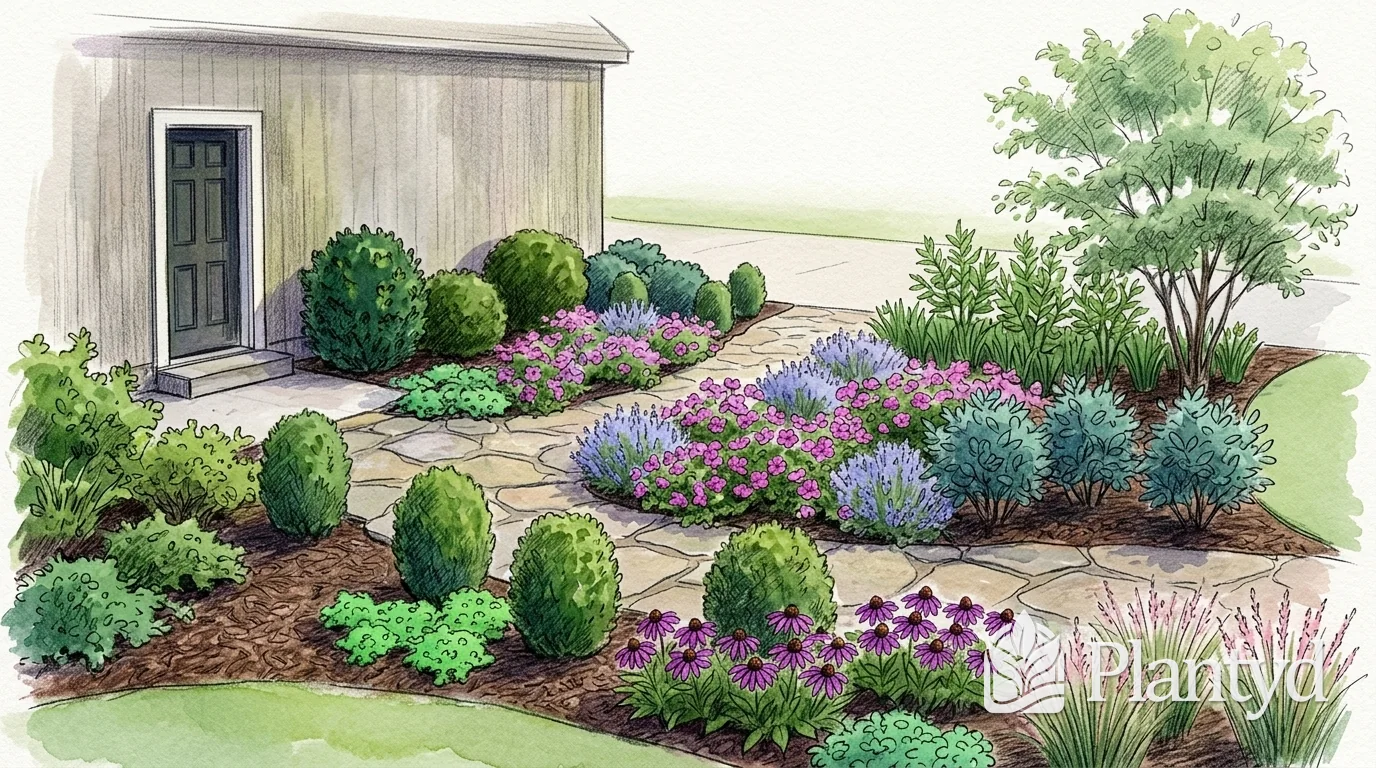
The plain concrete walk stays where it is. What changes is what grows beside it: a row of catmint along each side, thirteen plants bought in quart pots. Set each one a foot and a half back from the concrete, or by July it will be lying across the walk. By its second summer the catmint makes a soft lavender-blue edge from May into September, with one shearing in summer. The walk becomes the spine of the garden, and the only cost was the catmint.
Most of the lawn stays too. One bed wraps around the west end of the house and the tree. A narrow bed sits between the house and the walk, and the third runs along the south side of the walk to the drive.
No new paving goes in anywhere. Where the beds will go, smother the grass in fall with cardboard under the mulch, and plant through it in spring. At three inches deep, the beds take about six cubic yards of mulch.
Small plants catch up within a season or two
Sixty-four of the ninety-six plants go in as plugs or quarts: catmint, black-eyed Susan, aromatic aster, coneflower, little bluestem, moss phlox and, later, the ferns. Next to the gallon pots at the nursery, plugs and quarts look puny. Most catch up within a season or two, and fast growers such as the grasses can catch up with a gallon pot in a single season.
The first summer looks thin, with small tufts of plants in a lot of mulch. If the catmint and black-eyed Susans go in by late spring, they flower that first summer, and by July the bed looks planted. The coneflowers may wait a year to flower.
Small root balls dry out fast in a south-facing bed, so water through every dry spell that first summer. By year three the perennials have filled out, and the bed along the south side of the walk is as full as it will get.
Divide the first plants to fill the next bed
Four of the ten kinds divide easily: black-eyed Susan, aster, catmint and moss phlox. In year three or four you can lift them, split them, and use the pieces to widen a bed or start a new one along the property line. The plants for the second bed cost you a weekend of work.
Mulch is part of the plan, too. At full size the plants cover about half of each bed, a little more along the walk, and the rest is mulch between the groups. Filling every gap with groundcover would add a hundred more plants. For the first few years mulch is the cheaper fill, though you will need to top it up every spring.
One serviceberry, with the ferns planted once it grows
The only tree is a serviceberry called 'Autumn Brilliance', bought as a multi-stem five or six feet tall. It has white flowers in April, berries that the birds take in June, and red leaves in fall. It stands off the west end of the house, where its shade falls on that end of the house and on the side lawn.
Plantyd's sun analysis decided what grows under it. The ground beneath a full-grown serviceberry gets about two hours of summer sun. That is less sun than our plant library lists for wild geranium, the plant we first drew there, so the geranium came out.
Three Christmas ferns now grow on the north side of the trunk, and they go in last. In year one that spot gets thirteen hours of sun, and at year five Plantyd still shows two of the three ferns in sun. Plant them around year five and water them through their first summers. Until then, the spot stays mulched.
A tree you buy at six feet won't shade anything for years. If you draw your house and the tree on your own plan, Plantyd shows you where the tree's shade will fall once it is grown. If you haven't mapped your yard yet, start with how much sun your yard gets.
What to add later, in order
When you have more money for the yard, add these one at a time, in this order.
- The Christmas ferns, around year five.
- Divisions from the first beds, to widen them or start a new one. These cost nothing.
- A second drift of daffodils under the black-eyed Susans by the house.
- Three winterberries, with one male to pollinate them, at the corner where the walk meets the drive.
- Last, a wider walk, and only when the old one needs replacing anyway. Widening it to five feet takes a foot off the bed on its south side.
Using the plan in another yard
Every plant here is hardy to zone 5, so the same list works one zone colder than Columbus. One zone warmer, in zone 7, nothing needs to change either. On a smaller lot, start with the bed along the walk. It is the one you see from the car and the front door, and it holds more than half the plants.
If deer visit, most of this list holds up. Rutgers' ratings of deer-resistant plants list the catmint, daffodils, Christmas fern and little bluestem as rarely damaged, and the serviceberry, inkberry, coneflower, aster, black-eyed Susan and winterberry as seldom severely damaged. Deer eat phlox more often, so expect to lose some at the bed edges.
The plant list: ten kinds, ninety-six plants
Each letter is on the plan sheet, and the quantities match it. The table and the sheet disagree on the sizes of the daffodil and the fern. For those two, go by the table.
| Key | Qty | Plant | Size at maturity | Its job in the plan |
|---|---|---|---|---|
| A | 1 | Serviceberry 'Autumn Brilliance' Amelanchier x grandiflora 'Autumn Brilliance' | 25 ft tall, 15 ft wide | The one tree. Buy a 5 to 6 foot multi-stem |
| B | 6 | Inkberry 'Shamrock' Ilex glabra 'Shamrock' | 4 ft tall, 4 ft wide | Evergreen under the window and at the garage corner. Reaches about four feet, so trim it below the sill if you need to. Buy in 1 or 2 gallon pots |
| C | 9 | Coneflower 'Ruby Star' Echinacea purpurea 'Rubinstern' | 2 ft tall, 2 ft wide | Rose-pink from July. Buy as plugs |
| D | 25 | Daffodil 'Dutch Master' Narcissus 'Dutch Master' | 18 in tall, 6 in wide | Yellow in March and April, along the drive among the black-eyed Susans |
| E | 13 | Catmint 'Walker's Low' Nepeta x faassenii | 2.5 ft tall, 3 ft wide | Lines both sides of the walk. Lavender-blue May into September with one shearing. Buy in quarts |
| F | 3 | Christmas fern Polystichum acrostichoides | 18 in tall, 2.5 ft wide | Evergreen, on the north side of the tree. Plant around year five |
| G | 16 | Black-eyed Susan 'Goldsturm' Rudbeckia fulgida | 2.5 ft tall, 2 ft wide | Gold from July to fall, seed heads for winter. Buy plugs or quarts |
| H | 11 | Aromatic aster 'Raydon's Favorite' Symphyotrichum oblongifolium 'Raydon's Favorite' | 2 ft tall, 2 ft wide | Lavender-blue in September and October. Buy plugs or quarts |
| I | 6 | Little bluestem Schizachyrium scoparium | 4 ft tall, 3 ft wide | Native grass that turns copper in fall and, in lean soil, stands all winter. Don't feed it. Buy in quarts |
| J | 6 | Moss phlox (the sheet says creeping phlox) Phlox subulata | 6 in tall, 3 ft wide | Spring flowers at the bed edges, green in winter. Ask for Phlox subulata, not the shade-loving P. stolonifera. Buy small |
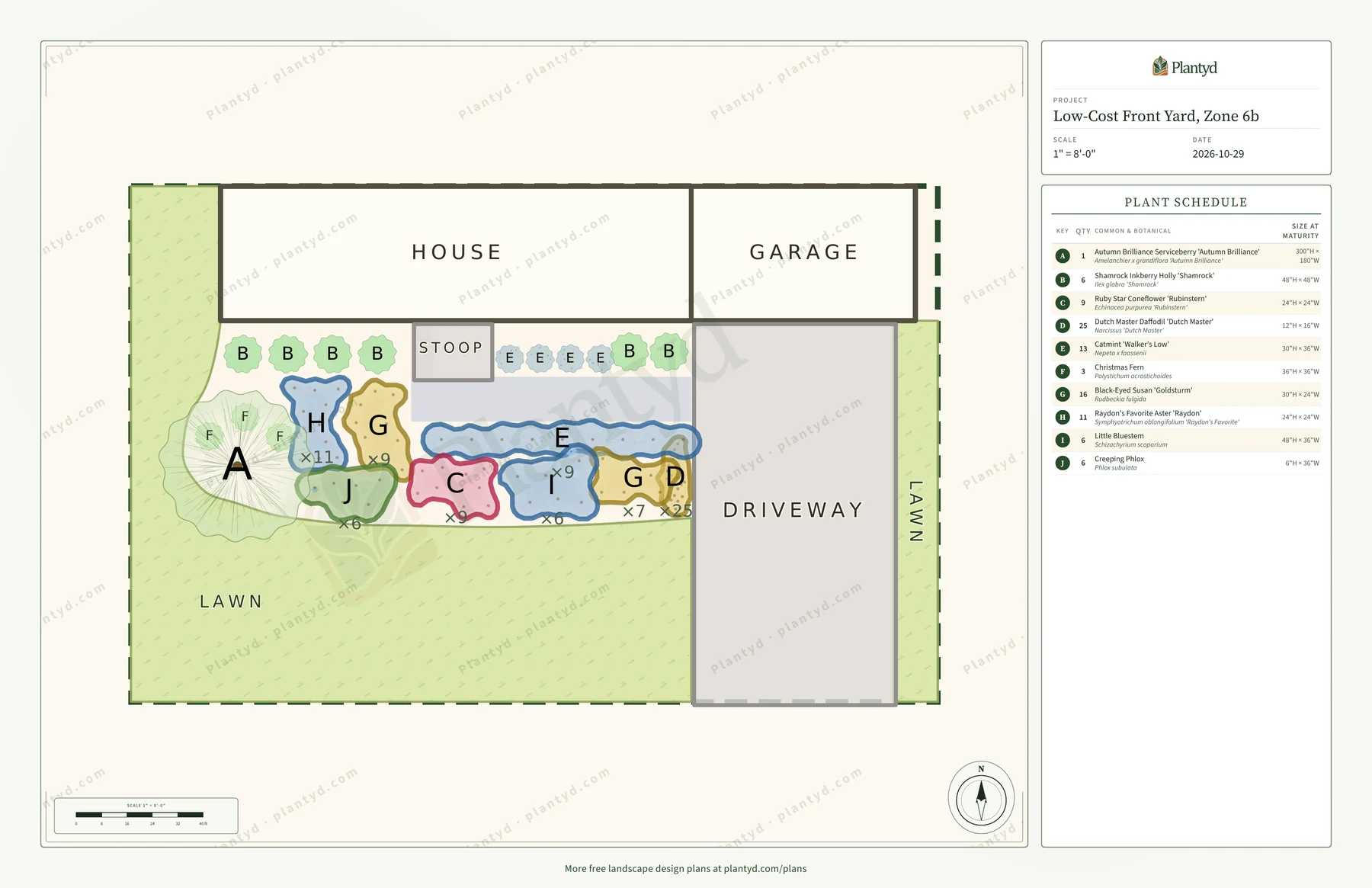
Instead of tearing out the walk, this plan plants beside it, and the money goes into plants that grow and divide to fill the next bed.
Common questions
How can I landscape my front yard on a budget?
Keep what already works: the lawn, the walk and the driveway. Spend on beds, mulch and plants, not paving. Buy perennials small, in plugs or quart pots, and choose kinds that divide, so the next bed comes from the first. Plant one small tree rather than several big shrubs.
Is it worth buying small perennials?
Usually, yes. Most perennials bought in quarts catch up with gallon pots within a season or two, and fast growers such as grasses can do it in one. You give up about a season of size, and for the same money you can plant bigger groups.
What are the easiest perennials for a sunny front yard?
Catmint, black-eyed Susan, coneflower, aromatic aster and little bluestem all handle full sun, ordinary soil and some drought once they are settled. None should need staking in lean soil, though little bluestem can flop by fall in rich clay. Catmint needs one shearing after its first flush of flowers. The rest just get cut back in early spring.
More plans like this
 Front Yard Landscaping for a Ranch House Without Hiding the Windows
 Front Yard Native Plant Garden Design That Still Looks Cared For
 Southern Front Yard Landscaping for a Hot West-Facing Porch
From the collection Front Yard Landscaping Ideas: 8 Plans, Drawn to Scale
Plan the beds before you buy
Sign up, trace your yard on its satellite photo, and see how much sun each bed gets before a single plant goes in the cart.
Start designing freeNo credit card required · Free tier is free forever