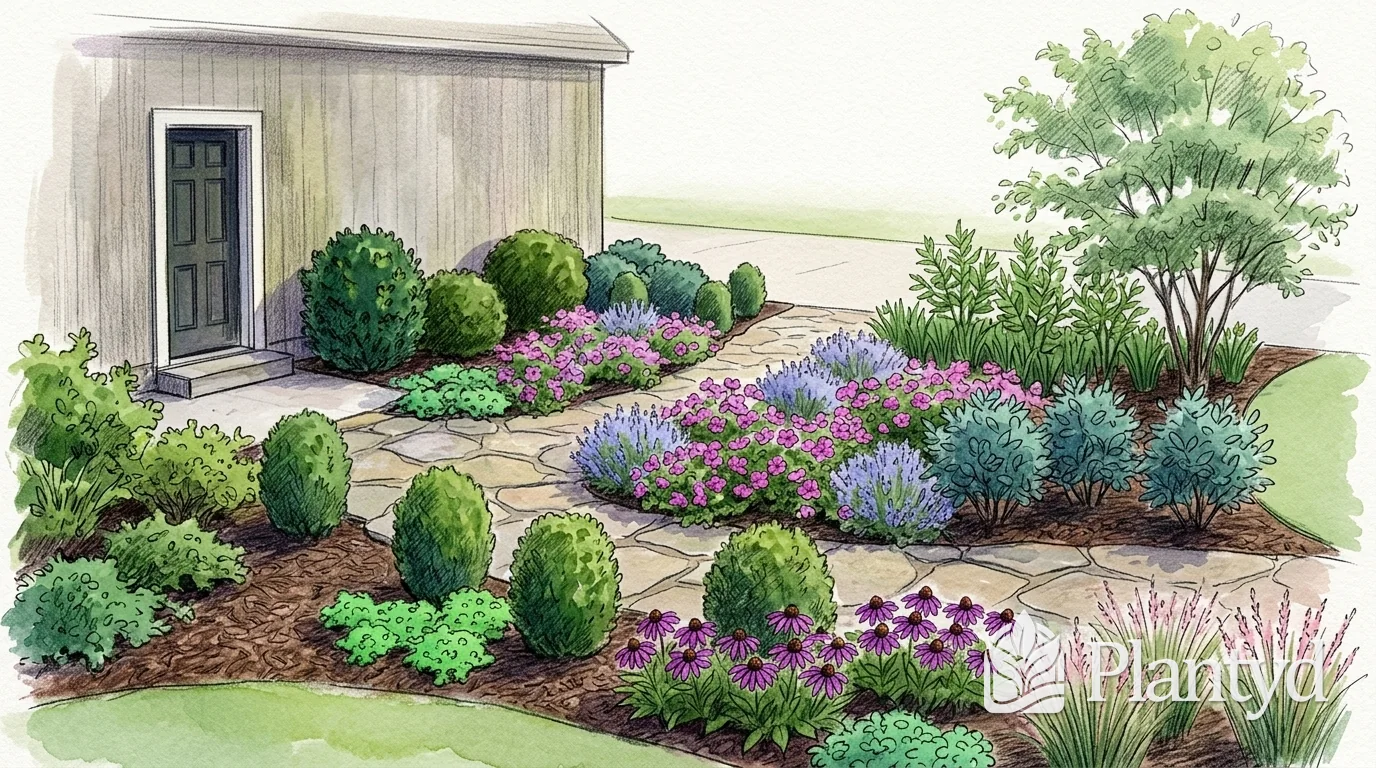
Many ranch houses end up with the same front yard. The house is long and low, the yard is shallow, and the shrubs that went in along the foundation thirty years ago have grown up over the windowsills. You pull into the drive and walk past them, and a first-time visitor stops on the lawn and wonders which door to knock on. The usual fix makes it worse. A tall evergreen at each corner and a shade tree out in the lawn take the sun from a front yard only 35 feet deep.
This front yard landscaping plan for a ranch house is for a one-story brick ranch in central Maryland, zone 7a, with a front yard that faces south. A curved bluestone walk leads from the drive to the door. Two small trees stand at the edges of the yard, a narrow serviceberry by the drive and a fringetree at the corner, so the beds keep their sun. Evergreens you can keep below the windows line the house, and fifteen kinds of plants grow in blocks you can read from the street. Something flowers from April to frost, and the evergreens, grasses and peeling bark carry the yard through winter.
We built the plan as a real project in Plantyd and ran Plantyd's sun analysis on it at year one and year fifteen. With small trees, the beds keep their sun all the way to year fifteen. The sunny door was another matter, because it needed different plants from the ones we first put beside it. You can download the plan sheet near the bottom of the page.
| Yard | 72 by 45 feet, with 35 feet from the house to the sidewalk |
|---|---|
| House | One-story brick ranch, 42 feet wide, attached garage, double drive |
| Where | Central Maryland, USDA zone 7a |
| Faces | South: full sun across the front |
| Built for | An easy way to the door, a garden that holds up in winter, light upkeep |
| Plants | 15 kinds, 115 plants; 11 of the kinds are native to North America |
| Paving | A curved bluestone walk 4.5 feet wide and a 6 by 8 foot landing |
| Upkeep | Cut back in early spring, shear the catmint once in summer, mulch |
Small trees keep the sun on the beds
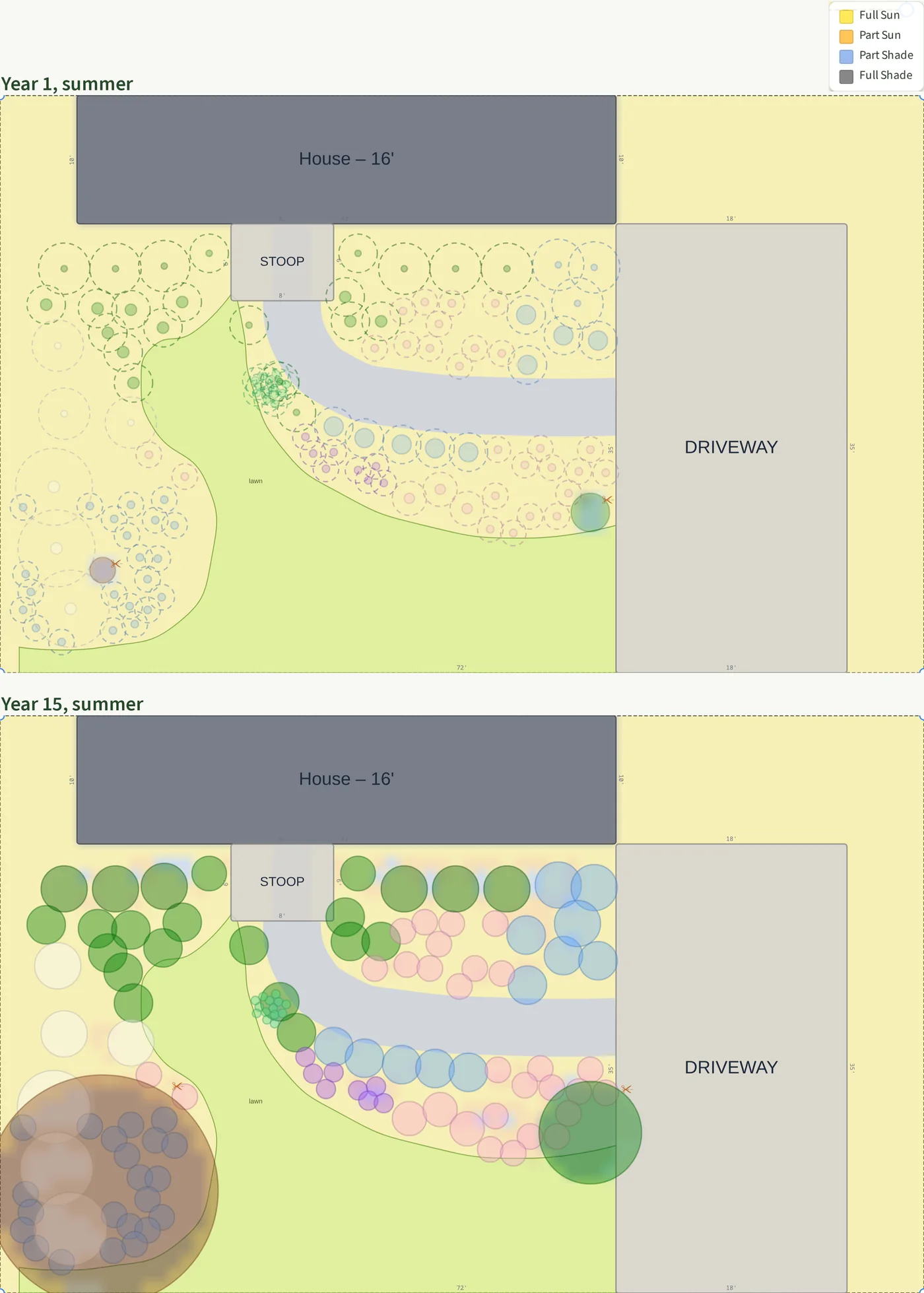
Our first sketch of this yard had a black gum at the west corner and a full-size serviceberry at the drive. Black gum reaches forty or fifty feet, and a full-size serviceberry spreads fifteen feet or more. Once the trees were grown, a sun check left the coneflowers and switchgrass between them with two to four hours of midsummer sun. The serviceberry shaded them in the morning and the black gum in the afternoon. A yard this shallow has no room for a big canopy tree beside its sunniest bed.
So the corner has a fringetree instead. It stops at around twenty feet and covers itself in fragrant white fringe in May. The drive has a columnar serviceberry, eight feet wide. In the year-fifteen sun map above, the fringetree's shade stays in the southwest corner, and the beds by the house and the walk keep their sun. That shaded corner is where the shade plants go.
Sun plants belong by a south-facing door
Hellebores by the front door are a classic, and our first plan had a drift of them beside the stoop for flowers in February. Plantyd's sun analysis put every one of them in full sun. On a ranch that faces south, the entry beds get eight to thirteen hours of summer sun, and hellebores want shade.
So the hellebores became moss phlox, a low, mostly evergreen mat that likes all the sun it can get. Buy a blue form such as 'Emerald Blue' for lavender-blue flowers in April. You give up flowers in February for flowers in April. In winter, the inkberry under the windows and the pair of boxwoods at the stoop keep the entry green.
If your ranch faces north, the reverse is true. The entry beds sit in the house's shade, and hellebores are the right plant there again. Plantyd works this out for your own yard. You draw the house and the trees, and it calculates how many hours of sun each spot gets, now and as the trees grow. If you haven't checked your yard yet, start with how much sun your yard gets.
Keep the windows clear and the shrubs off the brick
The row under the windows is inkberry 'Shamrock', a native evergreen holly that grows to about four feet. If your sills are lower than that, shear it each spring to keep the glass clear. Each plant sits about three feet out from the wall, so it can reach full size without rubbing the brick. That spacing is half the shrub's width plus a foot, the rule explained in how far apart to plant trees and shrubs.
Two upright boxwoods frame the stoop, and three dwarf fothergilla round off the garage corner. Many ranch foundations still have burning bush and Japanese barberry, and both are on Maryland's invasive plant list. Fothergilla gives you the same red fall color, and inkberry the same low hedge, without seeding into the woods.
Make the walk wide enough for two
The walk is bluestone, four and a half feet wide. It curves from the drive to a landing six by eight feet at the door. Four feet is about the narrowest walk that lets two people walk side by side. The landing gives the storm door room to swing and gives a guest somewhere to stand.
The curve leads people from where they park to the door, so nobody cuts across the lawn. The narrow serviceberry marks the spot where the walk leaves the drive, so someone who has never visited knows where to go.
Each kind of plant grows in one or two blocks
'Rozanne' geranium fills the front of both sunny beds and ties them together, with violet-blue flowers from June to frost. A single row of catmint edges the walk. Coneflowers and three clumps of switchgrass hold the sunniest stretch of the crescent bed beside the walk. Fewer kinds in bigger blocks look calmer from the street, and they cost less to plant.
How the yard changes from year one to year fifteen
In the first summer the beds are mostly mulch with young plants dotted through them, and the whole yard is in full sun. Fill the gaps with annuals for a season or two rather than with extra shrubs. By year three the perennials have closed up and the shrubs look like shrubs.
By year fifteen the fringetree is full grown and its corner is in shade. That is where the Allegheny spurge goes. It is a pachysandra native to the Southeast, with mottled leaves. The fringetree grows slowly, so the spurge will sit in sun for its first several summers. Water it through every dry spell until the shade arrives.
The plant list: fifteen kinds, with the perennials bought small
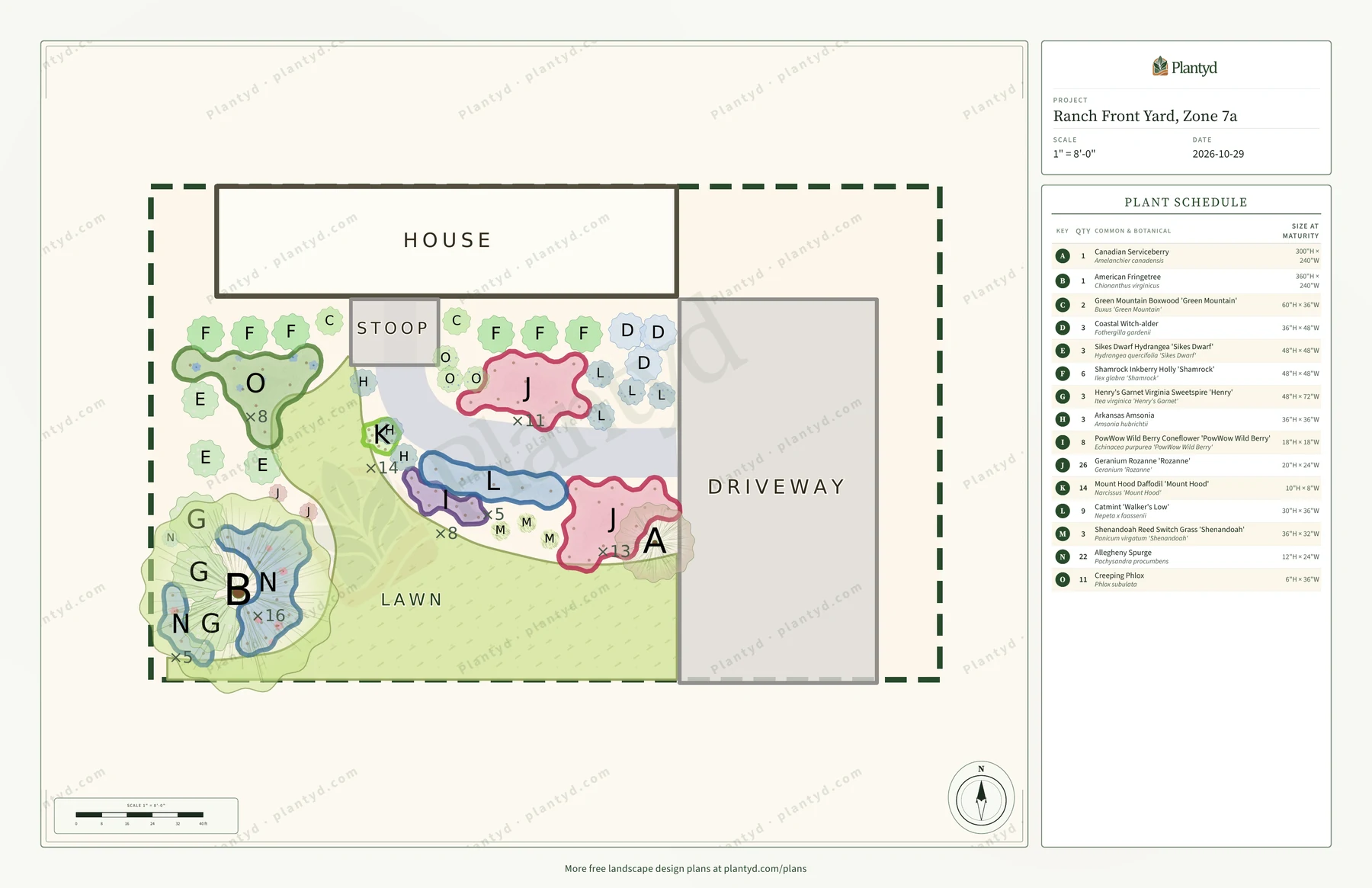
The letters match the plan sheet. Every plant on the list is hardy from zone 5 through zone 8, so the plan works as drawn across the Mid-Atlantic. The sizes are what each plant reaches when grown. Buy the perennials small, in quarts or gallons, and they will catch up within a couple of seasons.
| Key | Qty | Plant | Size at maturity | Its job in the plan |
|---|---|---|---|---|
| A | 1 | Serviceberry, columnar form Amelanchier canadensis | 18 ft tall, 8 ft wide | Narrow entry tree where the walk leaves the drive. White April flowers, orange fall color. Buy a columnar form such as 'Rainbow Pillar'. |
| B | 1 | American fringetree Chionanthus virginicus | 20 ft tall, 20 ft wide | Corner tree. Fragrant white flowers in May, yellow fall color, light shade below |
| C | 2 | Boxwood 'Green Mountain' Buxus 'Green Mountain' | 5 ft tall, 3 ft wide | Upright evergreen pair either side of the stoop |
| D | 3 | Dwarf fothergilla Fothergilla gardenii | 3 ft tall, 4 ft wide | Garage corner. Honey-scented white bottlebrushes in April, orange-red fall color |
| E | 3 | Oakleaf hydrangea 'Sikes Dwarf' Hydrangea quercifolia 'Sikes Dwarf' | 4 ft tall, 4 ft wide | West corner mass. White summer flowers, burgundy fall color, peeling bark in winter |
| F | 6 | Inkberry 'Shamrock' Ilex glabra 'Shamrock' | 4 ft tall, 4 ft wide | Evergreen line under the windows |
| G | 3 | Virginia sweetspire 'Henry's Garnet' Itea virginica 'Henry's Garnet' | 4 ft tall, 6 ft wide | Under the fringetree. Fragrant white tassels in June. Its fall red is duller in this much shade |
| H | 3 | Arkansas bluestar Amsonia hubrichtii | 3 ft tall, 3 ft wide | Landing end of the crescent bed. Pale blue May flowers, gold fall foliage |
| I | 8 | Coneflower 'PowWow Wild Berry' Echinacea purpurea 'PowWow Wild Berry' | 18 in tall, 18 in wide | Sunniest part of the crescent. Magenta from early summer, seed heads for finches |
| J | 26 | Geranium 'Rozanne' Geranium 'Rozanne' | 20 in tall, 2 ft wide | Front edge of both sunny beds. Violet-blue flowers from June to frost |
| K | 14 | Daffodil 'Mount Hood' Narcissus 'Mount Hood' | 16 in tall, 8 in wide | One drift among the bluestar, which hides the fading leaves |
| L | 9 | Catmint 'Walker's Low' Nepeta x faassenii | 2.5 ft tall, 3 ft wide | One row edging the walk. Lavender-blue in May and again after a summer shearing |
| M | 3 | Switchgrass 'Shenandoah' Panicum virgatum 'Shenandoah' | 3 ft tall, 2.5 ft wide | Upright clumps in the crescent. Burgundy in fall, standing all winter |
| N | 22 | Allegheny spurge Pachysandra procumbens | 12 in tall, 2 ft wide | Southeastern native groundcover for the fringetree's shade. Water it until the shade arrives |
| O | 11 | Moss phlox Phlox subulata | 6 in tall, 3 ft wide | Mostly evergreen mat in the sunny beds by the door. Buy a blue form such as 'Emerald Blue' |
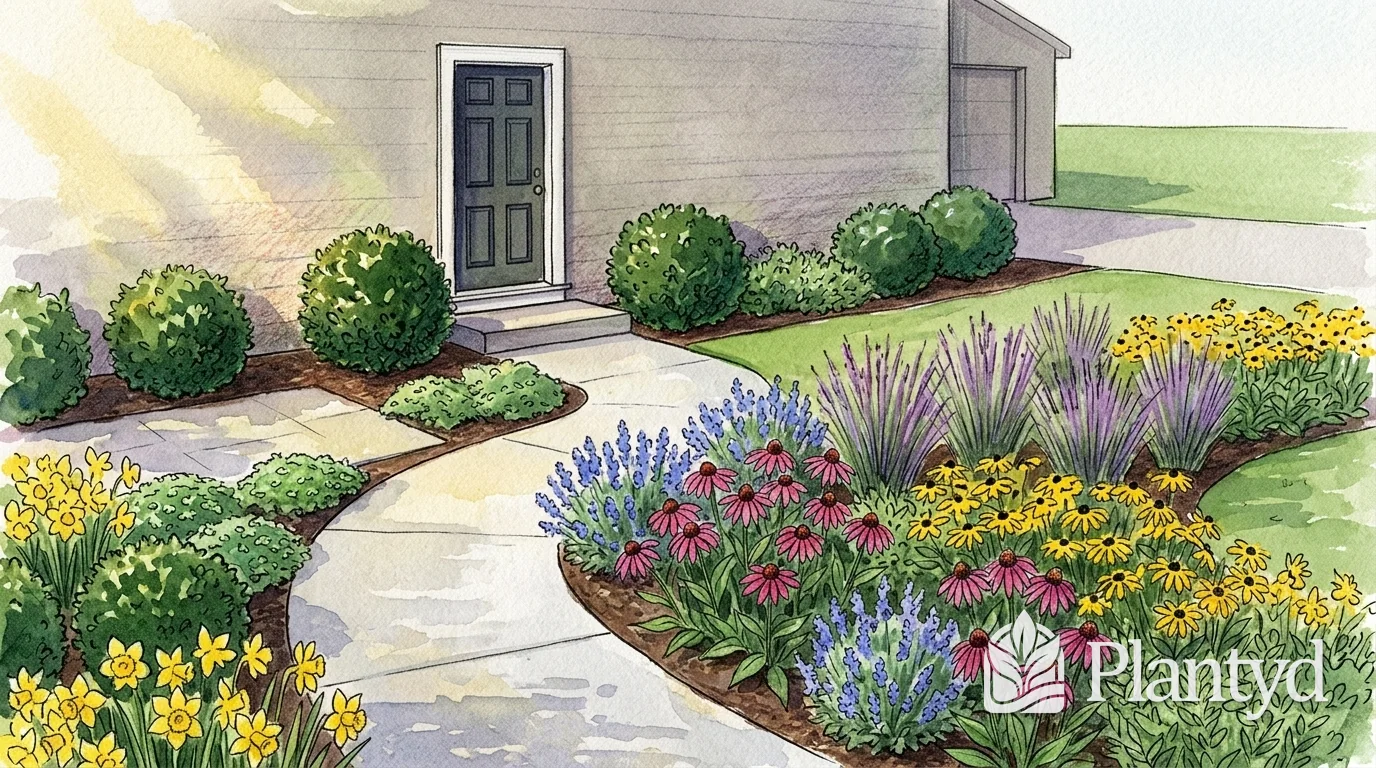
Planted this way, a long, low ranch still has clear windows in fifteen years, and nobody has to guess which door is the front.
Common questions
How do you landscape the front of a ranch house?
Start with the walk and the door, then the trees, then the shrubs. In a shallow front yard, keep the trees small and put them where their shade falls on a corner or the drive, not on your sunniest bed. Keep the shrubs along the house low and a few feet from the wall. Plant the perennials last, in large blocks.
What should I plant in front of a south-facing house?
Choose plants that like full sun and the heat that comes off the wall. In this plan, that means moss phlox, geranium 'Rozanne', catmint, coneflowers and switchgrass. Skip hellebores and hostas there. They are shade plants, and a south-facing entry gives them far more sun than they want.
How far from the house should foundation shrubs go?
Take the shrub's width when it is grown, halve it, and add about a foot. A four-foot inkberry goes about three feet out from the wall. That keeps it off the brick and leaves a strip behind it where you can get in with pruners.
What trees work in a small front yard?
Choose trees that stop near twenty feet and stay narrow, such as fringetree, or a columnar serviceberry beside the drive. Redbud and dogwood are small too, but both spread twenty-five feet or more, so give them a corner of their own. In a front yard less than fifty feet deep, a big shade tree's canopy ends up over most of the beds.
More plans like this
 Cheap, Simple Front Yard Landscaping: Keep the Lawn, Buy the Plants Small
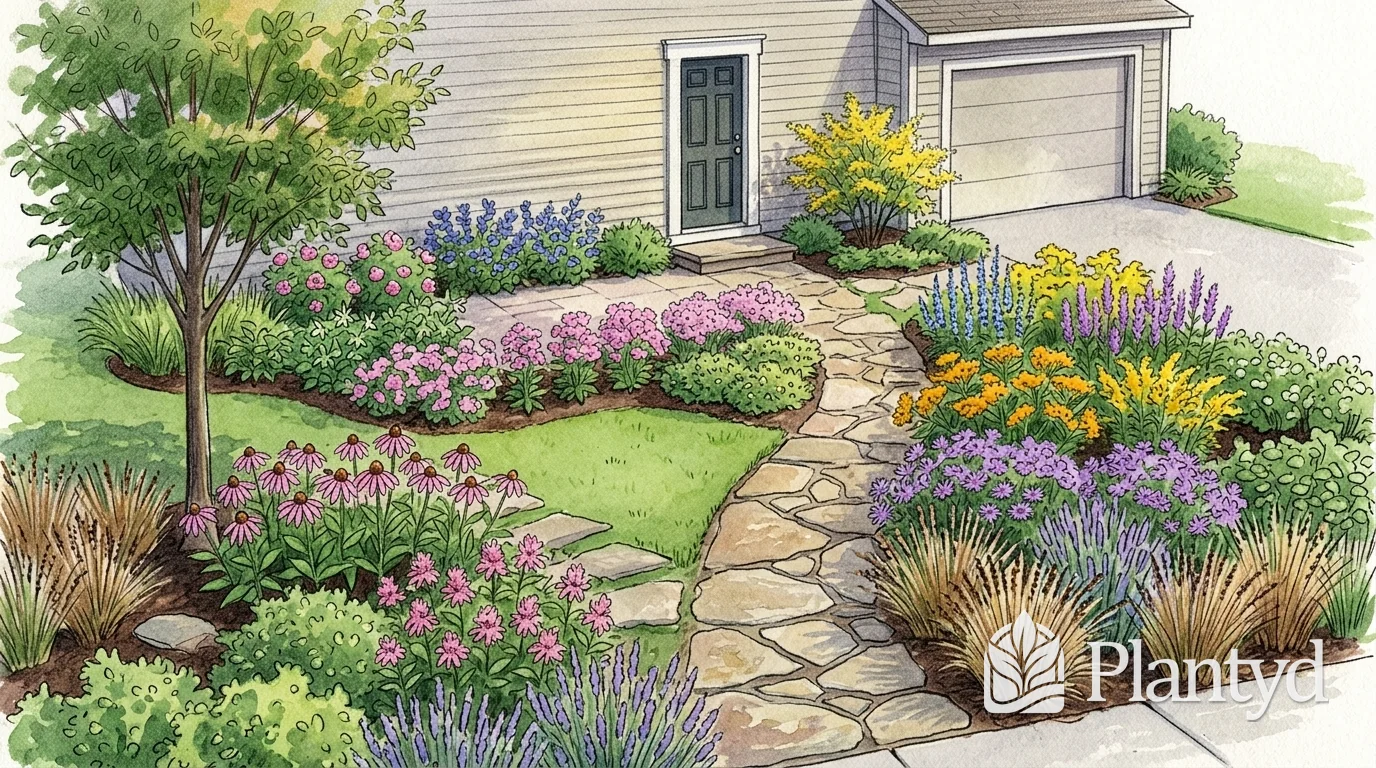 Front Yard Native Plant Garden Design That Still Looks Cared For
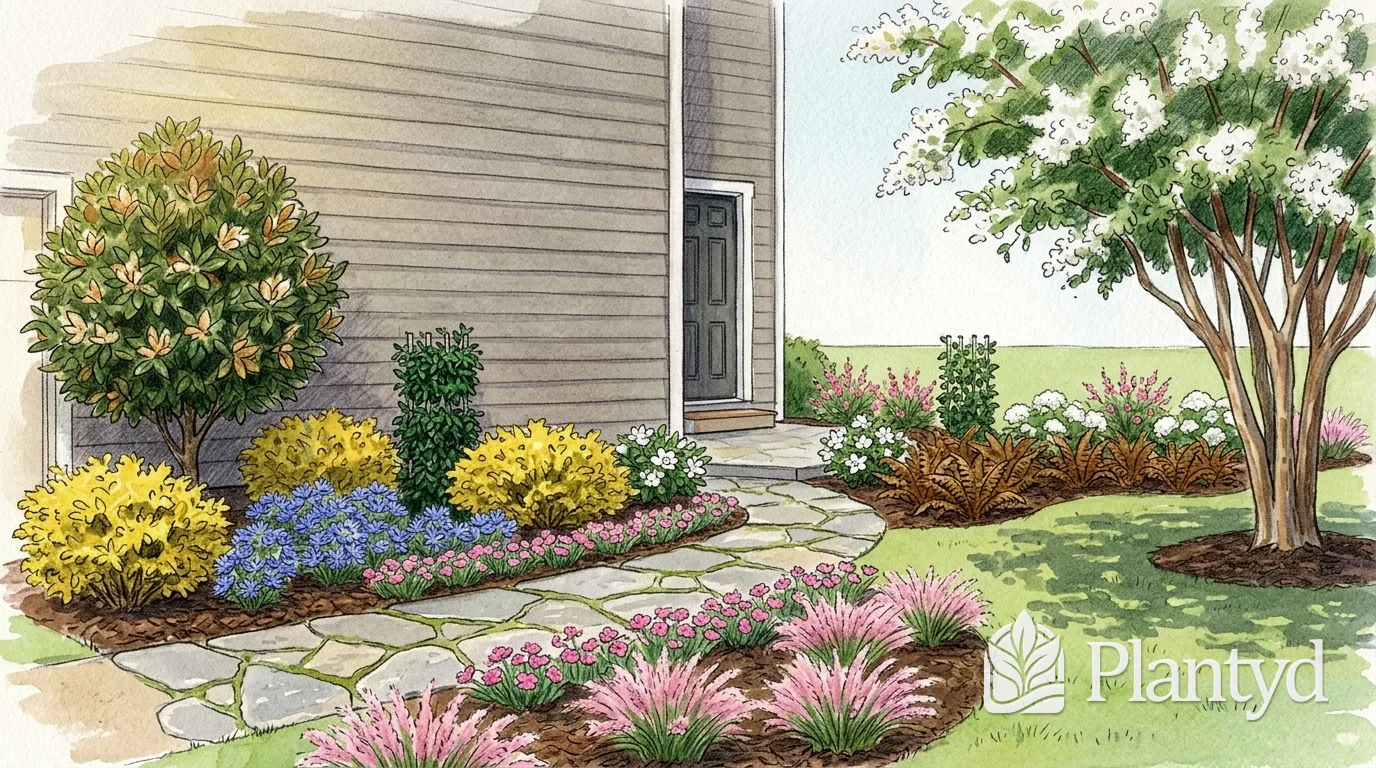 Southern Front Yard Landscaping for a Hot West-Facing Porch
From the collection Front Yard Landscaping Ideas: 8 Plans, Drawn to Scale
Draw your own front yard
Sign up, trace your yard on its satellite photo, and see where the sun falls on it now and fifteen years from now. Then decide where the trees go.
Start designing freeNo credit card required · Free tier is free forever