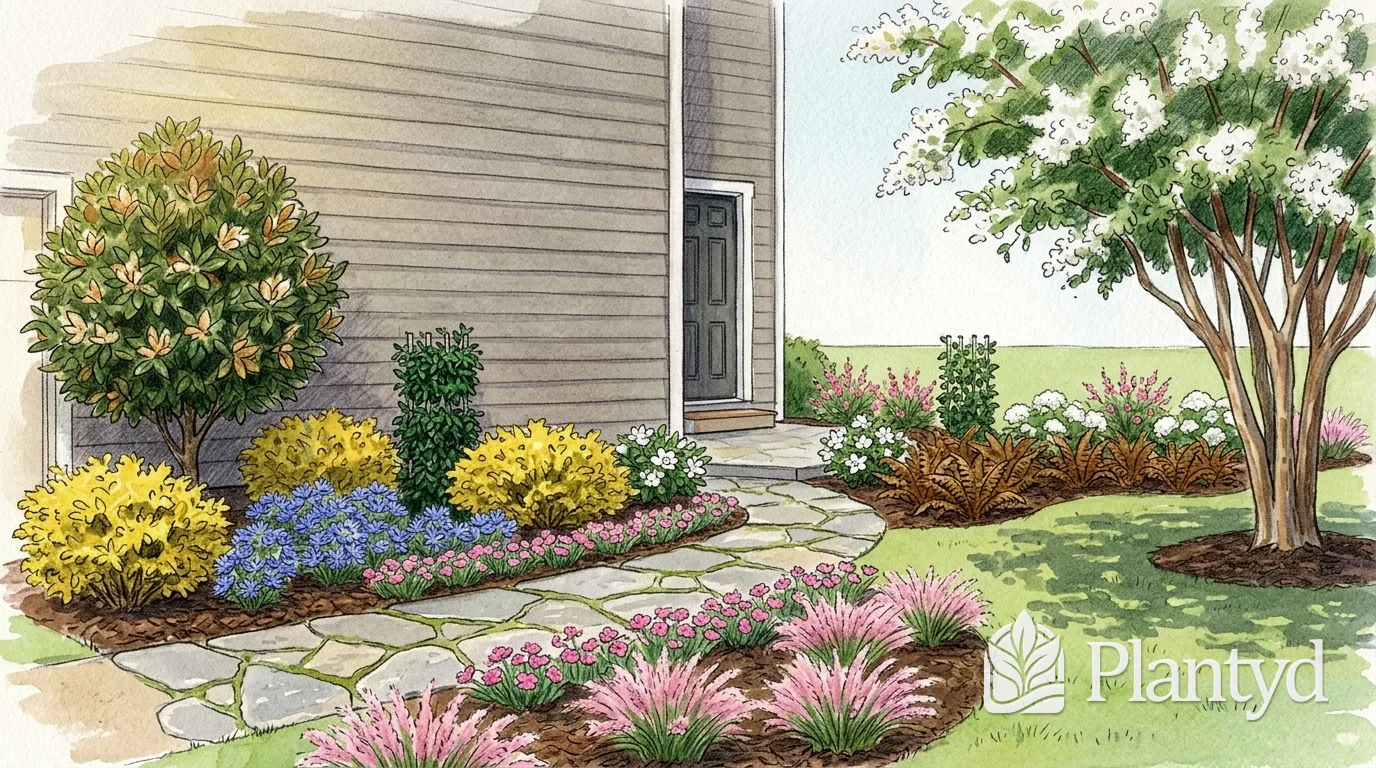
A front porch that faces west looks inviting from the street. By six o'clock on a July evening, though, the sun has been coming in under the roof since mid-afternoon, the rocking chairs are hot to the touch, and nobody sits out there. The usual planting doesn't help much: a row of tired boxwoods along the porch, and a small tree by the steps that shades the roof and little else.
This southern front yard landscaping plan is for a one-story brick ranch in Raleigh, North Carolina, in zone 8a, with a front yard 45 feet deep and an eight by twenty-four foot porch that faces west. A curving flagstone walk leads from the drive to the porch steps. One crape myrtle stands out in the lawn to shade the porch, and evergreens that take the heat carry the yard through winter. Something is in flower or in berry in every month of the year.
We built the plan as a real project in Plantyd and checked it with Plantyd's sun analysis, which grows the plants on the plan and shows where their shade falls at year one and year fifteen. It showed how far out the tree has to stand to shade the porch. It also showed where the ferns could not go, and when. You can download the plan sheet near the bottom of the page.
| Yard | 70 feet along the street, driveway included, and 45 feet from the street to the house |
|---|---|
| House | One-story brick ranch with an 8 by 24 foot front porch |
| Where | Raleigh, North Carolina, USDA zone 8a |
| Faces | West: the full afternoon sun on the porch |
| Built for | Shade on the porch on summer evenings, and something in flower or berry every month |
| Plants | 14 kinds, 97 plants; 8 of the kinds are native to the Southeast |
| Paving | A 4.5-foot flagstone walk curving from the drive to the porch steps |
| Upkeep | Shear the autumn sage in spring, cut the muhly back in late winter, limb the yaupon up over the walk, never top the crape myrtle |
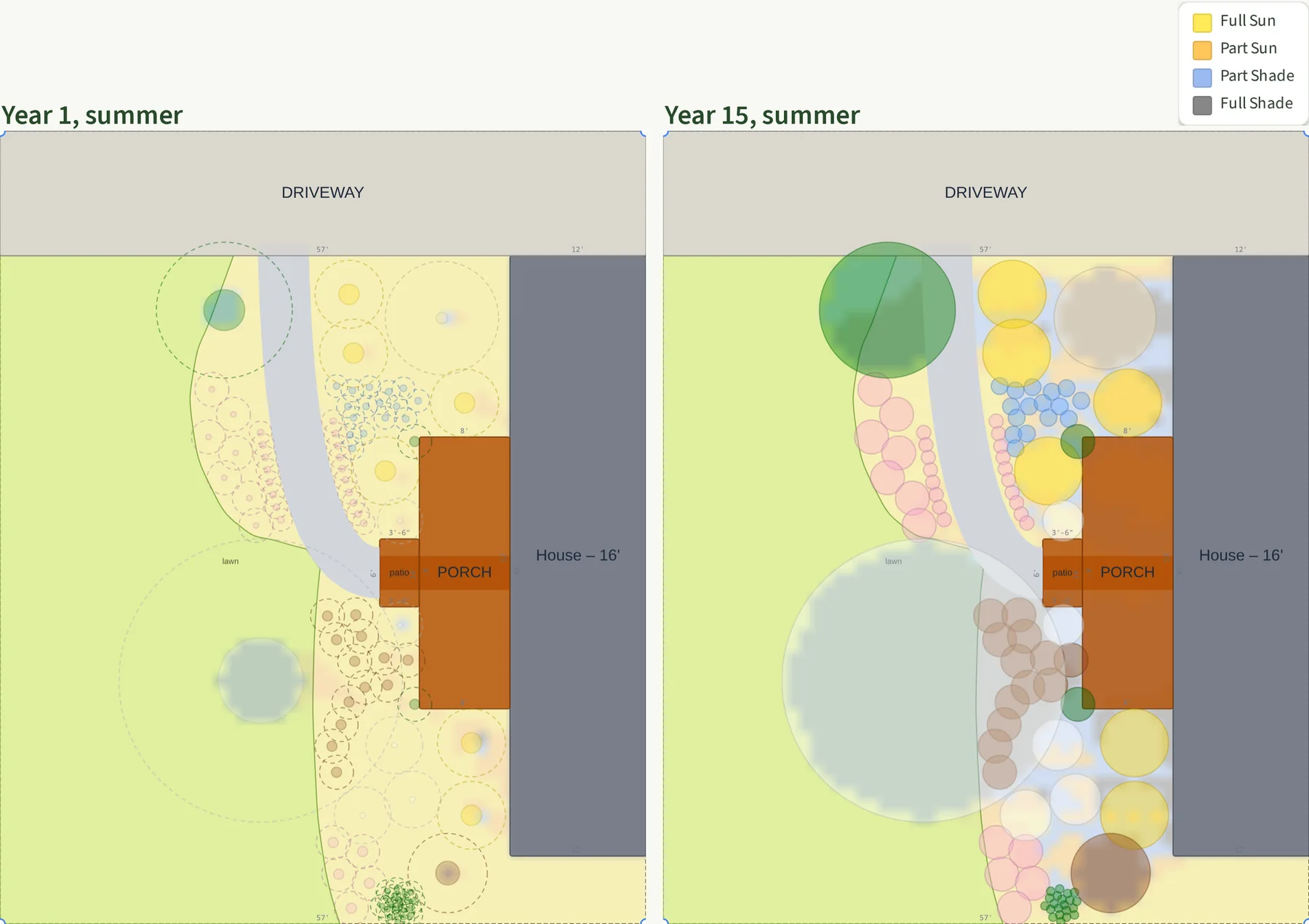
The crape myrtle stands out in the lawn to shade the porch
On a porch that faces west, the afternoon sun comes in low over the lawn. This plan puts a 'Natchez' crape myrtle out in that lawn, about fourteen feet west of the porch, not beside the steps.
Plantyd's sun map for year fifteen shows the ground in front of the south end of the porch in part shade. The angles explain why. At six on a July evening the sun is low and almost due west, and a full-grown 'Natchez' fourteen feet out shades the south half of the porch until about half past seven.
The crape myrtle drops its leaves in winter, so the low winter sun comes back through bare branches. It flowers white from July into September, after the spring shrubs have finished, when only the autumn sage is still in flower beside it.
Crape myrtle is not native, but it does two jobs here that no native small tree does as well: it shades a hot porch, and it flowers in late summer. Most of the plan's other trees and shrubs are native. Leave the top of the tree alone. The questions at the end of the post explain why.
Ferns fill the shade between the tree and the porch
The deepest shade in the yard lies between the tree and the porch. The house shades it in the morning and the crape myrtle shades it in the afternoon, so by year fifteen it gets less than four hours of summer sun. Christmas ferns fill it. Three native oakleaf hydrangeas grow just south of the porch, where the shade thins out.
We also tried ferns at the north end of the bed by the drive. Plantyd gave that spot four to six hours of summer sun, too much for a Christmas fern in a Raleigh July, so we took them out. The hydrangeas started closer to the tree, where Plantyd gave one of them an hour and a half of sun. We moved all three about four feet east and planted ferns in their place.
Your porch has its own angles. Trace your house and any trees on a Plantyd plan, and it counts the hours of summer sun on each patch of ground, this year and fifteen years from now. To measure yours first, read how much sun your yard gets.
Evergreens keep the yard looking finished in January
In Raleigh you look at the front yard twelve months a year, so evergreens do most of the work. A 'Little Gem' magnolia holds the house corner by the drive, and a sasanqua camellia holds the south corner. 'Little Gem' is a compact selection of southern magnolia, the big evergreen native to the Southeast's coastal plain.
A native yaupon holly stands where the walk meets the drive. Dwarf yaupon runs along the house on both sides of the porch, and two 'Frost Proof' gardenias stand on either side of the steps. Each dwarf yaupon gets the full six feet it will spread to, following the rule in how far apart to plant trees and shrubs.
Close to three-quarters of the shrubs are evergreen. In a colder climate that would look heavy. In Raleigh it means the yard still looks finished in January.
Something flowers or fruits in every month
The sasanqua flowers from October into December, and in January the red berries on the yaupon by the drive carry the yard. In February the Carolina jessamine on the porch posts and the old campernelle jonquils open.
The pinks, the magnolia and the gardenias flower in late spring. Stokes' aster and the hydrangeas follow into early summer, then the crape myrtle flowers through September. In October, pink muhly grass makes a pink haze along the street edge. Autumn sage flowers from May to October and fills any gap.
Leave out the nandina and liriope
You won't find nandina, liriope, privet or Bradford pear in this plan, though many Raleigh subdivisions were planted with them. All four are on North Carolina's invasive plant list, and nandina is on the invasive list in every neighboring state.
Dwarf yaupon does the evergreen job that nandina often does, and 'Bath's Pink' cheddar pinks edge the walk where liriope would have gone. The winter berries come from the yaupon by the drive.
Plant the ferns in year two or three
For its first few summers the crape myrtle is a sapling, and the shady pocket is not shady yet. Plantyd's sun map for year one gives the Christmas ferns six to eleven hours of summer sun, which is enough to scorch them. Plant everything else now and add the ferns in the second or third spring. If you plant them now, water them deeply through every dry spell until the tree catches up.
The beds start out mostly mulch, so fill the gaps with pansies in winter and zinnias in summer for the first couple of years. By year five the dwarf yaupons and perennials have filled in. Somewhere between years ten and fifteen the tree's shade reaches the porch. By then the yaupon by the drive needs its lower branches taken off, up to seven or eight feet, so it stops leaning into the walk.
Buy a female yaupon, with berries on it
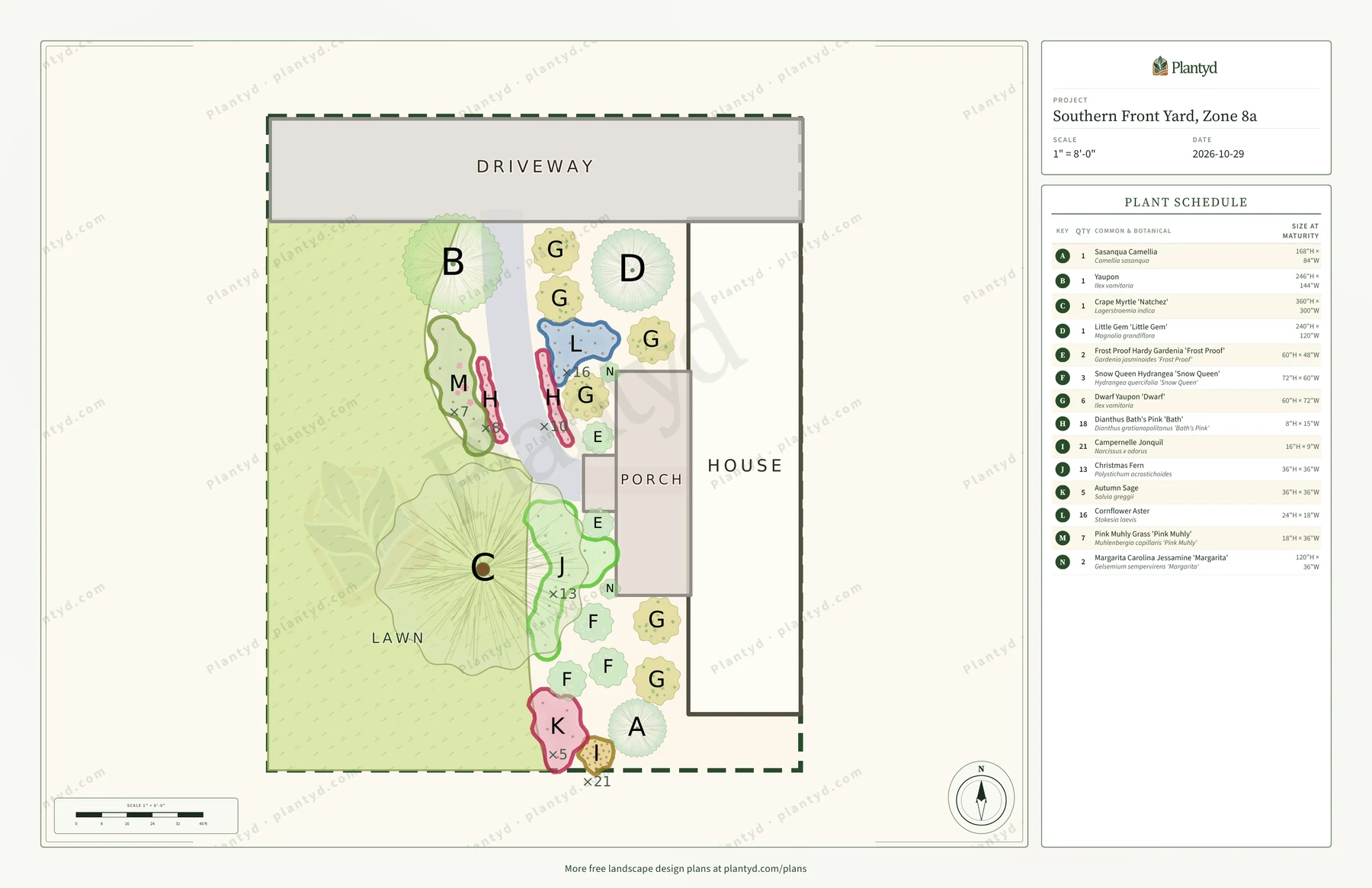
The letters in the list match the plan sheet. Every plant is rated for zone 8a in Plantyd's plant library. Only female yaupons have berries, so buy the one for the drive in fall, when you can see fruit on it.
The plan sheet calls Stokes' aster "Cornflower Aster" and prints the crape myrtle as plain Lagerstroemia indica. Buy 'Natchez'. Every part of Carolina jessamine is poisonous, and its yellow trumpets look enough like honeysuckle that a child might try to suck one. If a child at your house might, plant native coral honeysuckle on the posts instead.
| Key | Qty | Plant | Size at maturity | Its job in the plan |
|---|---|---|---|---|
| A | 1 | Sasanqua camellia Camellia sasanqua | 14 ft tall, 7 ft wide | Evergreen at the hot south corner. Flowers October to December. Water it deeply through its first two summers |
| B | 1 | Yaupon holly Ilex vomitoria | 20.5 ft tall, 12 ft wide | Native evergreen small tree where the walk meets the drive. Buy a female plant for red berries all winter |
| C | 1 | Crape myrtle 'Natchez' Lagerstroemia indica x fauriei 'Natchez' | 30 ft tall, 25 ft wide | The porch shade tree. White flowers July to September, cinnamon bark in winter |
| D | 1 | Southern magnolia 'Little Gem' Magnolia grandiflora 'Little Gem' | 20 ft tall, 10 ft wide | Evergreen at the house corner by the drive, a compact selection of the Southeast's native southern magnolia. Fragrant white flowers from late spring |
| E | 2 | Gardenia 'Frost Proof' Gardenia jasminoides 'Frost Proof' | 5 ft tall, 4 ft wide | Evergreen pair at the porch steps. Fragrant in May and June |
| F | 3 | Oakleaf hydrangea 'Snow Queen' Hydrangea quercifolia 'Snow Queen' | 6 ft tall, 5 ft wide | Native, in the part shade just south of the porch. White flowers in early summer, red fall leaves |
| G | 6 | Dwarf yaupon Ilex vomitoria (dwarf form) | 5 ft tall, 6 ft wide | Native evergreen along the house on both sides of the porch |
| H | 18 | Cheddar pink 'Bath's Pink' Dianthus gratianopolitanus 'Bath's Pink' | 8 in tall, 15 in wide | Gray-green evergreen edging. Pink, clove-scented in April and May |
| I | 21 | Campernelle jonquil Narcissus x odorus | 16 in tall, 9 in wide | Fragrant yellow in late winter, the old Southern heirloom |
| J | 13 | Christmas fern Polystichum acrostichoides | 3 ft tall, 3 ft wide | Evergreen fern for the shady pocket by the porch. Plant it in year two or three |
| K | 5 | Autumn sage Salvia greggii | 3 ft tall, 3 ft wide | Flowers from May to October in the hot southwest corner |
| L | 16 | Stokes' aster Stokesia laevis | 2 ft tall, 18 in wide | Native. Lavender-blue in May and June |
| M | 7 | Pink muhly grass Muhlenbergia capillaris | 18 in tall, 3 ft wide | Native grass facing the street. A pink haze in October |
| N | 2 | Carolina jessamine 'Margarita' Gelsemium sempervirens 'Margarita' | 10 ft tall, 3 ft wide | Native evergreen vine on the porch posts. Yellow from late winter into April. Poisonous if eaten |
The plan works a zone colder or warmer, and on a smaller lot
One zone colder, in 7b, every plant here is inside the hardiness range that NC State gives it. In 7a the gardenias are a gamble. NC State rates the species from 7b, though 'Frost Proof' is sold as hardy to zone 7. Put the pair in the most sheltered spot by the steps, or swap them for two more dwarf yaupons. Colder than that, the yaupons, the sasanqua and the magnolia are out of their range, and you need a different plan.
One zone warmer, in 8b, the list works as drawn. Farther south, in 9a, three plants go past the ranges NC State gives them: the magnolia, the cheddar pinks and the campernelles. Ask a local nursery what can do their jobs there.
On a smaller lot, keep the tree and the shady pocket and shorten the beds. The tree needs about twenty-five feet between the porch and the street: fourteen feet to the trunk, and room beyond it for the crown. Plant fewer dwarf yaupons along the house and a shorter group of muhly grass to make up the difference.
If deer come through, Rutgers' deer ratings cover six of these plants. Rutgers rates the jonquils and Christmas ferns as rarely damaged, and the crape myrtle, pinks and Stokes' aster as seldom badly damaged. It rates oakleaf hydrangea as occasionally damaged badly, so fence the three hydrangeas or plant more Christmas ferns in their place.
Plant the tree out in the lawn, where the afternoon sun comes from, and in about fifteen summers the south end of the porch will be the best place in the yard to sit at six o'clock.
Common questions
How do I shade a west-facing front porch?
Plant a small tree out in the lawn, about fourteen feet west of the end of the porch you sit at. On summer evenings the sun comes in low and a little north of west, so a tree by the steps only shades the roof. Choose one that drops its leaves, so the winter sun comes back through bare branches. In this plan, a grown 'Natchez' crape myrtle shades the south half of the porch on July evenings.
What are good evergreen shrubs for a Southern front yard?
Dwarf yaupon holly, inkberry, sasanqua camellia and 'Frost Proof' gardenia all take Southern heat and humidity. Native dwarf yaupon also handles drought and poor soil, which is why it lines the house in this plan.
What can I plant instead of liriope or nandina?
Both are on North Carolina's invasive plant list, and nandina is on the invasive list in every neighboring state. For a sunny edging, try 'Bath's Pink' cheddar pinks. In shade, try the native green-and-gold. For winter berries, plant a female yaupon or winterberry with a male of the same kind nearby.
Should you prune a crape myrtle back every year?
No. Cutting the trunks back to stubs, often called crape murder, ruins the tree's shape and weakens the new branches. Choose a variety that fits the space at its full height, and remove only crossing or low branches.
More plans like this
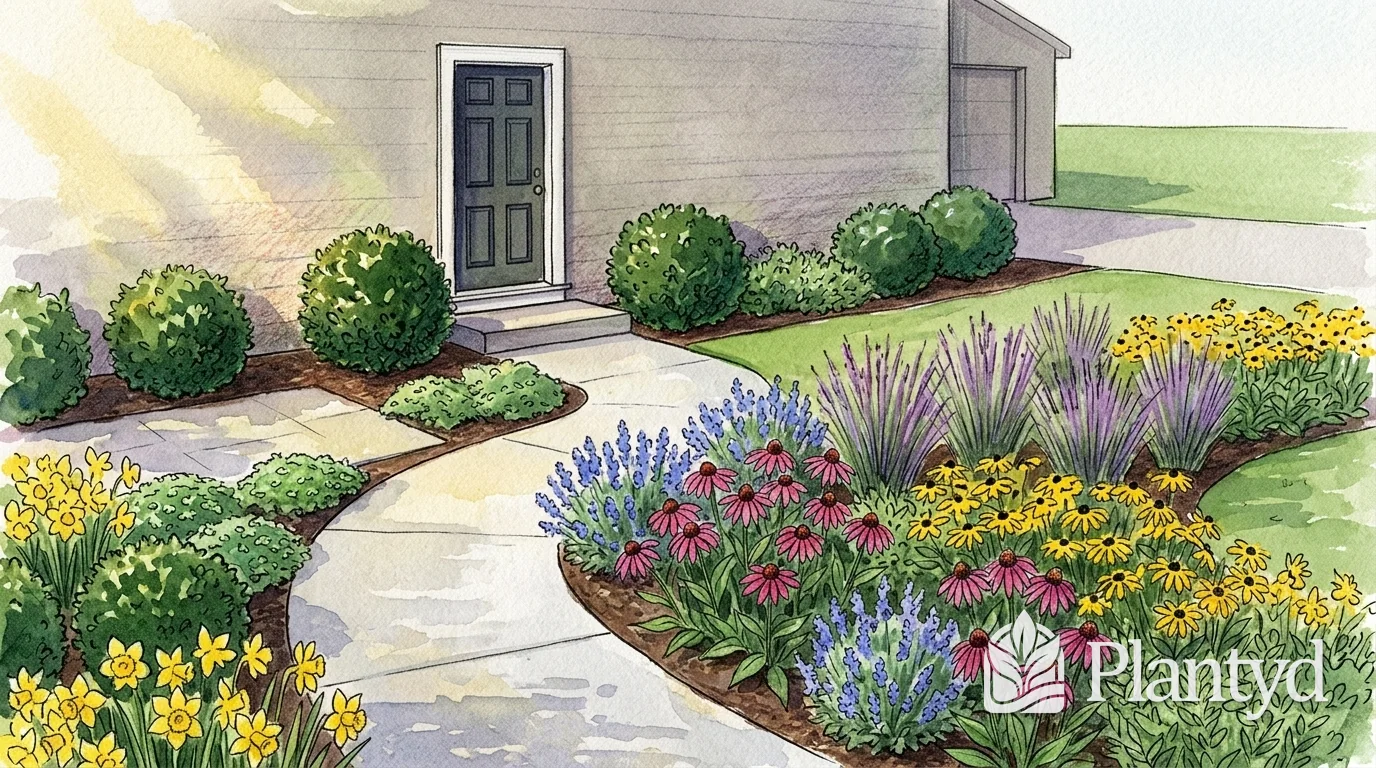 Cheap, Simple Front Yard Landscaping: Keep the Lawn, Buy the Plants Small
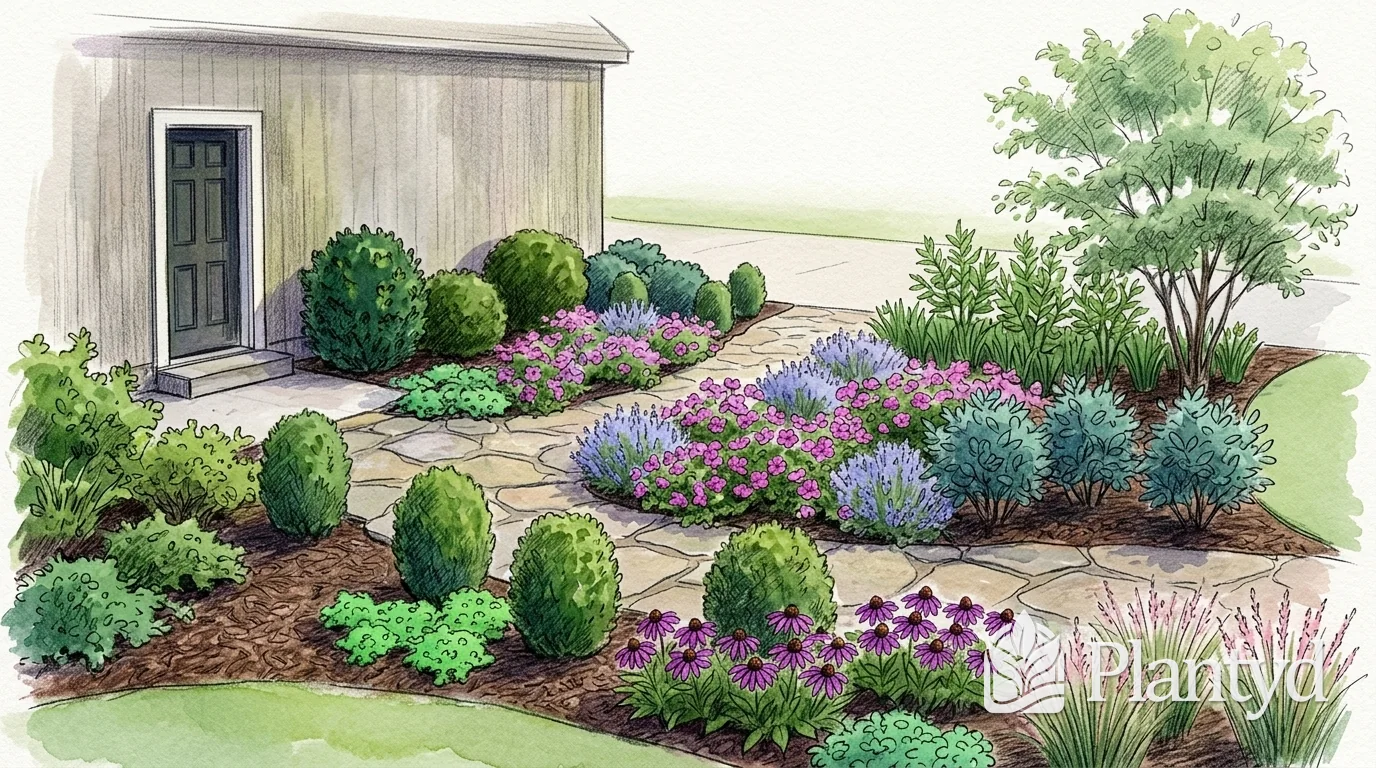 Front Yard Landscaping for a Ranch House Without Hiding the Windows
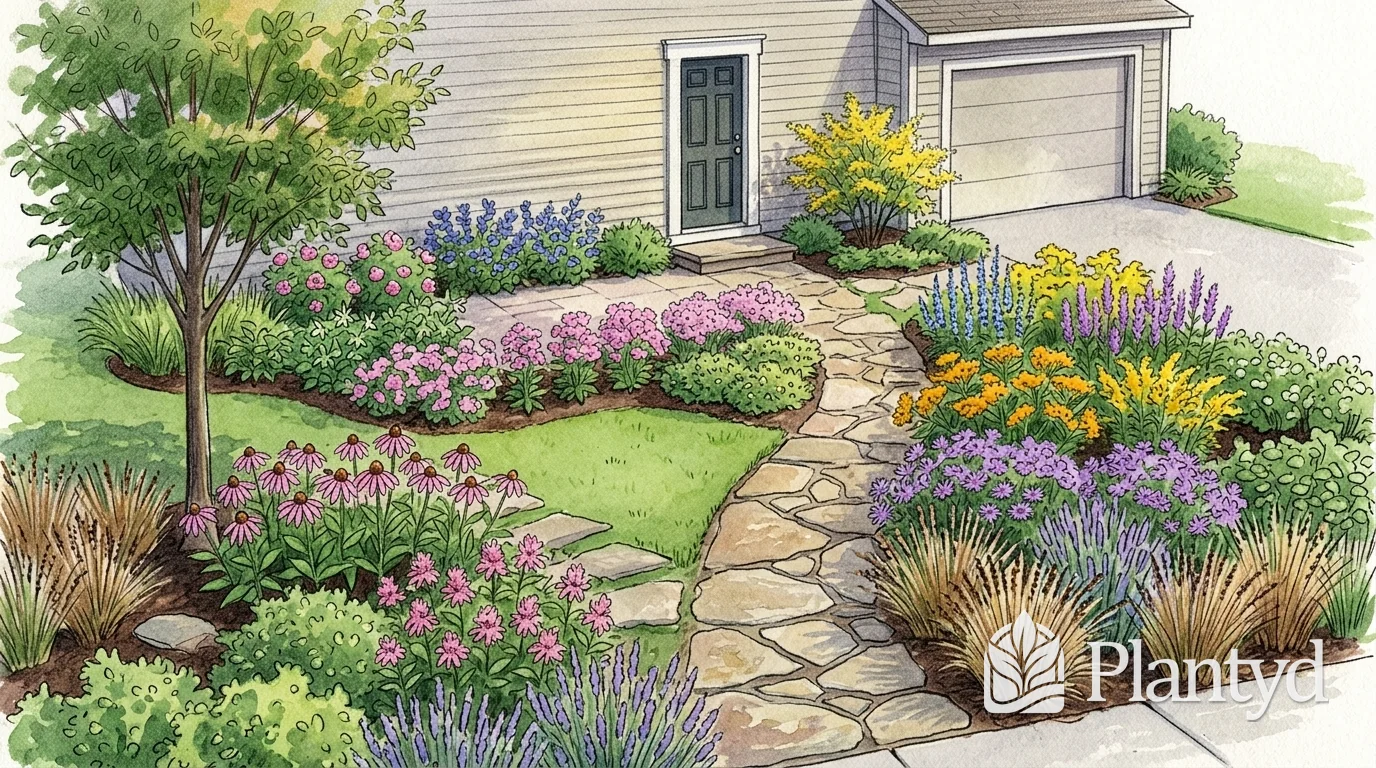 Front Yard Native Plant Garden Design That Still Looks Cared For
From the collection Front Yard Landscaping Ideas: 8 Plans, Drawn to Scale
Find where the afternoon sun hits
Sign up, trace your yard on its satellite photo, and see where the sun falls on your porch and beds, now and fifteen years from now.
Start designing freeNo credit card required · Free tier is free forever