
Every hard rain, the same thing happens. Water sheets off the back of the roof, roars out of the downspout at the corner of the house, and spreads into a muddy fan across the lawn. Two days later there is still a soft patch you can't mow. A rain garden fixes that, but only if it is the right size, and most advice skips straight to the plants.
This rain garden design is for the back yard of a two-story colonial in Princeton, New Jersey, zone 7a, where one downspout carries about 750 square feet of roof. We sized it with the state's own rain garden manual before choosing a single plant. The result is a shallow dish with a flat bottom of 150 square feet, 6 inches deep, fed by a stone swale, with an overflow for the storms it can't hold. Three rings of native plants fill it, one each for the wet bottom, the slope and the dry rim. Cardinal flower and great blue lobelia turn the bottom red and blue in late summer, and little bluestem stays copper on the rim all winter.
We built the plan in Plantyd and checked it with its sun analysis. The place where the water already goes, straight out from the downspout, turned out to be too shady. So the garden moved south into full sun, and the stone swale carries the water there. You can download the plan sheet below the plant list.
| Yard | A back yard 70 feet across and about 56 feet deep behind the house, with a paver patio by the back door |
|---|---|
| House | Two-story colonial facing the street to the west. The whole back gutter drains to one downspout at the north-east corner |
| Where | Princeton, New Jersey, USDA zone 7a |
| Sun | Full sun across the garden in midsummer: about 7 hours at the north end and 12 at the south, by Plantyd's sun analysis |
| Water | About 750 square feet of roof to that downspout, on silty soil |
| The garden | A flat bottom of 150 square feet, 6 inches deep, inside a planted oval of about 540 square feet |
| Plants | 16 kinds, 89 plants, all native to the eastern US |
| Stone | A river-stone swale from the downspout to the garden, and a stone-lined overflow onto the lawn |
| Upkeep | Water twice a week through the first year unless it rains, clear silt off the inlet stones each spring, cut back in late winter and top up the mulch |
Size it from the roof first
Start with how much roof drains to the downspout you will use. Measure the part of the roof that drains to that gutter from the ground, add the overhang, and divide by the number of downspouts on the gutter. Here the back half of the roof comes to about 750 square feet, and all of it drains to one corner.
The Rain Garden Manual of New Jersey, from Rutgers, sizes a garden to hold 1.25 inches of rain falling in two hours. For 750 square feet of roof, its table gives an answer for each kind of soil. Silty soil needs 150 square feet at 6 inches deep, sand about 112 square feet at 8 inches, and clay 350 square feet at just 3 inches, with sand and compost dug in.
This plan assumes silty soil. We added one thing to the manual's method. A dish with sloping sides holds less water than a box with straight sides, so the flat bottom alone gets the full 150 square feet, and the slopes are extra room.
Dig one test hole before you dig the garden
The soil decides how deep the garden can be, so test it where the garden will go. Dig a hole about 12 inches deep and 4 to 6 inches wide, fill it with water, and let it drain. Then fill it again to 1 inch from the top, and measure how far the water drops every hour for at least four hours.
If it drops 1.5 inches an hour or more, you can plant straight into the soil you have. If it drains more slowly, or is still wet the next day, the manual says to mix in coarse sand or move the garden. Test in a wet spell too, if you can, because dry clay drains fast and makes the soil look better than it is.
Put the garden in the sun, not in the soggy spot
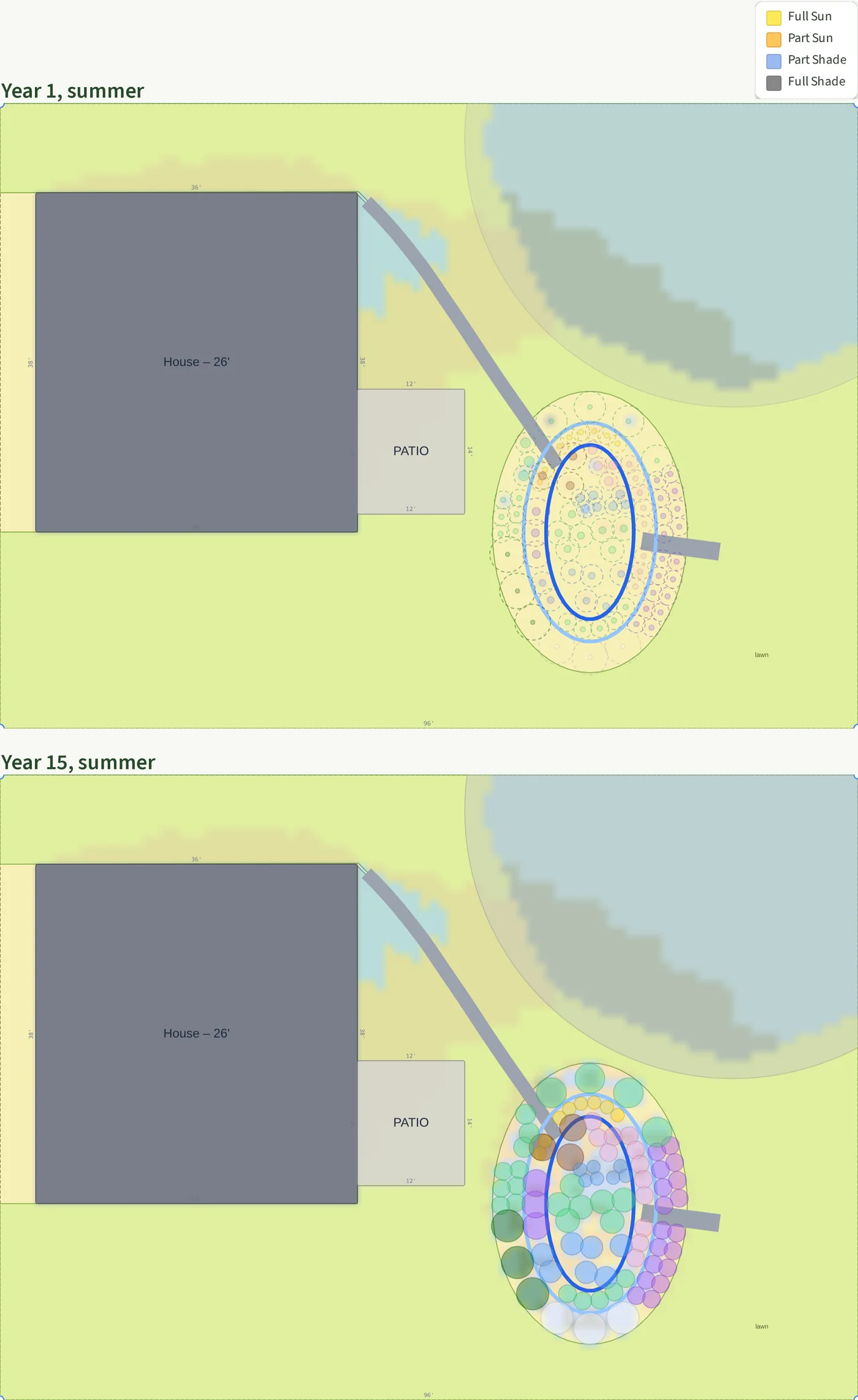
The obvious place for this garden is straight out from the downspout, where the water already goes. We checked that strip in Plantyd first. Near the house it got three to six hours of summer sun, with the oak shading it in the morning and the house in the afternoon. Farther out, under the oak, it got about two.
The manual says to skip that spot anyway. Catch the water before it reaches the place where it already pools. It also rules out the drip line of a big tree, and of oaks most of all, because digging there cuts their roots. And Plantyd's plant library rates soft rush, winterberry and little bluestem for full sun only, while none of the plants meant for the bottom flower well on two hours.
So the garden moved south, out of the oak's shadow, where Plantyd showed seven to thirteen hours of sun. A swale lined with river stone carries the water there, around the edge of the drip line. When the garden is full, the water's edge is almost 19 feet from the back wall of the house, and the manual asks for at least 10 feet from a house with a basement. If your roof and yard are different, find your own light with how much sun your yard gets.
Checking that before anyone digs is what Plantyd is for. You draw the house, the trees and the beds to scale, and Plantyd shows how many hours of sun each spot gets now and fifteen years from now, before you rent the sod cutter.
Plant it in three rings
A rain garden isn't evenly wet. The flat bottom floods after every storm and then dries out. The slope gets wet as the water rises and dries out first. The rim never sits in water at all, and the berm on the downhill side, built up from the soil you dig out, is the driest ground in the garden.
The bottom gets plants that can stand a day underwater and then a dry week. Soft rush grows in clumps around the foot of the inlet stones. Cardinal flower and great blue lobelia fill the north end with red and blue in late summer, white swamp milkweed holds the middle, and blue flag iris holds the south end. The milkweed is a white kind, not the usual pink, so it doesn't clash with the scarlet cardinal flower.
The slope gets plants that take both wet and dry spells: golden ragwort along the north end for April flowers, Joe-pye weed down the far side, fox sedge around the south end, and two more blue flag irises and low 'Purple Dome' asters facing the patio. Winterberry and summersweet, wetland shrubs the manual lists for the slope, stand along its top edge, with the winterberry to the north and the summersweet to the south.
The rest of the rim is planted for dry ground: inkberry on the south-west curve, aromatic aster and black-eyed Susan on the patio side, and two rows of little bluestem on the berm. The tall plants stand on the far side, so from the patio you look over the low ones into the garden.
Stones take the force of the water
Water arriving from a downspout carries enough force to wash away bare soil. The swale's stones run down the slope to the edge of the bottom, and the three clumps of rush stand around where the stones stop. The manual asks for a band of rock at least 1 foot wide where the water comes in. Add more if you see soil washing away.
Some storms bring more than 1.25 inches of rain, so the berm has a low notch on its east side, lined with river stone over landscape fabric. The overflow spills east onto about 15 feet of back lawn, away from the house and well short of the property line.
Mark the rings with string before you dig
Plantyd draws plants, beds and paving to scale, but it doesn't model the shape of the ground, so the dish, the slope and the berm aren't drawn in the plan. Instead, we drew two thin blue lines: one for the edge of the flat bottom and one for the top of the 6-inch slope. The edge of the lawn is the outside of the rim.
Lay out all three with string. Here the slope runs 2.5 feet from the edge of the bottom to the top. The manual's limit is 3 to 1, which means at least 3 inches across for every inch down, so a 6-inch dish needs at least 18 inches of slope. Anything steeper washes away.
The garden fills in by the third year
In the first summer, the garden is plugs and quart pots in shredded hardwood mulch, 3 inches deep, with no dye. Water them twice a week unless it rains, and after each big storm check that the bottom is empty within a day. By the second or third year, the rush, grasses and perennials have filled in.
The shrubs take a few more years to reach 3 to 4 feet, and that is where Plantyd changed the plan. In our first draft, the male winterberry stood at the north tip, between two berrying plants. At year one it got eight hours of sun. By year fifteen, its neighbors had grown around it and cut that to less than six hours, short of the full sun it is rated for. A male winterberry is there only to flower for the others, and it flowers best in sun. We spaced the group farther apart, using the rule in how far apart to plant trees and shrubs, and moved the male to the sunny east end.
Rutgers' ratings of deer-resistant plants put iris, soft rush and little bluestem among the plants rarely damaged, and the shrubs, milkweed, lobelias, asters and black-eyed Susan among those seldom badly damaged. Joe-pye weed, fox sedge and golden ragwort aren't on the list.
For a different roof or soil, change the size and keep the rings
On clay, use the manual's row for clay: more than twice the area at half the depth, with sand and compost dug in. For a smaller roof, scale down from the same table. For example, 500 square feet of roof on silty soil needs a garden of 100 square feet. Make the garden about twice as long as it is wide, with the long side across the slope.
Every plant here is hardy from zone 5 through zone 8, so the list works a zone either side of 7a as it stands. Don't plant yellow flag iris in the bottom, whatever the garden center has, because it invades wetlands. Blue flag is the native iris for the same wet spot.
| Key | Qty | Plant | Size at maturity | Its job in the plan |
|---|---|---|---|---|
| A | 1 | Swamp white oak (existing) Quercus bicolor | 60 ft tall, 60 ft wide | Already there. The garden stays outside its drip line and its shadow |
| B | 3 | Summersweet 'Hummingbird' Clethra alnifolia 'Hummingbird' | 3 ft tall, 4 ft wide | South end, at the top of the slope. Fragrant white spikes in July and August, yellow in fall |
| C | 3 | Inkberry 'Shamrock' Ilex glabra 'Shamrock' | 4 ft tall, 4 ft wide | Evergreen on the south-west curve, in view of the patio and the back windows all winter |
| D | 3 | Winterberry 'Berry Poppins' Ilex verticillata 'Berry Poppins' | 3.5 ft tall, 3.5 ft wide | North end, at the top of the slope. Red berries on bare stems from October into winter |
| E | 1 | Winterberry 'Mr. Poppins' (male) Ilex verticillata 'Mr. Poppins' | 3.5 ft tall, 3.5 ft wide | No berries of its own. Its pollen is what gives the other three theirs |
| F | 7 | Swamp milkweed 'Ice Ballet' Asclepias incarnata 'Ice Ballet' | 4 ft tall, 2.5 ft wide | White flower heads in midsummer, in the middle of the flat bottom |
| G | 8 | Joe-pye weed 'Gateway' Eutrochium maculatum 'Gateway' | 5 ft tall, 2 ft wide | Mauve domes on the far side of the slope, the tallest plant in the garden |
| H | 7 | Blue flag iris Iris versicolor | 3 ft tall, 2.5 ft wide | Violet-blue in late spring at the south end of the bottom and on the slope beside it |
| I | 4 | Cardinal flower Lobelia cardinalis | 3 ft tall, 2 ft wide | Scarlet spikes in late summer, in the north end of the bottom |
| J | 7 | Great blue lobelia Lobelia siphilitica | 3 ft tall, 18 in wide | Blue spikes beside the cardinal flower, at the same time |
| K | 3 | Black-eyed Susan 'Goldsturm' Rudbeckia fulgida 'Goldsturm' | 2.5 ft tall, 2.5 ft wide | Gold daisies on the dry rim beside the inlet stones |
| L | 3 | New England aster 'Purple Dome' Symphyotrichum novae-angliae 'Purple Dome' | 18 in tall, 3 ft wide | Low purple mounds in September, on the slope facing the patio |
| M | 6 | Aromatic aster 'October Skies' Symphyotrichum oblongifolium 'October Skies' | 2 ft tall, 2 ft wide | Lavender-blue in October, on the dry rim facing the patio |
| N | 5 | Fox sedge Carex vulpinoidea | 2 ft tall, 2 ft wide | Grassy clumps around the south end of the slope |
| O | 3 | Soft rush Juncus effusus | 3 ft tall, 3 ft wide | Three clumps around the foot of the inlet stones, where the water lands |
| P | 18 | Little bluestem 'Smoke Signal' Schizachyrium scoparium 'Smoke Signal' | 3 ft tall, 2 ft wide | Two rows on the berm. Blue-green in summer, copper-red all winter |
| Q | 8 | Golden ragwort Packera aurea | 2.5 ft tall, 18 in wide | Yellow daisies in April along the north end of the slope, the first color of the year |
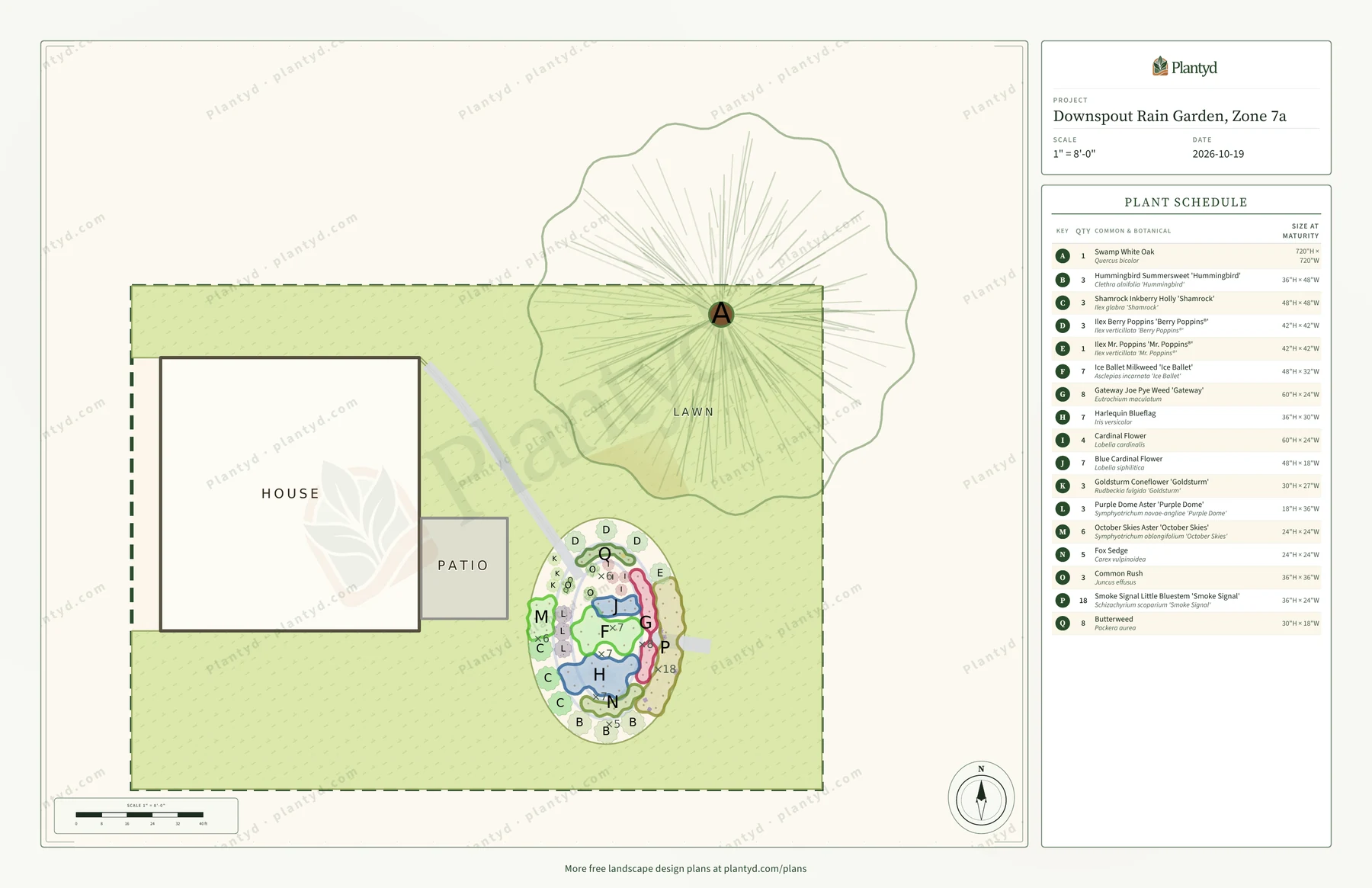
Size the garden from the roof, put it where the sun is, and fill each ring with plants that can stand the water it gets.
Common questions
How big should a rain garden be?
Big enough to hold the first 1.25 inches of a storm from everything that drains into it. In New Jersey's manual, that works out to about one-fifth of the roof area on silty soil at 6 inches deep, about one-seventh on sandy soil at 8 inches deep, and close to half on clay at 3 inches deep, with sand and compost dug in. Measure the roof that drains to your downspout, then look up your size in the manual's table.
How far from the house should a rain garden be?
At least 10 feet from a house with a basement, so the water soaks in away from the foundation. Keep it out from under the outer edge of a big tree's branches, at least 25 feet from a septic system, and away from buried utility lines. Call 811 before you dig.
Does a rain garden attract mosquitoes?
Not if it drains. Mosquitoes need water that stands for several days to breed, and a rain garden should be empty within 24 hours of a storm. If yours still holds water the next evening, the soil there drains too slowly for that spot.
More plans like this
 Pollinator Garden Plan: An Island Bed That Flowers From April to November
 Prairie Garden Design: A Backyard Meadow You Plant in Modules
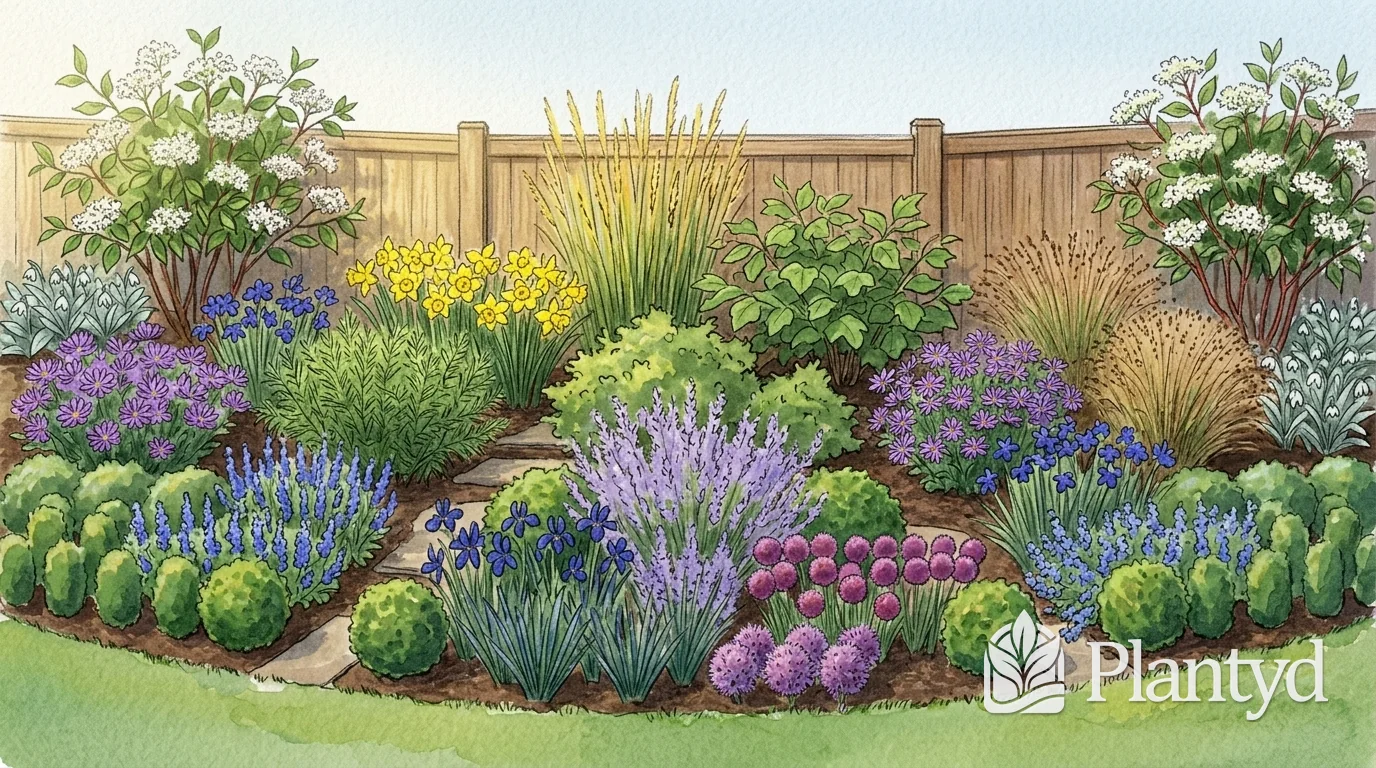 Perennial Garden Plan: A Four-Season Border Along a Fence
From the collection Native Plant Garden Design: Six Plans for Sun, Shade and Wet Ground
Find the sunny spot downhill of your downspout
Sign up, draw your house, your trees and the beds you have in mind to scale, and see which spot below the downspout still gets a full day of summer sun.
Start designing freeNo credit card required · Free tier is free forever