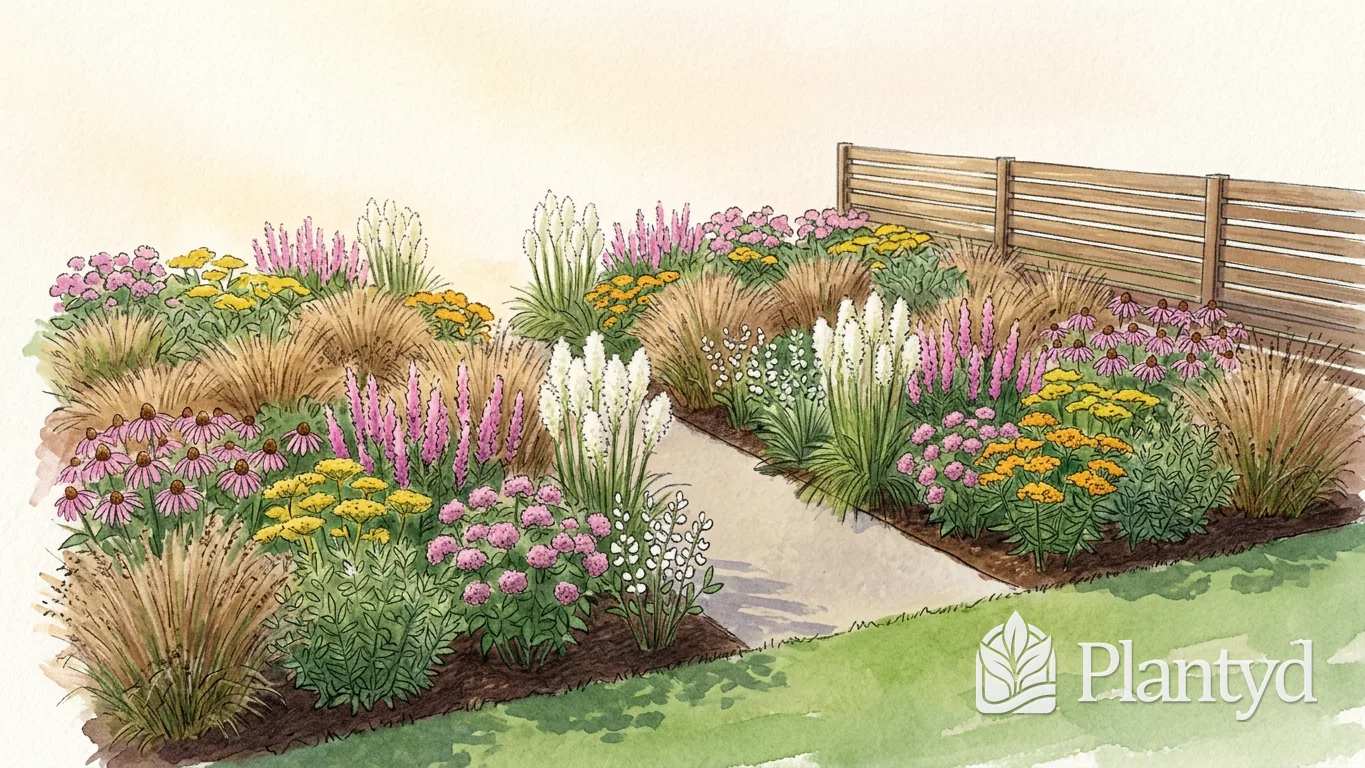
Most backyard meadows start with a packet of wildflower seed. By the second July, the back of the yard is foxtail and ragweed, with a few coneflowers holding out somewhere in the middle. The flowers were never the problem. The bare ground between them was. A prairie is mostly grass, and the grass is what keeps the weeds out. If you plant only the flowers and leave bare soil around them, the weeds move into the gaps before anything else can.
This prairie garden design starts with the grass instead. It is for a sunny backyard in Ames, Iowa, zone 5b, where two beds, each 20 by 36 feet, sit on either side of a mown path, starting 28 feet out from the house. One grass, prairie dropseed, covers about half the ground, and eight kinds of native flowers grow in it in drifts. They open in turn, from yellow golden alexanders in May to sky-blue asters in September, and the grass and seed heads stand through the winter. The whole meadow is one small pattern planted six times, so you can stake it out with string and a tape measure.
We drew the plan as a real project in Plantyd and used Plantyd's sun analysis to check every spot in it. The analysis showed that the side fences, not the house, take the most sun from the meadow, so wild bergamot, which can take a little shade, grows along the fences. You can download both pages of the plan near the bottom of the page.
| Yard | 57 feet wide; the meadow starts 28 feet out from the back of the house |
|---|---|
| Meadow | Two beds, each 20 by 36 feet, either side of a 5-foot mown path |
| Where | Ames, Iowa, USDA zone 5b |
| Sun | Full sun. Every plant gets nine and a half hours or more of direct sun at midsummer |
| Built for | A backyard meadow you can walk through, planted from plugs |
| Plants | 9 kinds, 444 plants, all native to Iowa |
| Pattern | One 20 by 12 foot module, planted six times |
| Upkeep | Weed and water the first summer. After that, one cutback in late winter and a mower on the path |
The meadow gets full sun, and the fences shade its edges a little
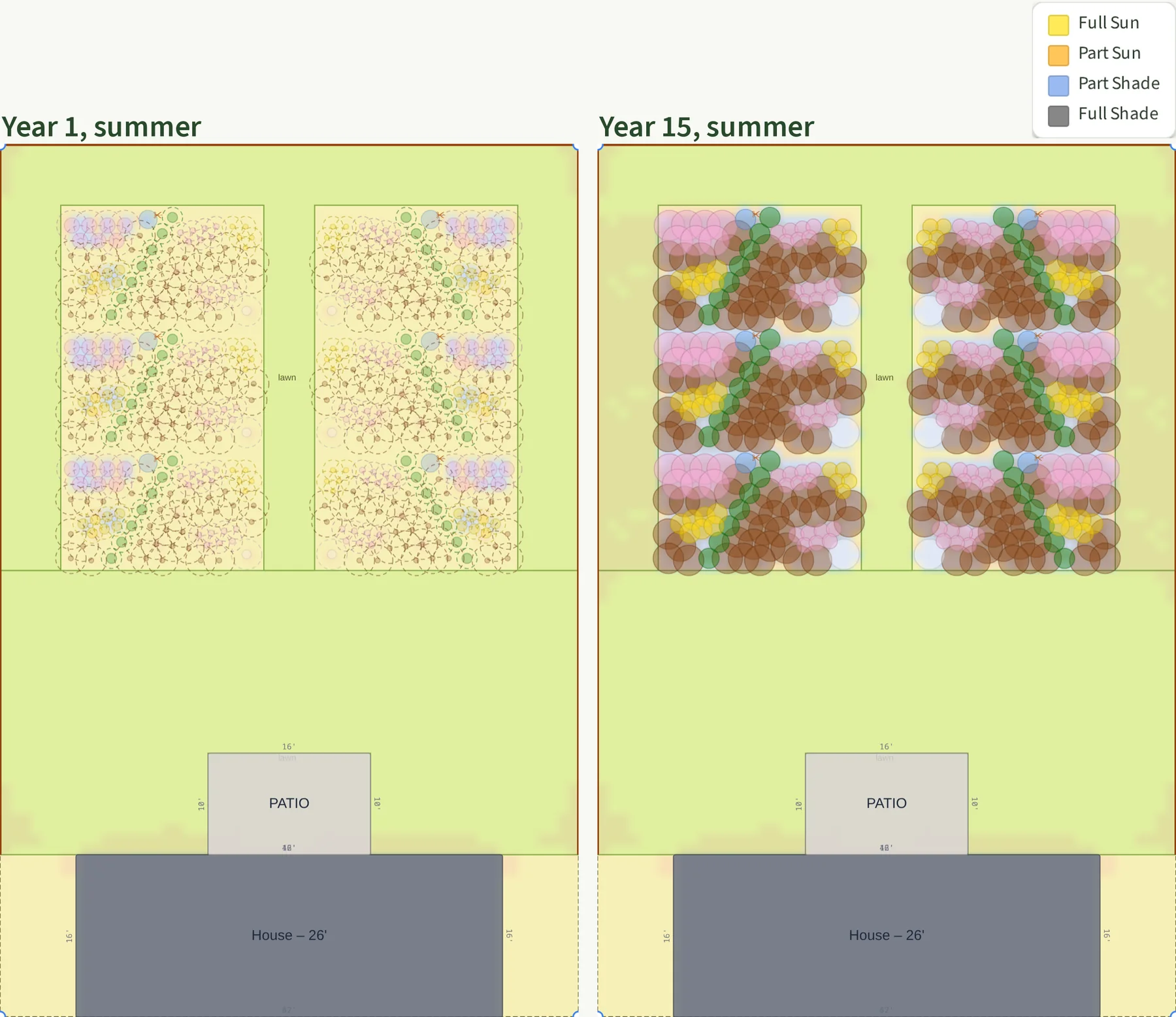
A prairie needs all the sun it can get. This backyard runs north from the house, so you might expect the house to shade the meadow. It doesn't. On Plantyd's midsummer map, the lawn just past the patio already gets full sun. The meadow begins 28 feet out, and nothing in it gets less than nine and a half hours of direct sun.
The six-foot fences take more sun than the house does. Plants seven feet from a side fence get about two and a half hours less than plants in the middle of a bed, which still leaves them plenty. Even so, the fence side of each bed gets wild bergamot, which can take a little shade. The east bed is a mirror image of the west bed, so its bergamot ends up by a fence too. Your fences and trees will be different, so find your own numbers with how much sun your yard gets.
One grass covers half the ground
Prairie dropseed is the matrix, the one grass planted through every gap between the drifts. It makes up 192 of the 444 plants. It grows as fine green fountains about two feet tall. In August it sends up an airy haze of flowers with a scent people compare to popcorn or cilantro. In fall it turns orange-gold, and it stands tan through the snow. It grows in clumps and doesn't spread, so the drifts stay where you put them.
The flowers go into the grass in ovals of five to seven plants, one kind to each oval. A drift that size shows up as a patch of color from the patio. On the plan sheet, each drift has one outline and one count, so you can see what you're buying. Single plants dotted all over can look wild in a photo, but in a backyard they just look messy.
Plant one 20 by 12 foot module six times
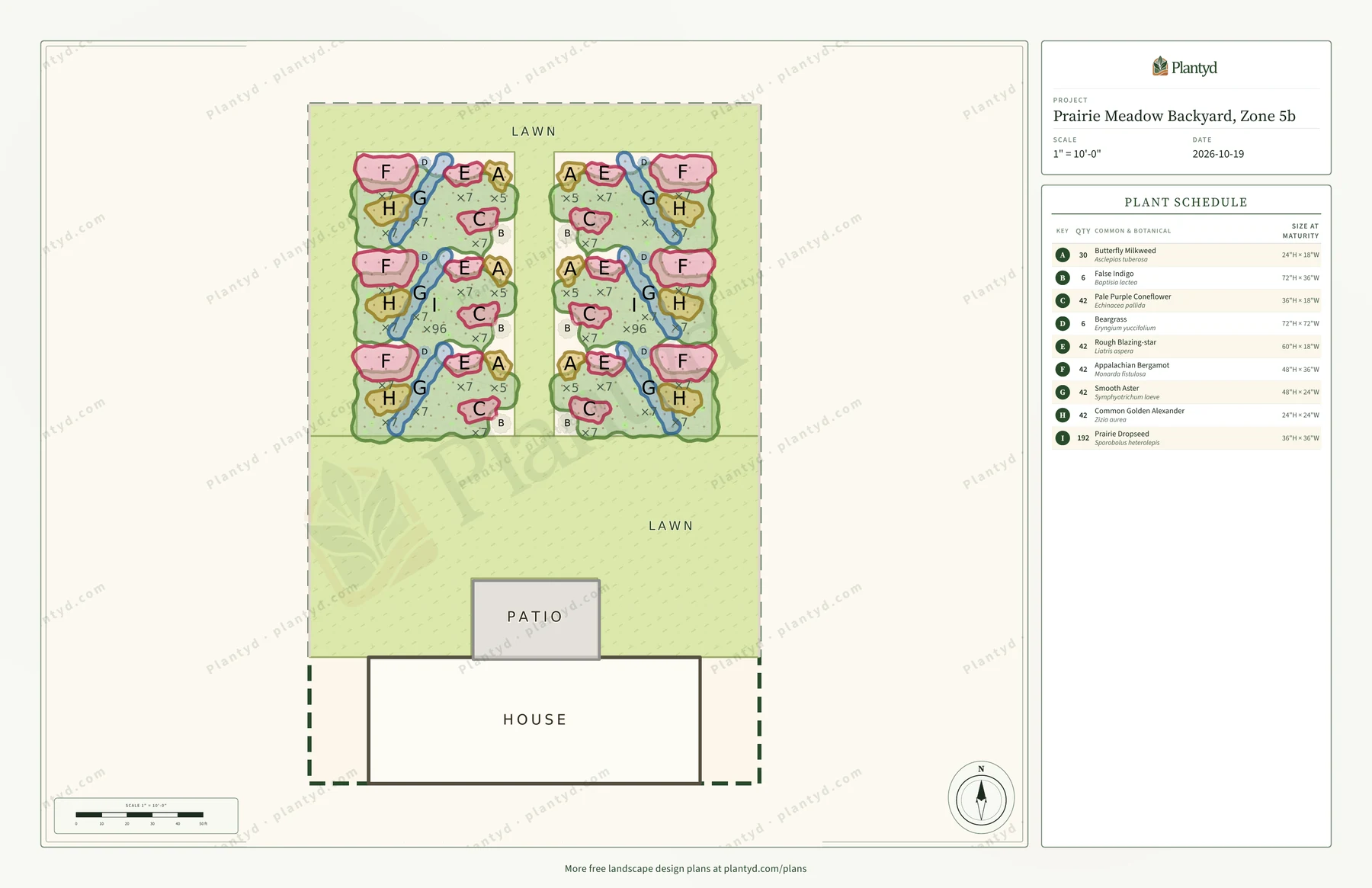
Each bed is 20 feet wide and 36 feet deep, which is three modules end to end. Here is one module as it sits in the west bed, with the side fence on the left and the path on the right:
- Seven wild bergamot across the top left, with seven golden alexanders below them.
- A line of seven smooth blue asters running from the bottom left up toward the top middle.
- One rattlesnake master beside the top of that line, seven rough blazing star to its right, and five butterfly milkweed by the path.
- Seven pale purple coneflowers at the bottom right, with one white wild indigo at the corner by the path.
- 32 prairie dropseed everywhere else, including an open patch in the middle.
That makes 74 plants. Lay out a 20 by 12 foot rectangle with string. Set the drifts and the two single plants first, then fill every gap with dropseed about 19 inches apart. In the east bed, flip the module left to right. Our guide to how far apart to plant covers how to space the plants in a drift.
The meadow takes three summers to fill in
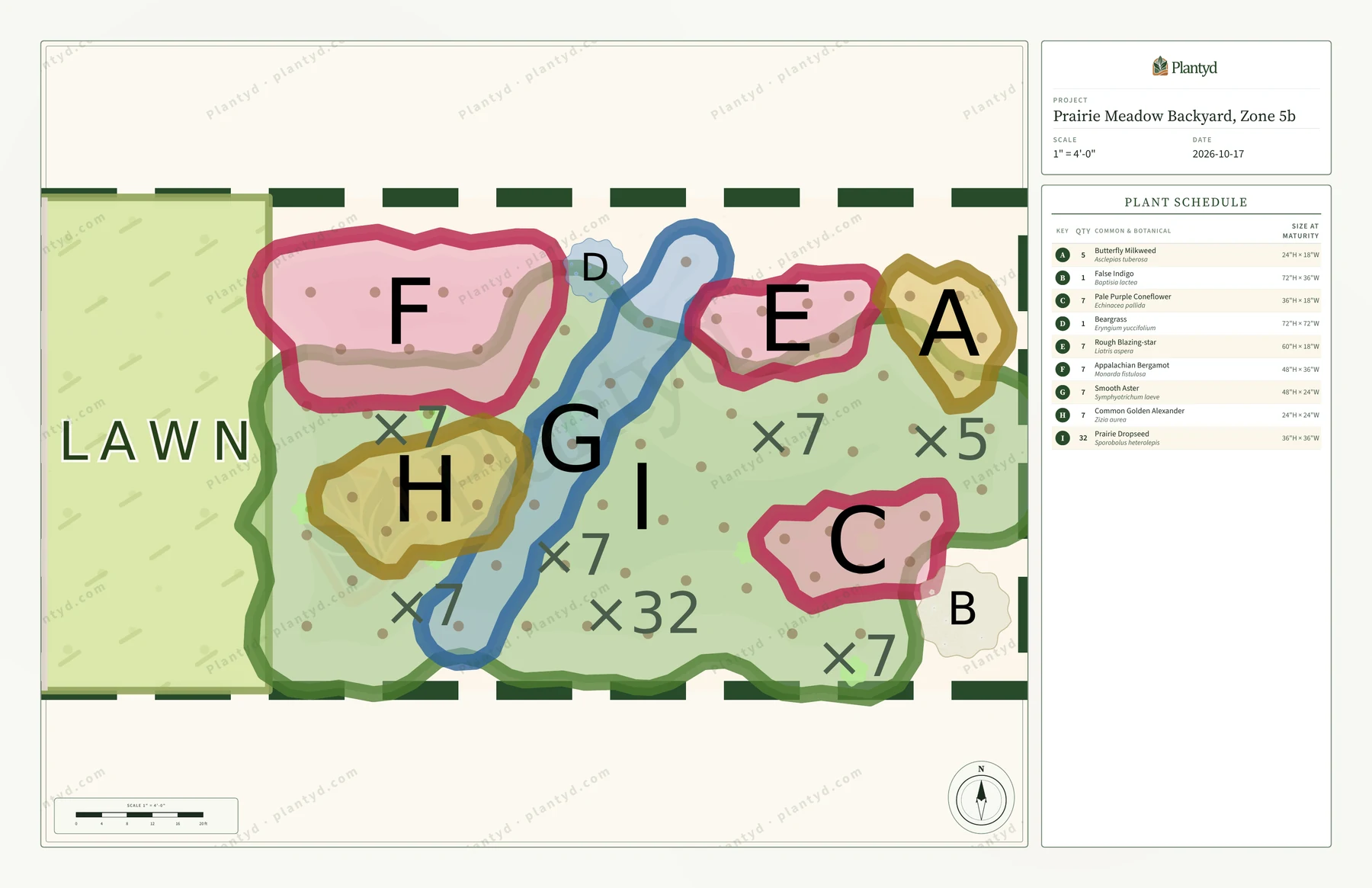
Prairie gardeners have a saying: the first year it sleeps, the second year it creeps, and the third year it leaps. Drawn at their expected sizes, the plants in this plan cover about a third of the beds in year one, and the beds are mostly closed by year three.
The first summer, water the plugs until they root in. Pull or trim the weeds every couple of weeks, before they set seed. Expect few flowers that year. The dropseed in particular puts its effort into roots.
By years three to five, the grass clumps are about two feet across. Bergamot spreads, so dig out its edges to keep it in its patch. The coneflowers will drop a few seedlings into the grass. White wild indigo takes the longest to reach full size, often several years.
Cut it back once, in late winter
Leave everything standing through fall and winter. Goldfinches feed on the coneflower cones, the indigo pods rattle in the wind, and the dropseed and rattlesnake master stand up through the snow.
In March or early April, before the new shoots show, cut everything down with a string trimmer or hedge shears. Leave a foot or so of stubble, because native bees nest in the hollow stems. That is the one big job of the year.
For a few weeks afterward, the beds are short green tufts, and golden alexanders are the only flowers until June. Keep the path and the strips along the fences mown at lawn height all summer. The path is also how you get in to pull the odd thistle.
Change the size and the plants to suit your yard
For a smaller yard, plant fewer modules. One bed of three modules, 20 by 36 feet, is still a meadow, and a single module makes a good bed on its own. For a bigger yard, add modules. If you want more kinds of plants, swap within a drift: purple prairie clover for the blazing star, or aromatic aster for the golden alexanders if fall matters more to you than May.
A zone colder or warmer than Ames won't hurt. Plantyd rates every plant here hardy from at least zone 4a to 8b. Farther from Iowa, look up each plant's native range. Where one of these plants isn't native to your state, use a local plant of the same height that flowers in the same season.
Deer will taste some of it. Rutgers' list of plants rated for deer damage rates butterfly weed as seldom severely damaged, and gives blazing stars and asters, as groups, the same rating. According to the University of Wisconsin Extension's page on rattlesnake master, deer and rabbits don't favor it.
The plant list: nine kinds and 444 plugs, 192 of them dropseed
Every plant here is native to Iowa. The letters match both pages of the PDF. Nursery labels go by the botanical names in the list.
| Key | Qty | Plant | Size at maturity | Its job in the plan |
|---|---|---|---|---|
| A | 30 | Butterfly milkweed Asclepias tuberosa | 2 ft tall, 18 in wide | Orange in June and July, at the path end of each module. The monarch's host plant |
| B | 6 | White wild indigo Baptisia lactea | 4 ft tall, 3 ft wide | Scatter plant, one per module. White spires in June, black pods all winter |
| C | 42 | Pale purple coneflower Echinacea pallida | 3 ft tall, 18 in wide | Drooping pink petals in early summer, black cones for goldfinches |
| D | 6 | Rattlesnake master Eryngium yuccifolium | 4 ft tall, 2 ft wide | Scatter plant, one per module. White globes in late summer that stand through snow |
| E | 42 | Rough blazing star Liatris aspera | 3 ft tall, 18 in wide | Purple button spikes in August, busy with monarchs |
| F | 42 | Wild bergamot Monarda fistulosa | 4 ft tall, 3 ft wide | Lavender in July, on the fence side, where it can take a little less sun |
| G | 42 | Smooth blue aster Symphyotrichum laeve | 4 ft tall, 2 ft wide | The diagonal line through each module, sky blue in September |
| H | 42 | Golden alexanders Zizia aurea | 2 ft tall, 2 ft wide | The first flowers, yellow in May and June |
| I | 192 | Prairie dropseed Sporobolus heterolepis | 3 ft tall, 3 ft wide | The matrix: fine fountains of grass on about half the ground, orange in fall |
Plant the grass along with the flowers and give it three summers, and the ground between the coneflowers will belong to the dropseed instead of the weeds.
Common questions
What is matrix planting?
It means planting one or two grasses across half or more of a bed as a living groundcover, then setting flowering perennials into it in groups. The grass fills the gaps that weeds would otherwise take, and it holds the look of the planting together when the flowers are over.
How far apart should I plant prairie plugs?
Plant them close enough that neighboring plants touch within two or three summers. This plan puts prairie dropseed about 19 inches apart and the flowers 13 to 23 inches apart, depending on how wide each kind grows. Planting closer gives you faster cover, but you have more plants to buy.
When should I cut back a prairie garden?
Cut it back in late winter or early spring, before the new shoots come up. Leave it standing through the winter for the seed heads, the birds and the insects sheltering in the stems. Then cut it down with a string trimmer, and leave a foot or so of stubble for the bees that nest in the hollow stems.
More plans like this
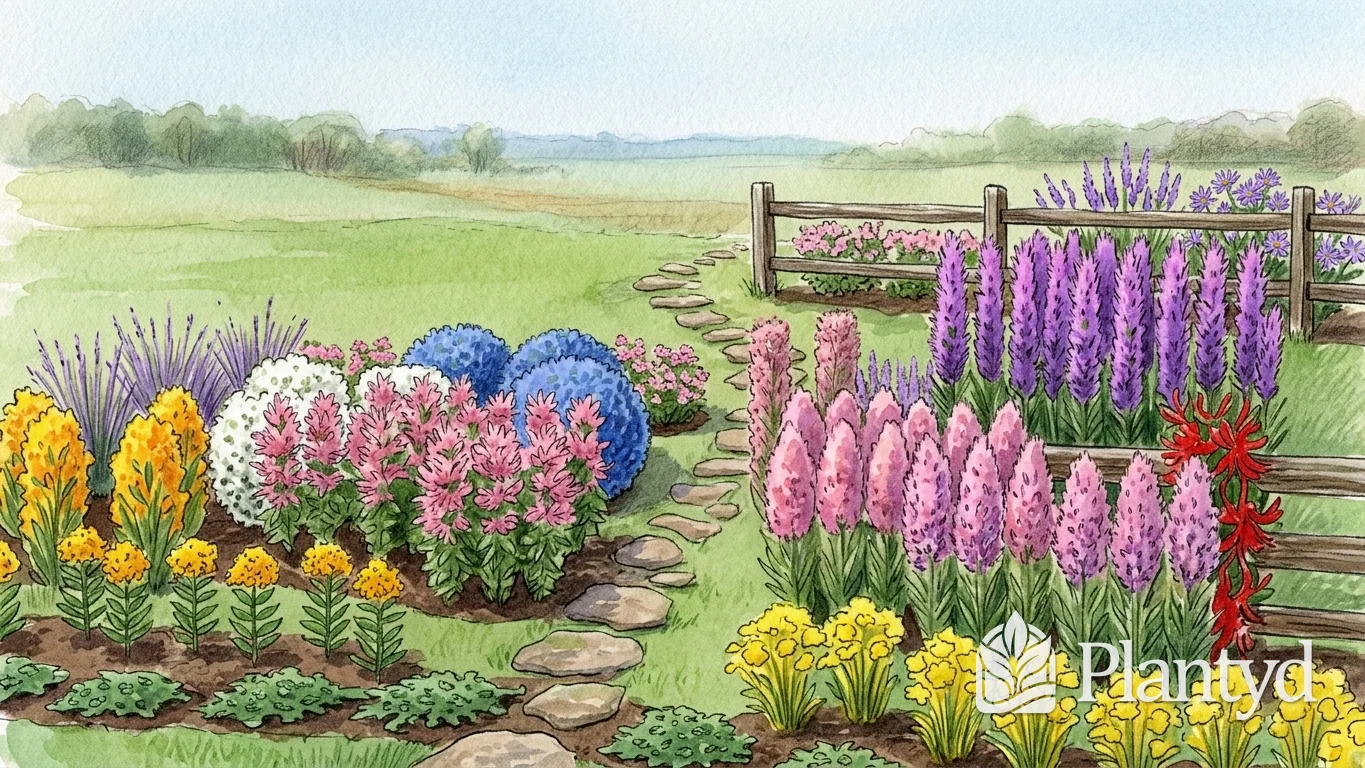 Pollinator Garden Plan: An Island Bed That Flowers From April to November
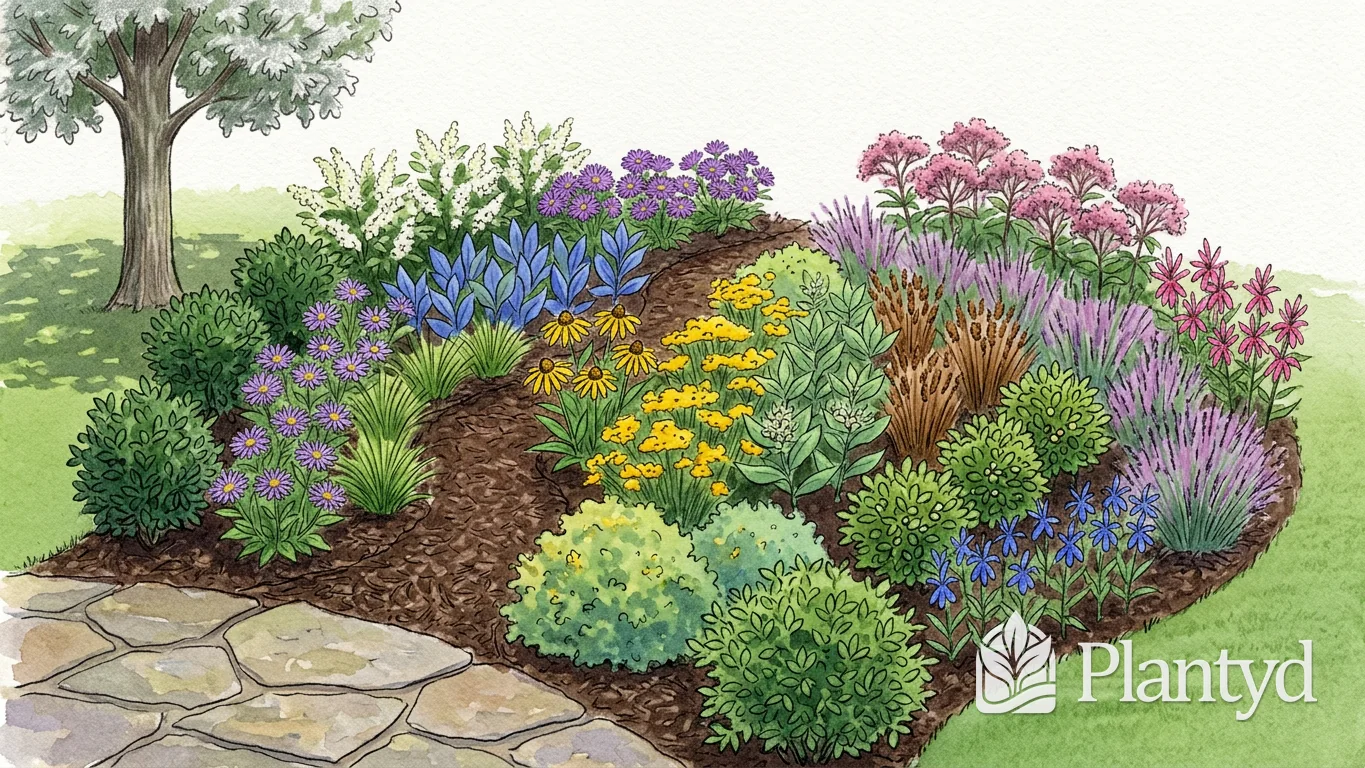 Rain Garden Design: Sized to One Downspout
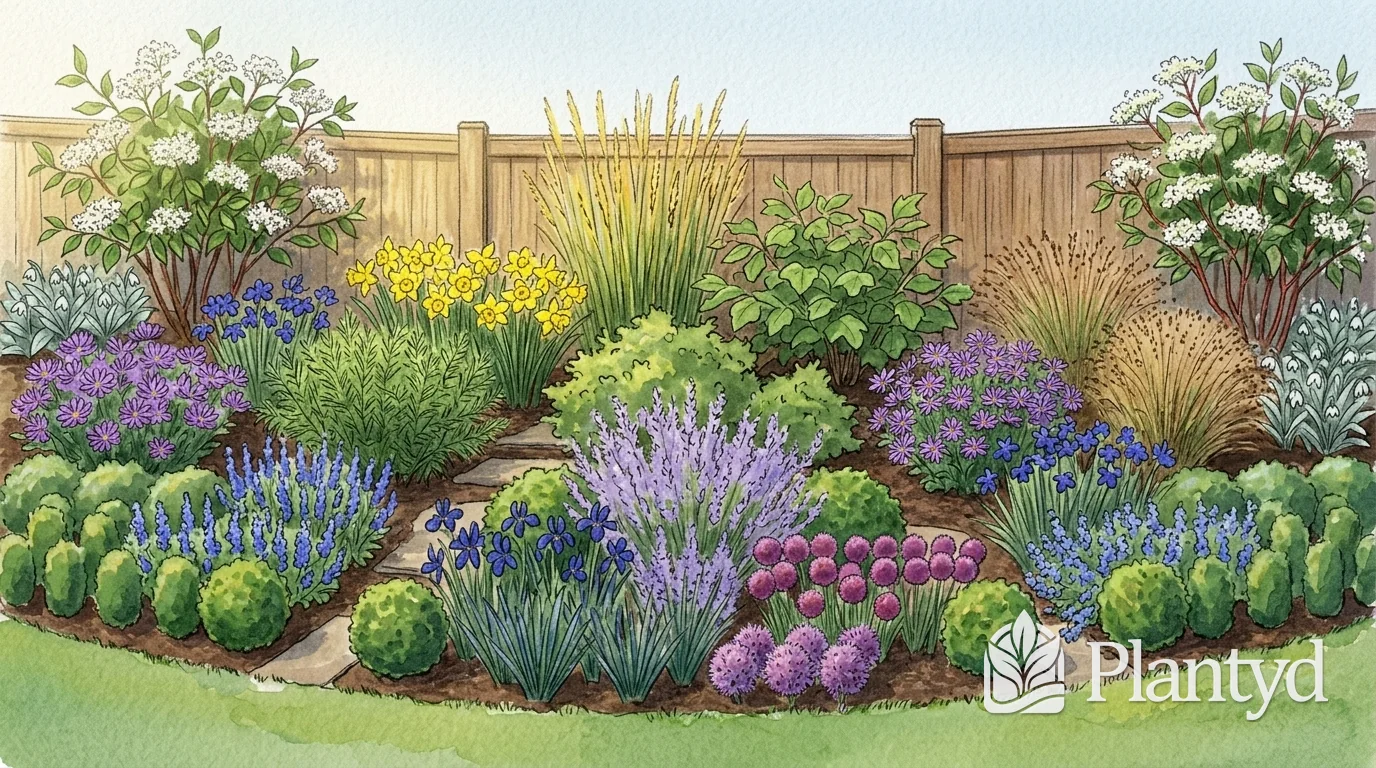 Perennial Garden Plan: A Four-Season Border Along a Fence
From the collection Native Plant Garden Design: Six Plans for Sun, Shade and Wet Ground
See where the sun lands in your backyard
Draw your house and back fences over a satellite photo of your yard, and Plantyd works out the summer sun on the patch you're eyeing, before you spend anything on plugs.
Start designing freeNo credit card required · Free tier is free forever