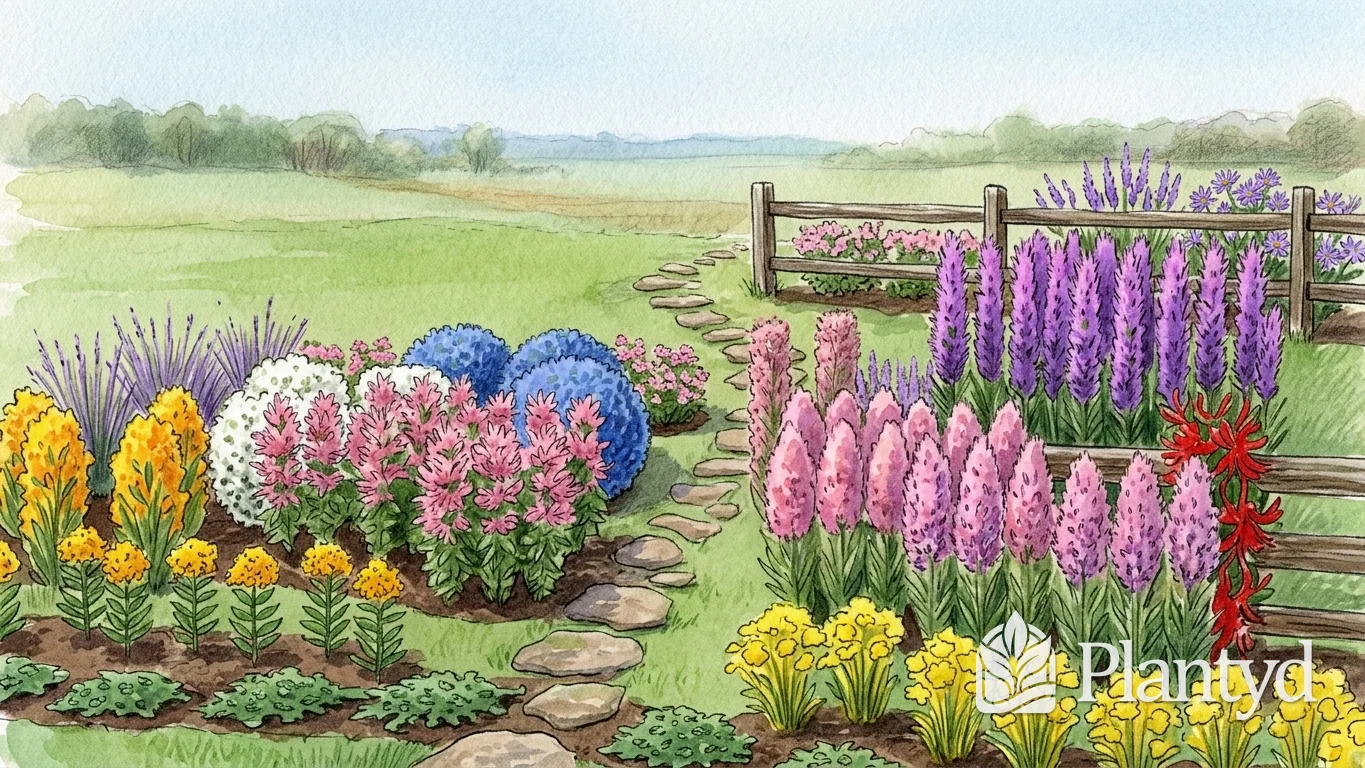
When you plan a pollinator bed, the obvious place for it is the sunny lawn just past the patio, close enough to watch the bees from a chair. In June that spot gets sun from breakfast to dinner, and a bed right off the flagstones looks like the natural choice. June is the easy month, though. By early fall, when the asters and goldenrod are feeding the last bees of the year, the house's shadow takes part of the day from the ground nearest the house.
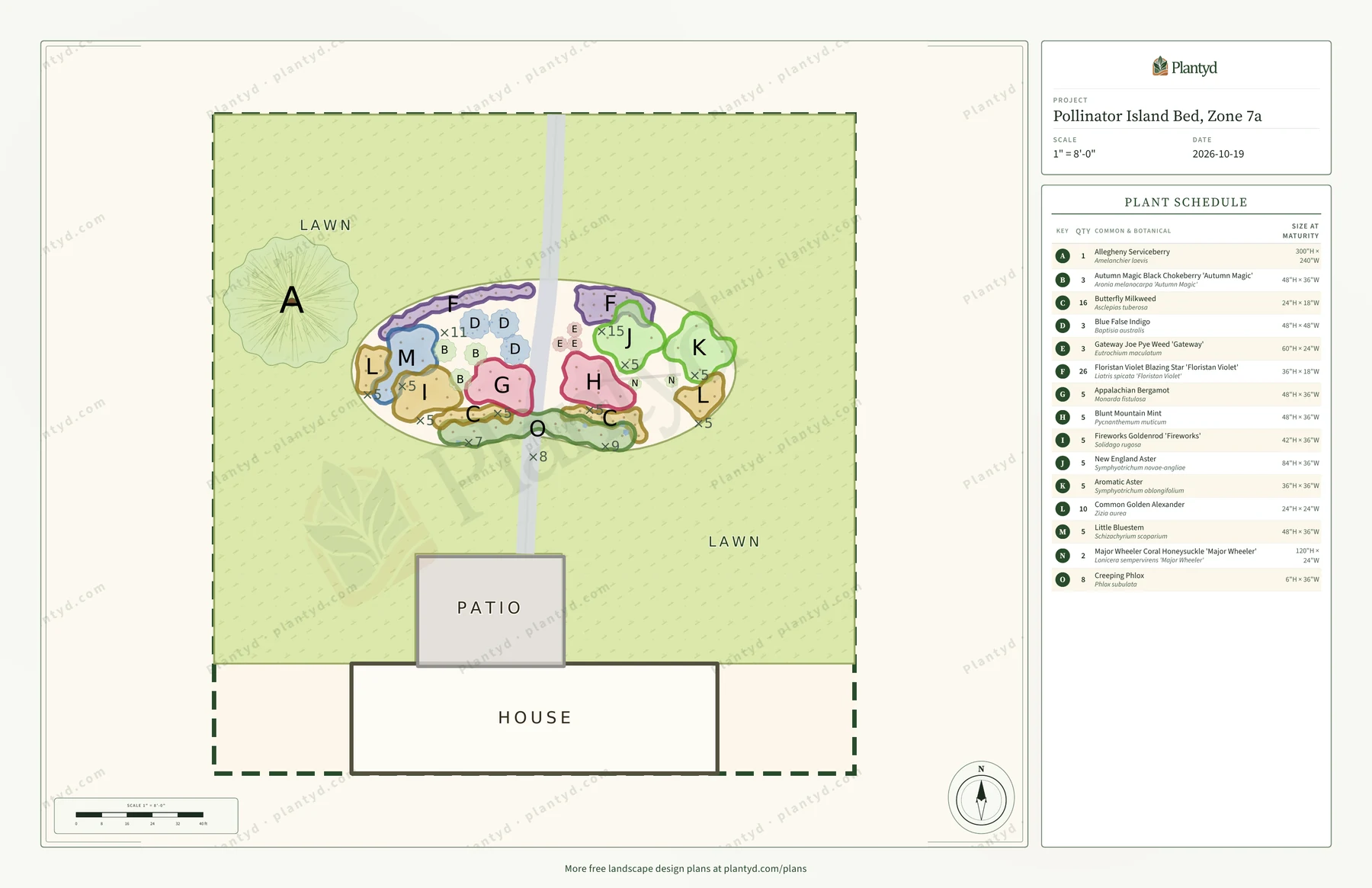
This pollinator garden plan is for a back lawn 70 feet wide behind a two-story house in Lancaster, Pennsylvania, in zone 7a. The bed is a kidney-shaped island, 42 feet long and 19 feet deep, set in open lawn twenty-three feet from the house, so you see it from every side. A line of stepping stones runs from the patio through the middle of the bed. All fifteen kinds of plants are native to the eastern US, and each one goes in as a group a bee can work. Something is in flower from April to November, and some of the plants are there to feed caterpillars.
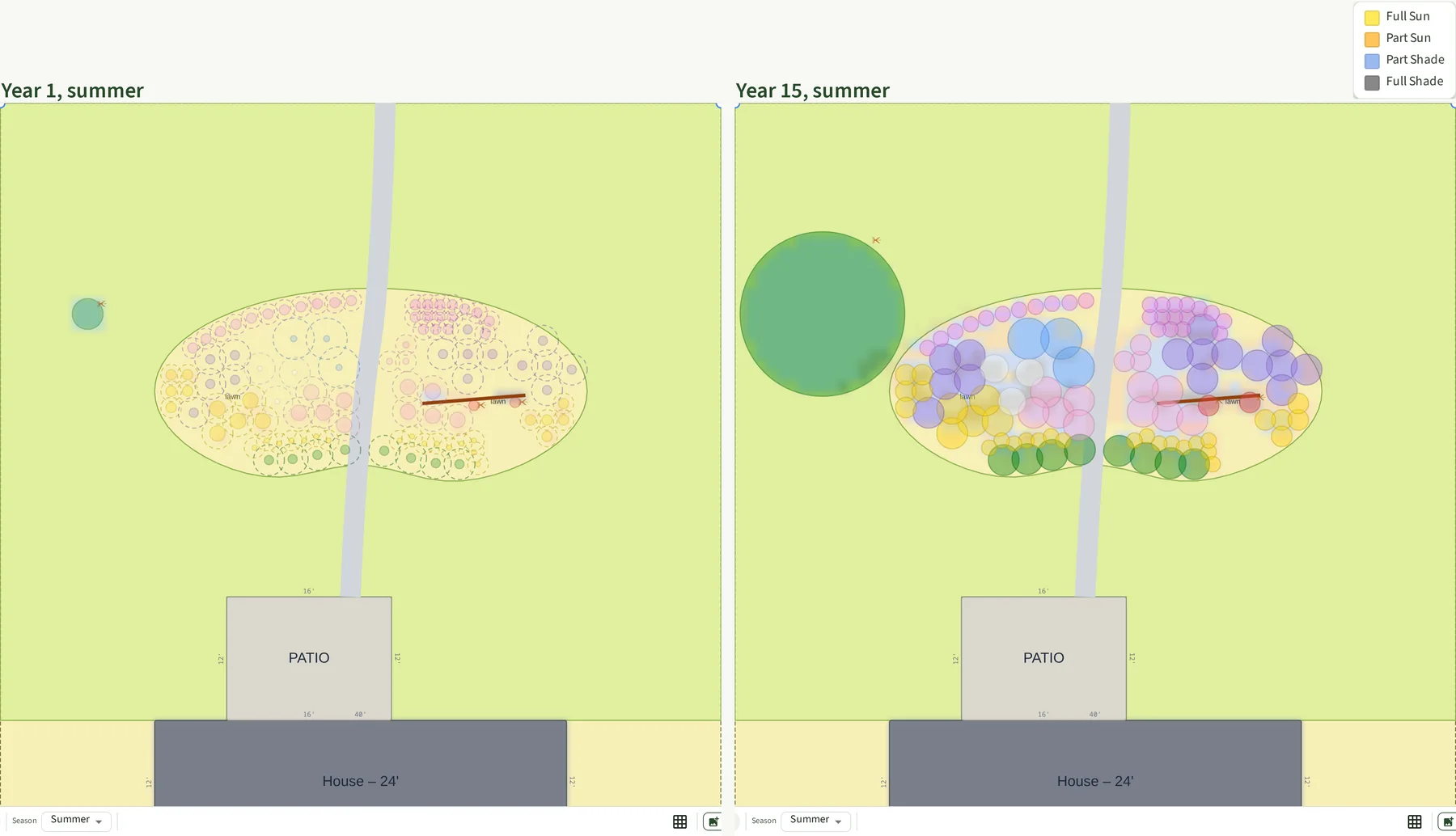
We set the yard up in Plantyd with just the house and the patio, and read the sun on the empty grass before we drew any bed. In midsummer the house's shadow never gets past the patio. On an early fall day, though, ground nineteen feet out loses about a third of its day to that shadow, while from twenty-two feet out the lawn keeps the whole day. That is why the island starts twenty-three feet from the house. You can download the plan sheet further down the page.
| Yard | A back lawn 70 feet wide behind a two-story house, with a 16 by 12 foot patio at the back door |
|---|---|
| The bed | A kidney-shaped island 42 feet long and 19 feet deep, about 590 square feet, 23 feet out from the house |
| Where | Lancaster, Pennsylvania, USDA zone 7a |
| Sun | Full sun. Plantyd's sun analysis gives every plant at least seven and a half hours in midsummer at year 15 |
| Built for | Bees, butterflies and their caterpillars, in a bed you look at from the patio and from every side of the lawn |
| Plants | 15 kinds, 102 plants, all native to the eastern US |
| Paving | A line of stepping stones from the patio, through the bed, to the back of the lot |
| Upkeep | Cut back once, in late March. Edge the lawn line. Divide the mountain mint and bergamot when they wander |
The bed sits where the fall sun still reaches
Right against the patio is the natural place for a flower bed, but it costs you light in fall. At the patio's edge, Plantyd reads about six and a half hours of sun on an early fall day, compared with twelve and a half out in the open lawn. Early spring reads about half an hour less in both places, a few weeks before the moss phlox opens.
Twenty-three feet out, the house's shadow never reaches the island in spring, summer or fall. The stepping stones cross the twelve feet of lawn between the bed and the patio. You can still watch the bees from a chair, and you only have to walk a few steps to get closer.
Plantyd gives you the same reading for your own yard. You draw the house, the trees and the beds, and it counts the hours of direct sun on each spot, at planting and fifteen years later. Before you choose a spot, read how much sun your yard gets.
The tallest plants run down the middle of the island
"Tall at the back" is right for a border along a fence, but out in the lawn every side of the bed is the front. Here the tall plants run along the center line. Joe-pye weed stands beside the stones in the middle of the island, with New England asters behind a short split rail and mountain mint around the rail's west end. Across the stones, three chokeberries hold the middle of the west half. Wild indigo and bergamot grow by the stones, goldenrod to the south of them, and little bluestem toward the tip.
From the middle, every edge steps down. A band of blazing star, about three feet tall, runs along the north edge of both halves. Golden alexanders wrap around the west tip and the south side of the east tip, and aromatic aster fills the east tip. On the side facing the patio, butterfly weed stands behind an edging of moss phlox a few inches high, so from your chair you look over the low plants into the tall ones.
The split rail carries two coral honeysuckles for hummingbirds and gives the bed a line through winter. Plantyd treats the rail as a solid fence, and in one early fall reading an aster planted just north of it got less than an hour of sun. The asters now stand two feet or more behind the rail, and the honeysuckle grows on its sunny south side. Plantyd still reads the nearest aster at a little over three hours on that fall day. A real split rail is mostly air, so your asters will get more.
The serviceberry stands in the lawn, not in the bed
The usual way to anchor an island bed is a small tree at each end. We built it that way first, with a serviceberry at the west tip and a blackhaw viburnum at the east. When we moved the timeline to year fifteen, Plantyd put 30 of the 102 plants below the sun their catalog listing asks for. The chokeberries were down to less than two hours.
So the blackhaw came out, and the serviceberry moved into the lawn, about nine feet off the west tip. Its canopy stops just short of the bed, and most of its shade falls on grass. At year fifteen, every plant in the bed now gets the sun it needs. The little bluestem nearest the tree gets eight to eleven hours instead of two.
The tree still does its jobs. It flowers in April, when little else is open, it has berries for birds in June, and its leaves feed caterpillars. For spacing a tree beside a bed, see how far apart to plant trees and shrubs.
Plant in groups of five, not one of everything
A bee on a foraging trip tends to stay with one kind of flower, so a group it can work from plant to plant is worth more than single plants scattered around. Every small perennial here goes in as a group of five or more. The blazing star goes in two long drifts on the north edge, the butterfly weed and golden alexanders go in two drifts each, and the rest go in fives. The big plants come in threes, because three wild indigos already make a mass eight feet across.
The groups make the plan easier to read, too. On the plan sheet, each group is a single outlined drift with one letter. In the yard, five of a kind looks planned, which counts for something when the neighbors' yards are all mown lawn.
Something is in flower every month from April to November
Moss phlox and the serviceberry start in April. Golden alexanders, chokeberry and wild indigo flower in May. Butterfly weed and the honeysuckle carry on into summer, and in July and August the bergamot, mountain mint, blazing star and Joe-pye weed all flower together.
Goldenrod and New England aster carry September, and aromatic aster keeps going until hard frost, often into November. In every season, something is in flower in both halves of the bed.
Some of the plants are there for caterpillars. Monarch caterpillars eat the butterfly weed, and black swallowtail caterpillars eat the golden alexanders. Wild indigo feeds a small dark skipper named after it, the wild indigo duskywing. The asters feed pearl crescents, and little bluestem feeds several grass skippers. Chewed leaves mean the bed is doing its job.
Mark the butterfly weed, then give the bed three summers
In the first summer the bed is mostly mulch, and Plantyd's view at year one shows small dots with a lot of bare ground between them. Butterfly weed is slow. It comes up late in spring and often doesn't flower properly until its second year, so mark where it is. Don't add plants to fill the gaps.
By the third summer the drifts have filled in. Wild indigo takes about that long to look like a shrub, and then it stays put for decades. From year four, dig out the edges of the mountain mint and bergamot where they push into their neighbors. By year fifteen the serviceberry is full grown, and Plantyd still shows its shade landing on the lawn.
On a small lot, build the west half
Nothing on the list needs swapping in zone 6 or zone 8, because all fifteen plants are hardy from zone 5 to zone 8. For a smaller lot, build the west half alone, about 290 square feet. It keeps the stones as its edge and flowers from April to October. Its only fall flower is the goldenrod, though, so add a few aromatic asters at its tip.
There is no butterfly bush anywhere in the plan. Joe-pye weed, bergamot, mountain mint and blazing star carry midsummer instead.
If deer come through, check Rutgers' deer-resistance ratings. Wild indigo and little bluestem are rarely damaged. The serviceberry, asters, blazing star, goldenrod and butterfly weed are seldom badly damaged. Wild bergamot isn't listed, but its cousin bee balm is also rated seldom badly damaged. Phlox is occasionally damaged badly, so expect some nibbling on the moss phlox edging. The list doesn't rate mountain mint, Joe-pye weed, golden alexanders, black chokeberry or coral honeysuckle.
Buy the plants by their botanical names
All fifteen plants are native to the eastern US. A nursery tag that says "blazing star" or "goldenrod" can mean several different plants, so shop by the botanical names in the list. Blue wild indigo is a threatened species in the wild in Pennsylvania, so buy plants a nursery has grown, not plants dug from the wild.
| Key | Qty | Plant | Size at maturity | Its job in the plan |
|---|---|---|---|---|
| A | 1 | Allegheny serviceberry Amelanchier laevis | 25 ft tall, 20 ft wide | In the lawn off the west tip. White flowers in April, berries in June, leaves for many moth caterpillars |
| B | 3 | Black chokeberry 'Autumn Magic' Aronia melanocarpa 'Autumn Magic' | 4 ft tall, 3 ft wide | The middle of the west half. White flowers in May, black fruit, red fall leaves |
| C | 16 | Butterfly weed Asclepias tuberosa | 2 ft tall, 18 in wide | Two drifts behind the moss phlox, facing the patio. Orange in early summer; monarch caterpillars eat it |
| D | 3 | Blue wild indigo Baptisia australis | 4 ft tall, 4 ft wide | By the stones on the north side of the west half. Blue spikes for bumblebees in late spring; food for wild indigo duskywing caterpillars |
| E | 3 | Joe-pye weed 'Gateway' Eutrochium maculatum 'Gateway' | 5 ft tall, 2 ft wide | The middle of the island, by the stones. Mauve domes in midsummer |
| F | 26 | Dense blazing star 'Floristan Violet' Liatris spicata 'Floristan Violet' | 3 ft tall, 18 in wide | The north rim of both halves. Purple spikes in July and August |
| G | 5 | Wild bergamot Monarda fistulosa | 4 ft tall, 3 ft wide | By the stones, south of the wild indigo. Pale lilac pompoms in July, a bumblebee favorite |
| H | 5 | Blunt mountain mint Pycnanthemum muticum | 4 ft tall, 3 ft wide | Around the west end of the rail. Silver bracts from July into September, busy with wasps and small bees |
| I | 5 | Rough goldenrod 'Fireworks' Solidago rugosa 'Fireworks' | 3.5 ft tall, 3 ft wide | South-west of the chokeberries. Gold sprays in September and October |
| J | 5 | New England aster Symphyotrichum novae-angliae | 7 ft tall, 3 ft wide | North of the rail. Purple in September and October; pearl crescent caterpillars eat the leaves |
| K | 5 | Aromatic aster Symphyotrichum oblongifolium | 3 ft tall, 3 ft wide | The east tip. Violet asters from late September until hard frost |
| L | 10 | Golden alexanders Zizia aurea | 2 ft tall, 2 ft wide | Round the west tip and on the east tip's south side. Yellow in May; black swallowtail caterpillars eat it |
| M | 5 | Little bluestem Schizachyrium scoparium | 4 ft tall, 3 ft wide | Toward the west tip, inside the golden alexanders. Copper all winter; skipper caterpillars feed on it |
| N | 2 | Coral honeysuckle 'Major Wheeler' Lonicera sempervirens 'Major Wheeler' | 10 ft tall, 2 ft wide | On the split rail, trained along it. Red tubes for hummingbirds from late spring |
| O | 8 | Moss phlox Phlox subulata | 6 in tall, 3 ft wide | Rims the curve of the bed that faces the patio. The first flowers, in April |
The spot right by the patio looks perfect in June, but this bed goes where the sun still reaches it when the asters open in fall.
Common questions
How big should a pollinator garden be?
Any size helps, but plant each kind in a group, not one at a time. Five plants of one kind, covering a few feet, make a patch bees can work. This island is about 590 square feet.
What is the best layout for a pollinator garden?
Choose full sun, group the plants by kind, and have something in flower from early spring to late fall. In a bed you see from all sides, put the tallest plants down the middle and the shortest around the edge. Include a few plants that caterpillars eat, such as milkweed, golden alexanders and asters.
Should I cut back a pollinator garden in the fall?
Wait until late March. The seed heads feed birds over winter, and many insects spend the winter in the stems and leaf litter. When you cut back, leave the stems about a foot tall, because some native bees nest in them the following summer.
Does a pollinator garden need full sun?
Most pollinator plants flower best in full sun, which is six hours or more of direct sun a day. Golden alexanders, wild bergamot and New England aster also take some shade, so they suit the shadier edge of a yard. Check how many hours of sun your yard gets before you dig.
More plans like this
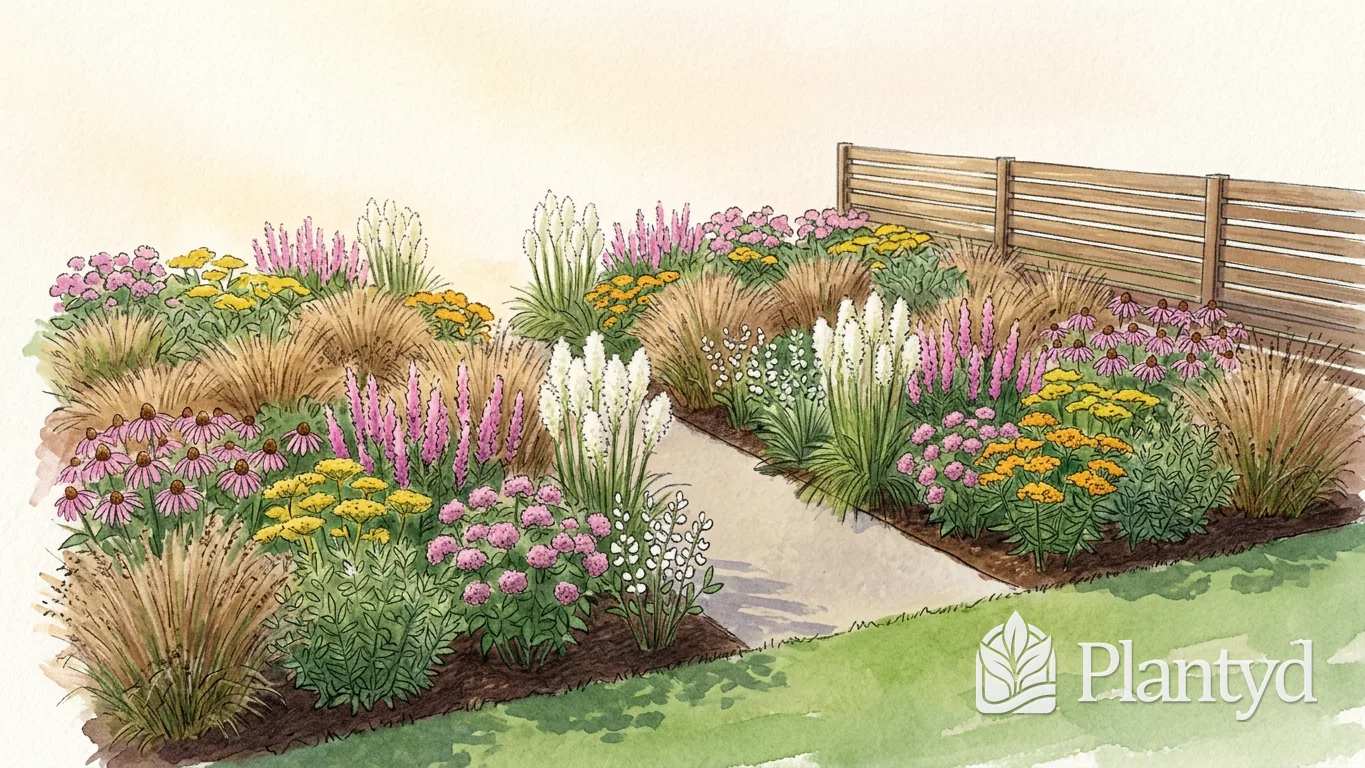 Prairie Garden Design: A Backyard Meadow You Plant in Modules
 Rain Garden Design: Sized to One Downspout
 Perennial Garden Plan: A Four-Season Border Along a Fence
From the collection Native Plant Garden Design: Six Plans for Sun, Shade and Wet Ground
Find out where a new tree's shade will land
Sign up, trace your yard and your house on its satellite photo, and see where a new tree's midsummer shade falls at year fifteen before you cut the first bed.
Start designing freeNo credit card required · Free tier is free forever