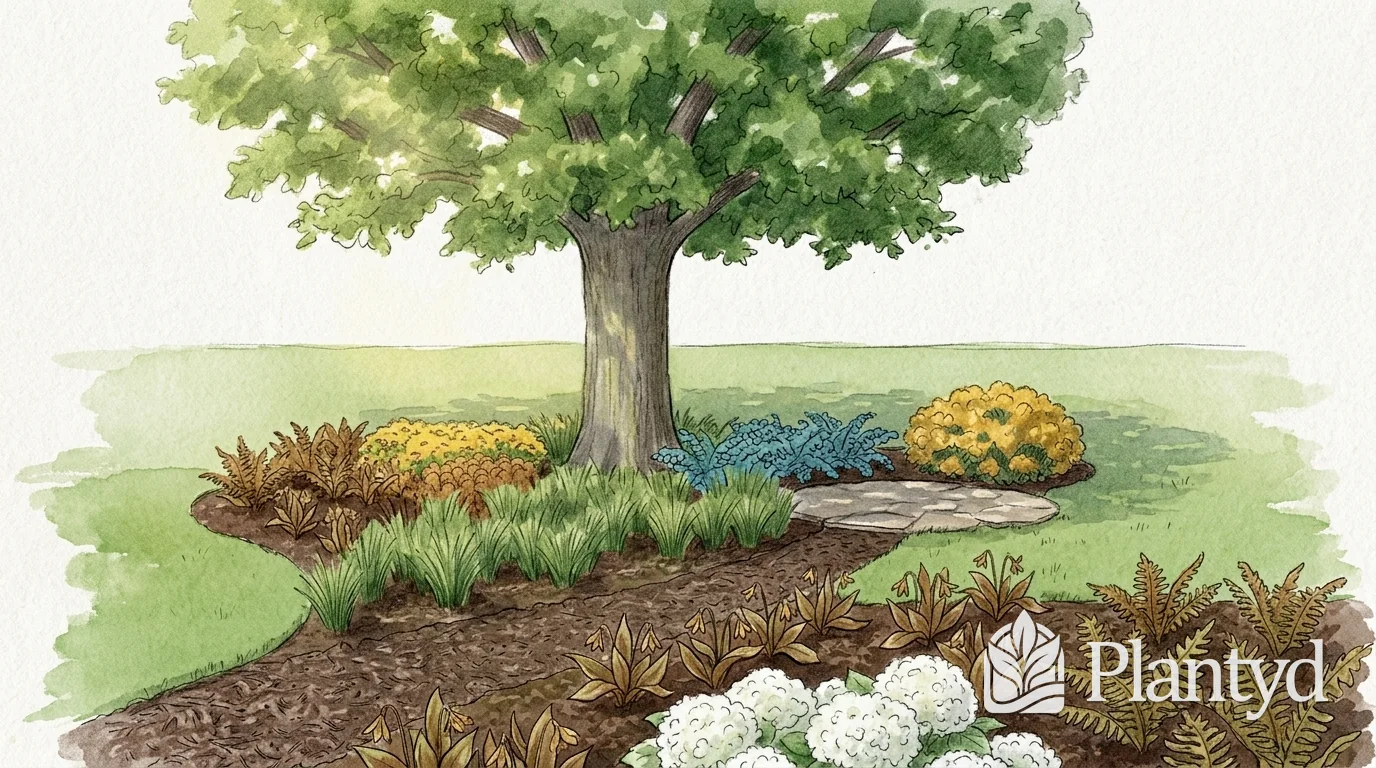
Under a big old oak, the grass usually gives up, and the ground around the trunk turns into a bare ring of brown leaves. From the kitchen window in January, you look out at a gray trunk over that ring. In July the same view is green and dim, and nothing in it makes you want to walk out there. Keep the oak. The trouble is what's under it.
This shade garden plan is for a back yard in Knoxville, Tennessee, zone 7b, where a white oak sixty feet tall stands thirty-six feet from the house. Plantyd puts the ground beneath it at about two hours of sun on a summer day. Ferns, sedges and a handful of woodland flowers grow well in that, but flowers alone won't give you a year of things to look at from the window. So the plan works from the kitchen window out, one season at a time. Evergreens are placed for the winter view, leaves do the work in summer, a spring show is timed for the weeks when the branches are bare, and a bench sits under the tree.
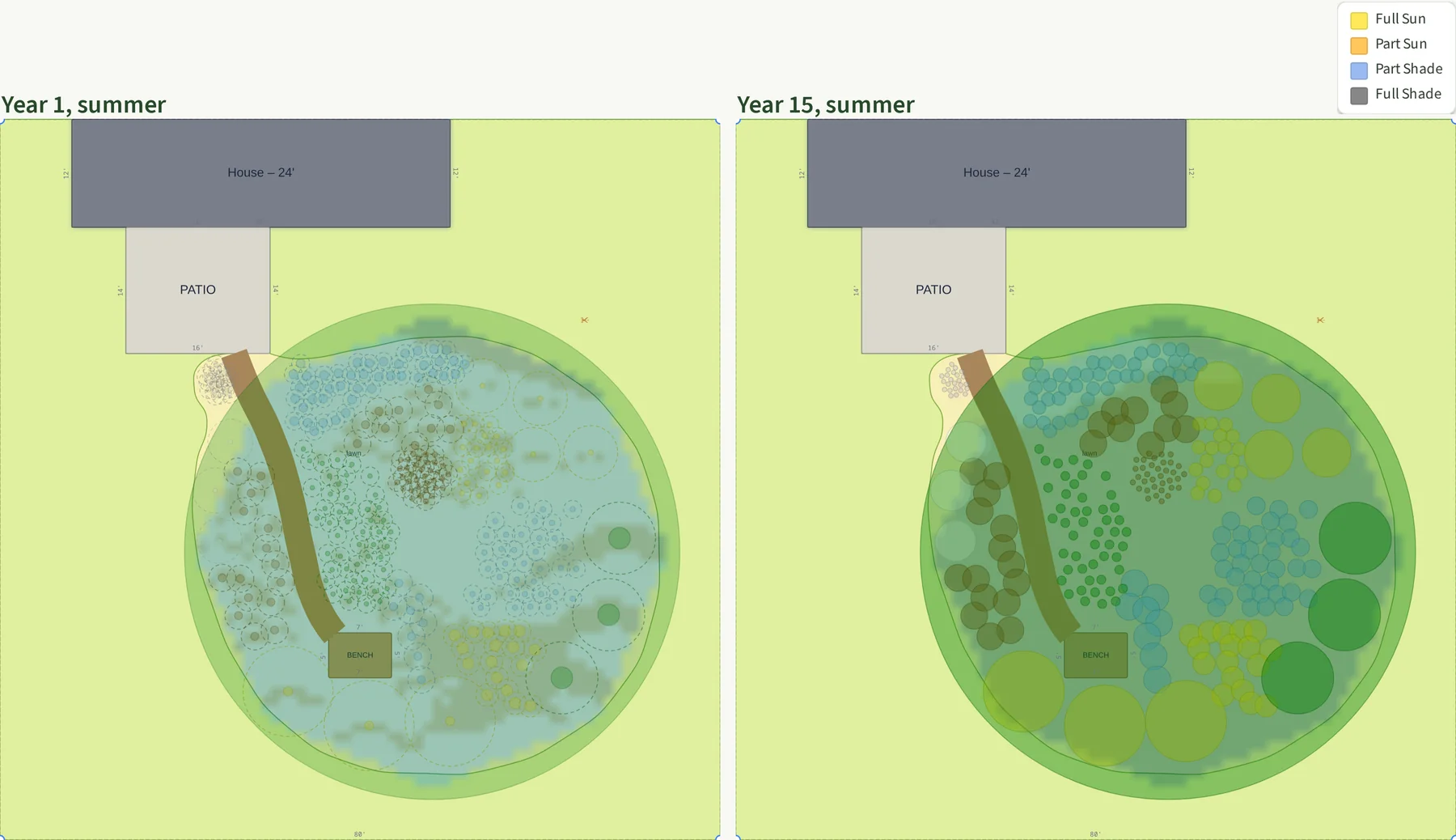
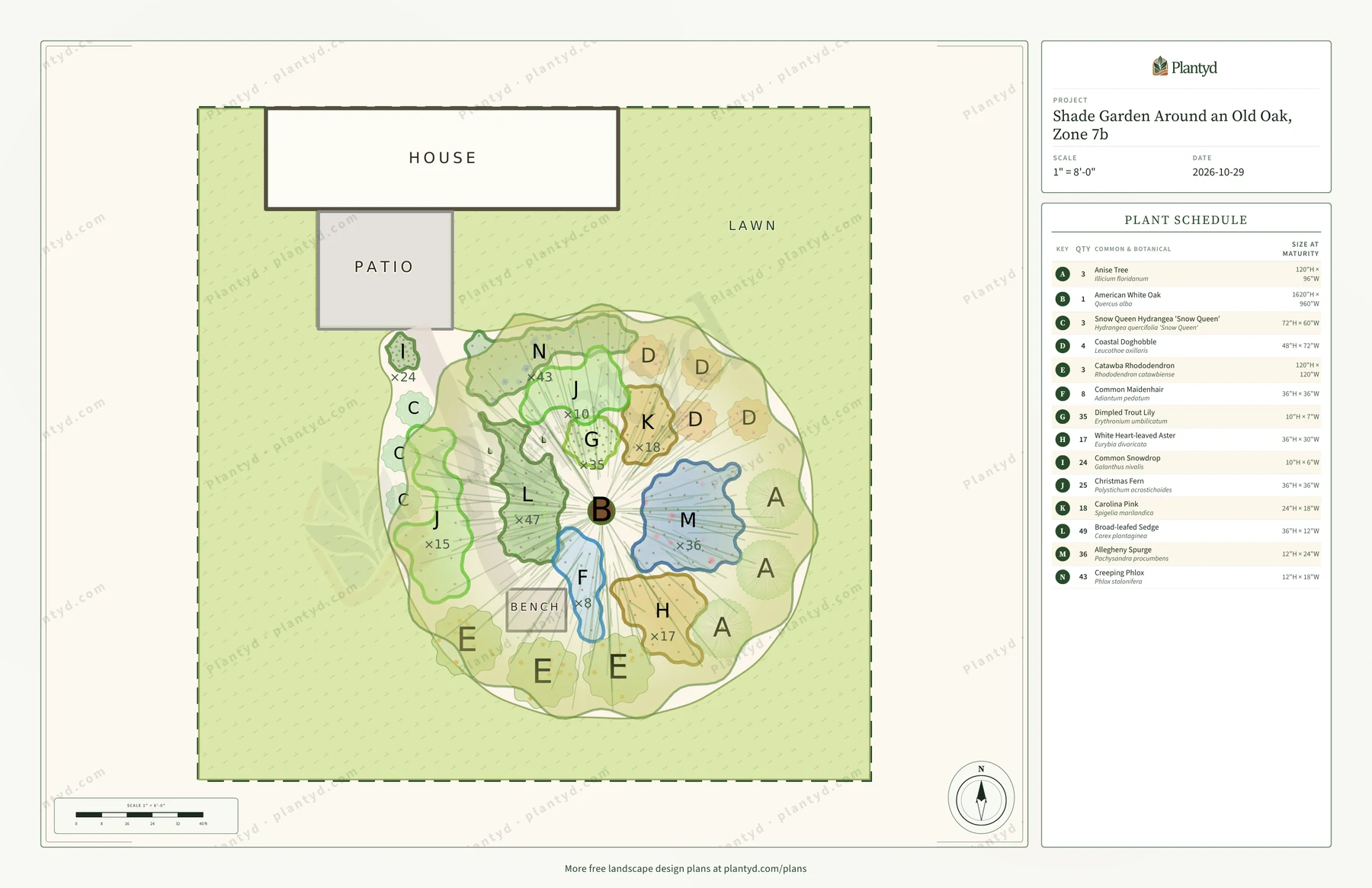
We built the plan as a real project in Plantyd and checked it with Plantyd's sun analysis, in the year you plant and at year fifteen. It showed the shade under the oak getting deeper as the shrubs grow, so every plant on the ground under the tree is one that takes full shade. The oakleaf hydrangeas, which want more light, sit on the rim of the oak's shade. You can download the plan sheet, drawn to scale, near the bottom of the page.
| Yard | 80 by 80 feet, with a bed of about 2,000 square feet around the tree |
|---|---|
| House | Two-story, with the back of the house and a flagstone patio facing south onto the yard |
| The tree | An existing white oak, 60 feet tall and 55 feet across, 36 feet from the house |
| Where | Knoxville, Tennessee (ZIP 37919), USDA zone 7b |
| Built for | Something to look at from the kitchen window and the patio in every month, and a seat in the shade |
| Plants | 13 new kinds, 268 new plants, all native to the eastern US except the snowdrops |
| Paving | The existing patio, plus a wood-chip path and bench pad laid on the ground |
| Upkeep | Water through the first two summers and the anise in every dry spell after, top up the wood chips and leaf mulch each fall, cut back the asters and Indian pink in late winter |
Plant the January view first
Start with what you see from the window in winter, because that is the season with nothing to hide behind. The window looks south across the bed to the trunk, so the near side stays low. A strip of creeping phlox runs along the lawn edge, with a block of Christmas fern behind it that stays green all winter.
The tall evergreens frame the trunk instead of hiding it. Three Catawba rhododendrons, native to the Smokies an hour's drive away, stand behind the bench at the back of the bed. Four coastal doghobbles arch toward the lawn on the north-east side. Three Florida anise hold the east side. They stay glossy all year and have maroon flowers in April.
Nearly every shrub in the plan is evergreen. The exception is oakleaf hydrangea, which earns its place after its leaves drop, with peeling cinnamon bark and dried flower heads that hang on into winter.
The shade gets deeper as the shrubs grow
In the year you plant, Plantyd reads the ground under the canopy at about two hours of sun. That is right at the edge of full shade, which means less than two hours. Fifteen years later, the rhododendrons and anise have grown up around the bench, and the darkest spots beside them get less than an hour.
That is why nothing on the ground under the oak is a part-shade plant. All eight kinds down there take full shade, and none of them fell outside its sun range in either year.
The oakleaf hydrangeas want more light, so the three of them sit on the west edge, south of the patio, with their centers on the rim of the oak's shade. In our first draft, two of them framed the entrance to the path, and one of those got exactly two hours. On the rim, the shadiest one still gets only a little over two hours, and the other two get about eight. In the real yard they will also pick up afternoon sun from the west.
You can't see any of that from the kitchen window, and the shrubs you plant this year will have changed it by the time they are grown. Plantyd shows you both. You draw your house and your trees, and it counts the hours of sun on every spot, in the year you plant and once everything is grown. If you have never timed the light in your own yard, start with our guide to reading the sun in your yard.
In summer, the leaves do the work
By midsummer most of the flowers are done, and the bed depends on the shapes of its leaves. When different shapes grow side by side, the bed looks planted even when everything in it is green.
Behind the bench, the rhododendrons hold up big leathery leaves. Next to the bench, maidenhair fern fans out on black stems. The seersucker sedge, with broad, pleated leaves, runs in one long drift down the path, and the hydrangeas add coarse lobed leaves and white cones that age to pink.
Indian pink, in a group by the doghobble, brings the strongest color. Its red tubes open to yellow stars in late spring, and hummingbirds find them. Then white wood aster takes over in a block south-east of the trunk, with small white stars on dark stems into October.
Spring flowers bloom before the oak leafs out
Oaks leaf out late. The spring flowers get their light while the branches are bare, and they finish about when the canopy fills in.
Snowdrops open first, in late winter, in a drift where the path leaves the patio. We first had them under the canopy beside a hydrangea, and Plantyd read that spot at under two hours of summer sun by year fifteen. A bulb that is dormant by May doesn't care much about July, though. The better reason to move them is where they ended up: the sunny patch by the patio that you pass on the way out the back door.
Trout lilies come next, with yellow flowers over mottled leaves, and the spurge's fragrant white spikes open a few feet away. April is the month to watch from the window. The phlox turns the lawn edge lavender-blue, and the doghobble hangs out its bells. By June the trout lilies are gone, and you won't miss them, because the sedge and ferns have filled in around them.
Sit in the sun in March and under the oak in July
In summer the oak's shade falls on the bed and misses the patio, which gets eight hours of sun or more in Plantyd. That is pleasant in March, before the oak leafs out, and it is why the bed has a second seat.
A wood-chip path three feet wide runs from the patio, past the west side of the trunk, to a bench fourteen feet from the trunk that faces back toward the house. The rhododendrons behind the bench screen the neighbors, and the maidenhair beside it is close enough to touch. The path and the bench pad are wood chips laid straight on the ground, so nothing gets dug in the oak's root zone.
In year one, the view is mostly mulch
The first spring, the window looks out on a full-size oak over a bed of brown leaves, dotted with plugs. The shrubs go in from two- or three-gallon pots and stand about knee-high. For the first two summers, water whenever a week goes by without rain, because the oak has roots under every new plant.
Florida anise grows along streams in the wild, so it never stops needing that water. Keep soaking it through dry spells after year two, because the ground under an oak is dry by August.
By year five the view from the sink has its shape. You see green blocks of fern, sedge and spurge, the doghobble arching at the north-east, and the hydrangeas at full size on the west. The gaps between the groups stay mulch for good, about half the bed, and the oak refills them with leaves every November.
From year ten, the rhododendrons and anise fill out and give the bench its screen. For a planting whose light changes much more over fifteen years, because its trees are young, see our zone 7a sun and shade analysis.
Keep the layout and swap a few plants for your zone
One zone colder, in 7a, the plan works as drawn. Plantyd's plant library rates Florida anise hardy to 7a and no colder, so in 6b, plant two more Catawba rhododendrons on the east side in its place. One zone warmer, in 8a, Catawba rhododendron is the plant most likely to struggle, because it is a mountain plant that likes cool summers. Put Florida anise behind the bench too, and keep it watered.
Under a smaller tree, keep the same order and make the bed smaller: low plants on the side you look from, evergreens behind them, and a seat if there's room.
This plan assumes a moderate number of deer. In Rutgers' deer-resistance ratings, Christmas fern, sedges, Allegheny spurge and snowdrops are rarely damaged, and coastal doghobble is seldom severely damaged. Catawba rhododendron, oakleaf hydrangea and phlox are occasionally severely damaged, so protect those three.
You might expect Lenten roses in a Southern shade garden. They are left out because the North Carolina Native Plant Society lists hellebores as invasive, in its lesser-threat rank, and Knoxville is close to that state line. The snowdrops and the spurge's early flowers fill late winter instead.
The plant list: thirteen kinds, every one rated for zone 7b
Two kinds here don't grow wild in Tennessee: Florida anise, from the Gulf Coast, and coastal doghobble, from the coastal plain of the Southeast. The snowdrops come from Europe. Plantyd's plant library rates every kind for zone 7b.
| Key | Qty | Plant | Size at maturity | Its job in the plan |
|---|---|---|---|---|
| A | 3 | Florida anise Illicium floridanum | 10 ft tall, 8 ft wide | Glossy evergreen screen on the east side. Maroon starry flowers in April, aromatic leaves. Needs water in dry spells for good |
| B | 1 | White oak (existing) Quercus alba | 60 ft tall, 55 ft wide | Already there. Gray scaly bark in winter, russet leaves in fall |
| C | 3 | Oakleaf hydrangea 'Snow Queen' Hydrangea quercifolia 'Snow Queen' | 6 ft tall, 5 ft wide | On the west edge, where the shade ends. White cones in June, red fall leaves, peeling bark in winter |
| D | 4 | Coastal doghobble Leucothoe axillaris | 4 ft tall, 6 ft wide | Arching evergreen on the north-east side. White bells in spring, often a bronze tint in winter |
| E | 3 | Catawba rhododendron Rhododendron catawbiense | 10 ft tall, 10 ft wide | Evergreen screen behind the bench. Lilac-purple flowers in May, fewer in deep shade |
| F | 8 | Maidenhair fern Adiantum pedatum | 18 in tall, 2 ft wide | Lacy fronds on black stems, beside the bench. Yellow in fall |
| G | 35 | Dimpled trout lily Erythronium umbilicatum | 10 in tall, 7 in wide | Nodding yellow flowers over mottled leaves in early spring, north of the trunk. Gone by summer |
| H | 17 | White wood aster Eurybia divaricata | 3 ft tall, 2.5 ft wide | White stars on dark stems from late summer, south-east of the trunk |
| I | 24 | Snowdrop Galanthus nivalis | 10 in tall, 6 in wide | The first flowers of the year, where the path leaves the patio |
| J | 25 | Christmas fern Polystichum acrostichoides | 2 ft tall, 2.5 ft wide | Evergreen block on the window side, and repeated down the west side |
| K | 18 | Indian pink Spigelia marilandica | 2 ft tall, 18 in wide | Red tubes opening to yellow stars in late spring, by the doghobble. Hummingbirds come to it |
| L | 49 | Seersucker sedge Carex plantaginea | 12 in tall, 12 in wide | Broad, pleated evergreen leaves in one drift along the path |
| M | 36 | Allegheny spurge Pachysandra procumbens | 12 in tall, 2 ft wide | Mottled groundcover east of the trunk, fragrant white spikes in early spring. Ask for Pachysandra procumbens, not the Japanese pachysandra sold beside it |
| N | 43 | Creeping phlox Phlox stolonifera | 12 in tall, 18 in wide | Lavender-blue in April, along the lawn edge on the window side |
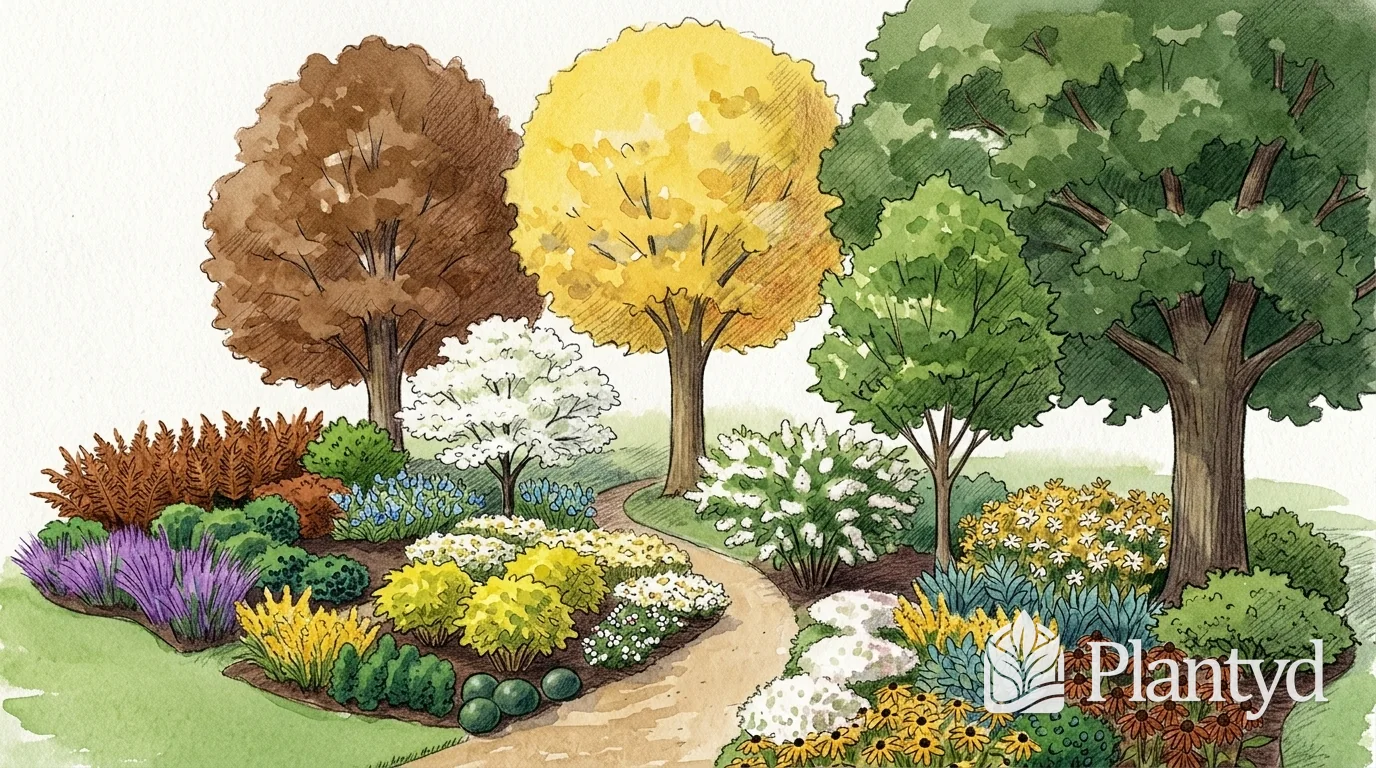
You will still see a gray trunk from the sink in January, but now it stands among green ferns, with a dark evergreen screen behind it and a bench waiting for July.
Common questions
How do you plan a shade garden?
First find out how much sun the spot really gets, because two hours and four hours call for different plants. Then place the evergreens and shrubs for the view you see most, usually from a window. Fill the ground with a few kinds of shade plants in large groups, and give the spring bulbs a patch of their own.
What shade plants stay green all winter?
In the Southeast, Christmas fern, seersucker sedge, Allegheny spurge and creeping phlox stay green, or nearly green, at ground level. For height, Catawba rhododendron, coastal doghobble and Florida anise are evergreen shrubs that take full shade, though the rhododendron flowers less there.
When should I plant a shade garden under a tree?
Plant in fall if you garden in the Southeast. Roots keep growing in cool soil through the winter, so the plants are settled before the oak starts pulling water the next summer. Plant snowdrop bulbs in October or November, and they flower in late winter.
More plans like this
 Woodland Garden Plan: Where Your Lawn Meets the Trees
 Pollinator Garden Plan: An Island Bed That Flowers From April to November
 Prairie Garden Design: A Backyard Meadow You Plant in Modules
From the collection Native Plant Garden Design: Six Plans for Sun, Shade and Wet Ground
Plan the view from your own window
Sign up, outline your house and your tree on the satellite photo, and Plantyd shows the summer sun on the ground beneath it, in the year you plant and at year fifteen. Then pick the ferns.
Start designing freeNo credit card required · Free tier is free forever