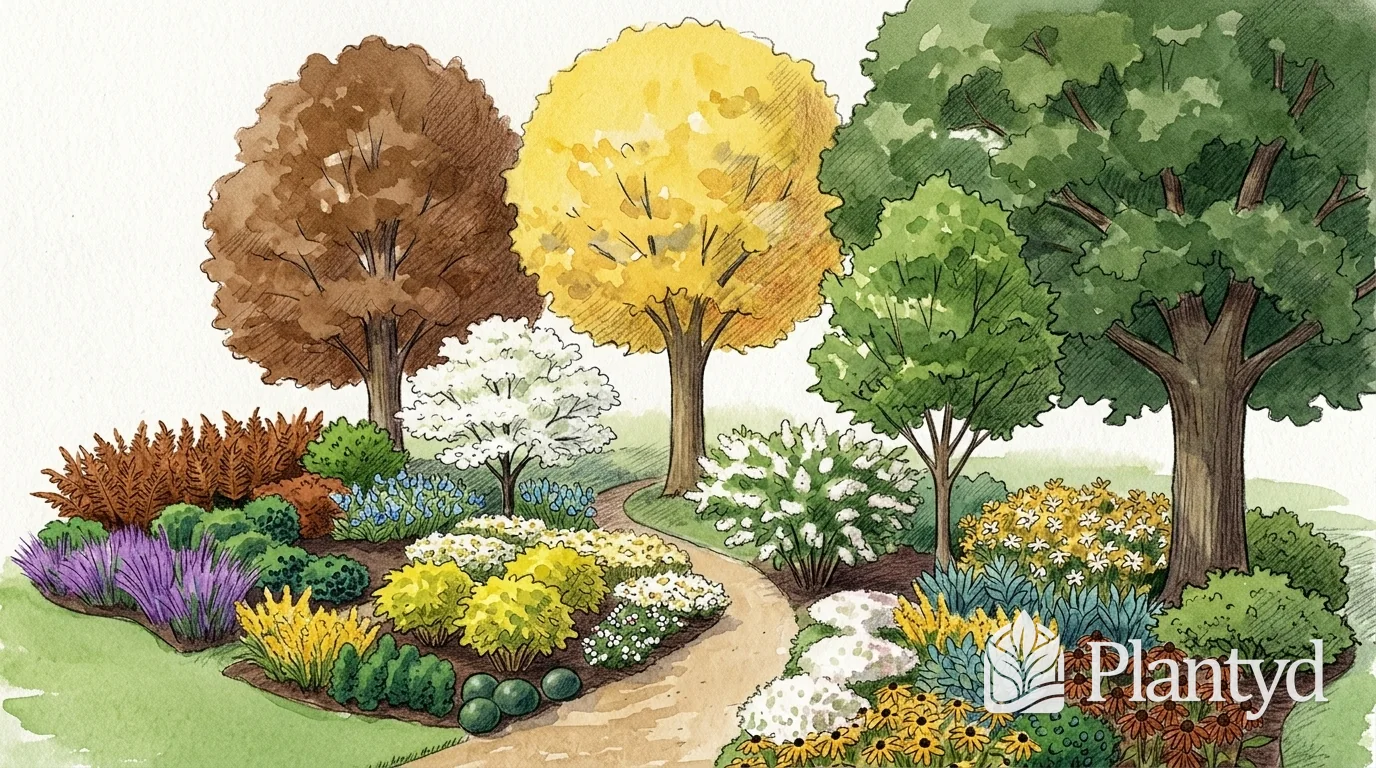
Where a back lawn meets a line of big trees, most of us mow right up to the trunks. Past the last stripe there is a band of thin grass, a few brambles and some maple seedlings. Every year you think about planting something there, and every year you can't decide what. Yet once it is planted, that band is the best place for birds on the lot.
This woodland garden plan is for the back of a 100-foot lot in Skillman, New Jersey, zone 7a, where the lawn runs south from the house to a white oak, a tulip tree and an American beech. Small trees go in the gaps between the big crowns, and berry shrubs stand in the sun just in front of the drip line, the outer edge of the crowns. Grasses and late flowers run along the lawn. Something is ripe for the birds from June to March.
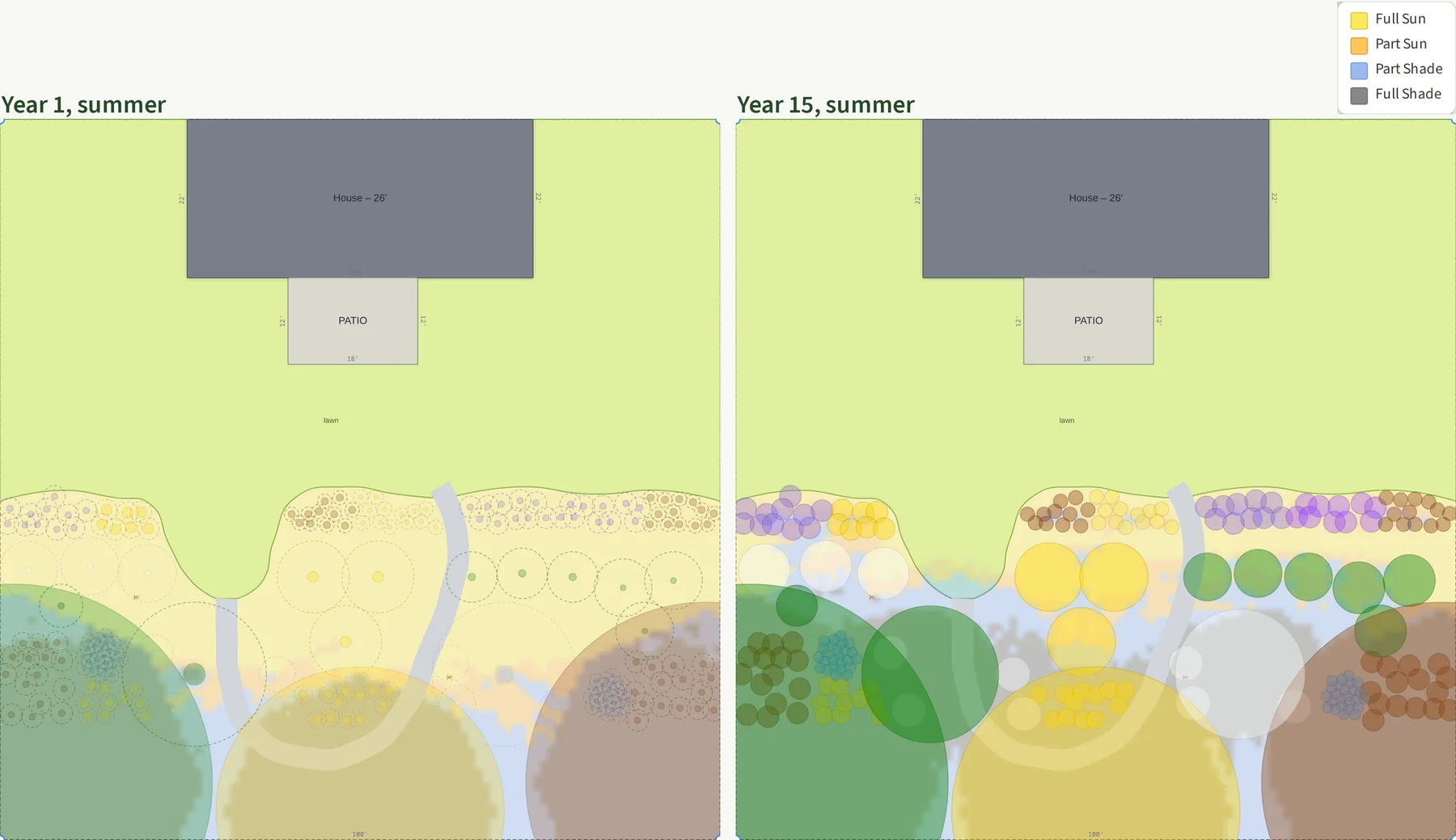
We built the plan in Plantyd and checked it with its sun analysis. The sun map split the band into three kinds of ground: shade under the crowns, sun for most of the day a few feet out, and two bright gaps where the crowns don't meet. You can download the plan sheet near the bottom of the page.
| Yard | 100 feet wide. The border runs the full width, about 30 feet from the lawn back to the trees |
|---|---|
| House | Two-story house, its back door and patio facing south across the lawn |
| The trees | A white oak, a tulip tree and an American beech along the back line, 65 to 90 feet tall, their crowns hanging 8 to 20 feet over the border |
| Where | Skillman, Montgomery Township, New Jersey, USDA zone 7a |
| Built for | Birds all year: berries from June to March, thickets to nest in, seed heads through winter |
| Plants | 16 new kinds, 199 new plants, all native to the eastern US |
| Paving | The patio, plus a wood-chip path that loops through the trees |
| Upkeep | Cut the flowers and grasses back in March, leave the fallen leaves, pull tree seedlings, and water the new plants for two summers |
Berries ripen from June to March
The serviceberry fruits in June and the blueberries in July. The dogwood and the arrowwood follow in September, just as migrating thrushes come through. The winterberries show red on bare twigs from November until the robins strip them, and the inkberries hold black berries into March.
Winterberry and inkberry plants are either male or female, and only the females bear fruit. The three 'Winter Red' winterberries get one 'Southern Gentleman' behind them, a male that flowers when they do. The inkberries need a male of their own.
The arrowwoods in the middle bed grow into thickets where catbirds and cardinals nest, and the evergreen inkberries at the east end give birds a winter roost.
The small trees stand in the gaps between the crowns
Three big crowns don't make a solid wall. Between the oak and the tulip tree, and again between the tulip tree and the beech, the sun analysis found a gap reaching back toward the trunks with five to seven hours of summer sun. In real woods, that is where a young tree comes up, so the serviceberry takes one gap and the dogwood the other.
Each gap gets one tree. Our first draft stood the two small trees 13 feet apart, with an arrowwood close beside the dogwood, and by year fifteen Plantyd showed both trees down to about an hour of sun. The light in a gap comes in low from the east and west, and a tall neighbor blocks it. With a gap between them, the serviceberry keeps nearly three hours of sun at year fifteen and the dogwood two and a half.
Around the two trees grows summersweet 'Crystalina', a three-foot shrub with fragrant white flower spikes in July. Most of it starts out in bright sun and ends up in shade once the small trees close over it, so expect fewer flowers by then.
Sun reaches almost to the drip line
The usual picture of a woods edge is a ramp, with deep shade at the trunks fading to sun across the lawn and a layer of plants for each step. The plants in this plan still step down in height, but in summer the light doesn't step down with them.
With the trees to the south, the high summer sun throws their shade only a few feet past the crowns. Two or three feet out, the ground misses the midday sun but still gets seven to ten hours in all. Eight or ten feet out, it is in sun nearly all day. When we ran the same yard for early fall, with the sun lower, a real slope did appear: six or seven hours on the lawn, and two or three at the drip line.
So the shrubs and the flower strip are sun plants that run right up to the crowns. Your own trees will draw a different line, and how much sun your yard gets shows how to find it.
Each shrub stands two feet back from the flowers
Here the flowers grow on the north side of the shrubs, and a shrub's midday shadow falls to the north. In an early draft, one black-eyed Susan sat four and a half feet from the middle of an arrowwood, inside the arrowwood's grown spread. By year fifteen Plantyd gave it less than three and a half hours of sun, too little for a sun plant.
Now each shrub stands back from the flower strip by half its grown width plus two feet, and the strip still gets thirteen to fifteen hours of sun at year fifteen. The rule behind that setback is in how far apart to plant trees and shrubs.
The strip is planted in blocks of one kind each: little bluestem and goldenrod at the west end, coneflower and black-eyed Susan in the middle, and bluestem, New England aster and coneflower to the east. Leave it all standing until March, long after the goldfinches have emptied the coneflower heads.
Fallen leaves cover most of the ground under the trees
Under the crowns the ground gets about two hours of sun, a little more at the edges, so what grows there has to take full shade. Evergreen Christmas fern covers the ground under the oak at the west end and under the beech at the east end. White wood aster grows beside the ferns under the oak and also under the tulip tree, with white flowers in September.
Fifty Virginia bluebells grow in two drifts, one under the oak and one under the beech. Their flowers come and go in April, before the trees leaf out, and by June the ferns have closed over them.
The rest of the ground stays covered in fallen leaves. Towhees and thrushes scratch through them for food, and many moths spend the winter in them. Plant the shade plants from small pots, each in a hand-dug hole between the roots, and never spread new soil over the tree roots.
The border starts sparse and grows into a thicket
The oak, tulip tree and beech are already there, and so is their shade. Everything else goes in small: the serviceberry and dogwood at five or six feet tall, the shrubs at two or three feet, and the flowers as plugs. The flower strip blooms in its first summer, but between the new plants the border is mostly bare mulch. Give the woody plants a slow soak in any dry week until their third spring.
By years three to five, the flower blocks have filled in, and the blueberries and winterberries start to fruit well. By years ten to fifteen, the serviceberry stands near 25 feet, arching over the path, and the dogwood near 20 feet. The shrubs have grown together into masses seven to ten feet high, and the bare mulch of year one is gone. The flower strip barely changes, because nothing grows between it and the sun.
If your trees stand north of the lawn, plant it all for sun
This plan depends on the trees standing to the south. If yours are to the north, their shade falls away from the lawn, and the border in front of them gets sun most of the way to the trunks. Plant the whole depth as a sun border, with the shrubs against the trunks. A tree line to the east or west falls in between, shading the border for either the morning or the afternoon, so map it before you choose.
Every new plant here is rated for at least zones 5b to 8b in our plant library, so the list works a full zone either side of 7a. On a narrower lot, keep the layers and make each one shorter: one small tree instead of two, and two groups of berry shrubs instead of four.
In central New Jersey, plan for deer. Rutgers' ratings of deer-resistant plants list arrowwood, little bluestem and Christmas fern as rarely damaged, but flowering dogwood and highbush blueberry as occasionally severely damaged. Cage those two for their first few years.
The plant list: sixteen new kinds, all eastern natives
Each letter matches the plan sheet. Ask the nursery for at least one male among the three inkberries, or none of them will bear berries. Buy nursery-grown bluebells. They are uncommon in the wild in New Jersey, so never dig them.
| Key | Qty | Plant | Size at maturity | Its job in the plan |
|---|---|---|---|---|
| A | 1 | Allegheny serviceberry Amelanchier laevis | 25 ft tall, 20 ft wide | In the gap between the oak and the tulip tree. White April flowers, June berries |
| B | 1 | Flowering dogwood 'Appalachian Spring' Cornus florida 'Appalachian Spring' | 20 ft tall, 20 ft wide | In the gap between the tulip tree and the beech. Red berries for fall migrants |
| C | 1 | American beech (existing) Fagus grandifolia | 65 ft tall, 50 ft wide | Already there, east end. Pale leaves hang on all winter |
| D | 1 | Tulip tree (existing) Liriodendron tulipifera | 90 ft tall, 40 ft wide | Already there, in the middle |
| E | 1 | White oak (existing) Quercus alba | 75 ft tall, 55 ft wide | Already there, west end. Casts the deepest shade |
| F | 7 | Summersweet 'Crystalina' Clethra alnifolia 'Crystalina' | 3 ft tall, 5 ft wide | Low shrub around the two small trees. Fragrant white July spikes |
| G | 3 | Inkberry Ilex glabra | 10 ft tall, 8 ft wide | Evergreen roost at the beech's edge. Black berries on the females into March; buy at least one male |
| H | 3 | Winterberry 'Winter Red' Ilex verticillata 'Winter Red' | 8 ft tall, 8 ft wide | Red berries on bare twigs, November into winter |
| I | 1 | Winterberry 'Southern Gentleman' (male) Ilex verticillata 'Southern Gentleman' | 7 ft tall, 6 ft wide | No berries. Pollinates the three 'Winter Red' |
| J | 3 | Highbush blueberry 'Jersey' Vaccinium corymbosum 'Jersey' | 7 ft tall, 7 ft wide | July berries and scarlet fall color, in full sun by the path |
| K | 3 | Arrowwood viburnum Viburnum dentatum | 10 ft tall, 10 ft wide | Dense nesting cover in the middle bed. Blue-black September berries |
| L | 24 | Purple coneflower Echinacea purpurea | 4 ft tall, 2 ft wide | July flowers, then seed cones for goldfinches |
| M | 22 | White wood aster Eurybia divaricata | 3 ft tall, 2.5 ft wide | White asters in September, under the oak and the tulip tree |
| N | 50 | Virginia bluebells Mertensia virginica | 2 ft tall, 18 in wide | Blue in April under bare branches. Dormant by summer |
| O | 30 | Christmas fern Polystichum acrostichoides | 3 ft tall, 3 ft wide | Evergreen ground under the oak and the beech |
| P | 13 | Black-eyed Susan 'Goldsturm' Rudbeckia fulgida 'Goldsturm' | 2.5 ft tall, 2 ft wide | Gold from July to September, seed heads after |
| Q | 7 | Wrinkleleaf goldenrod 'Fireworks' Solidago rugosa 'Fireworks' | 3.5 ft tall, 3 ft wide | Arching gold sprays in September and October |
| R | 10 | New England aster 'Purple Dome' Symphyotrichum novae-angliae 'Purple Dome' | 18 in tall, 3 ft wide | Low violet asters for late bees and monarchs |
| S | 21 | Little bluestem Schizachyrium scoparium | 4 ft tall, 3 ft wide | Copper all winter, at both ends of the lawn edge |
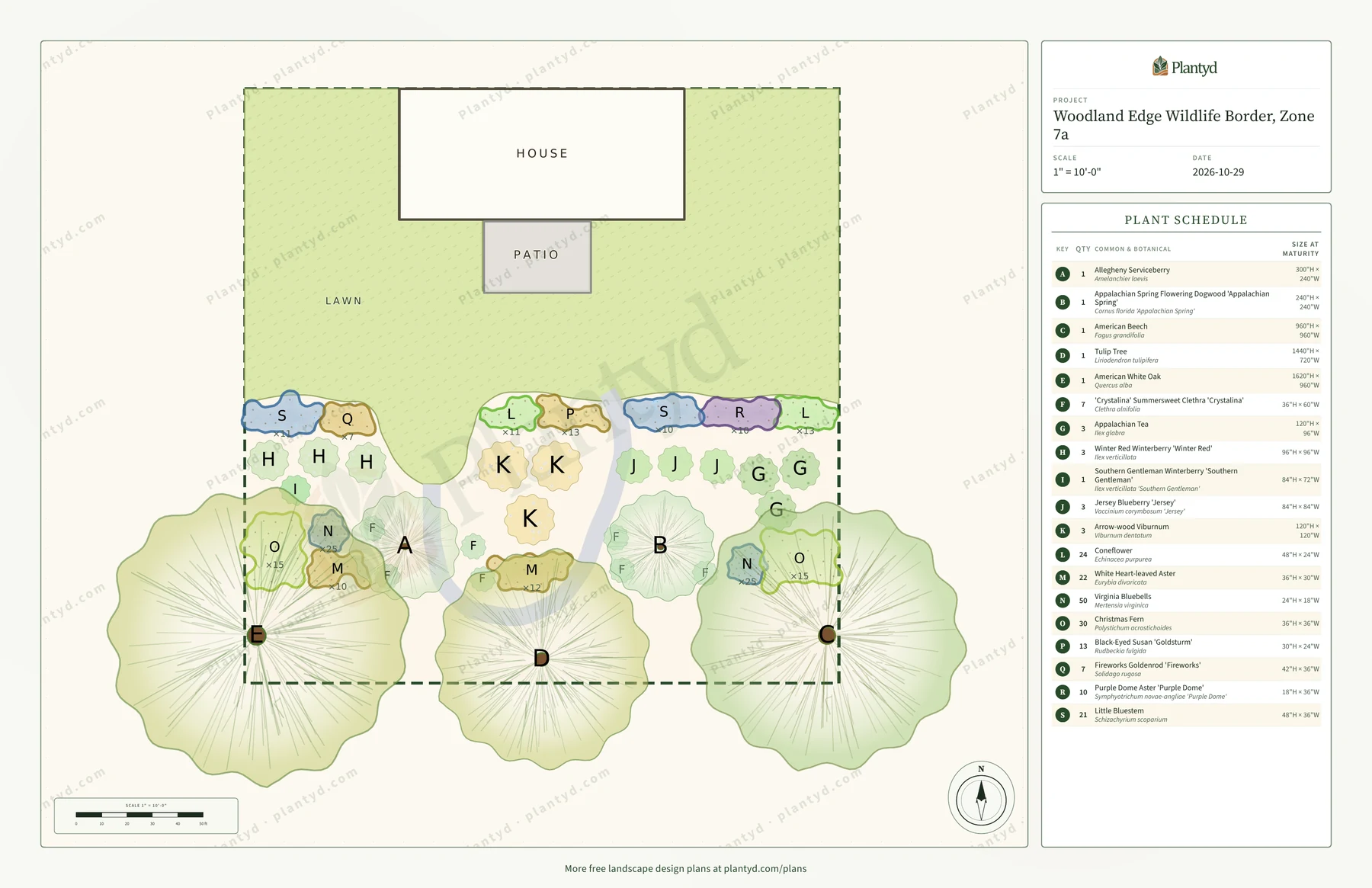
Planted this way, the thin grass by the trunks becomes a border that feeds and shelters birds all year.
Common questions
What should I plant at the edge of the woods?
Plant it in layers. Put small trees such as serviceberry and dogwood where the big crowns leave a gap, berry shrubs in the sun just in front of the edge of the crowns, and grasses and late flowers along the lawn. Under the big trees, leave the fallen leaves in place and plant Christmas fern and white wood aster between the roots.
What shrubs feed birds in winter?
Winterberry holds red berries on its bare twigs into winter, and evergreen inkberry keeps its black berries into early spring. Both have separate male and female plants, so plant a male of the same kind near the females, one that flowers at the same time. Leave grasses, coneflowers and asters standing too, because finches and sparrows eat their seed.
Should I rake the leaves under my trees?
Not in the beds. Leaves left under shrubs and trees feed the soil, cover the bare ground between plants, and shelter the insects that ground-feeding birds eat. Rake them off the lawn and onto the beds instead.
More plans like this
 Pollinator Garden Plan: An Island Bed That Flowers From April to November
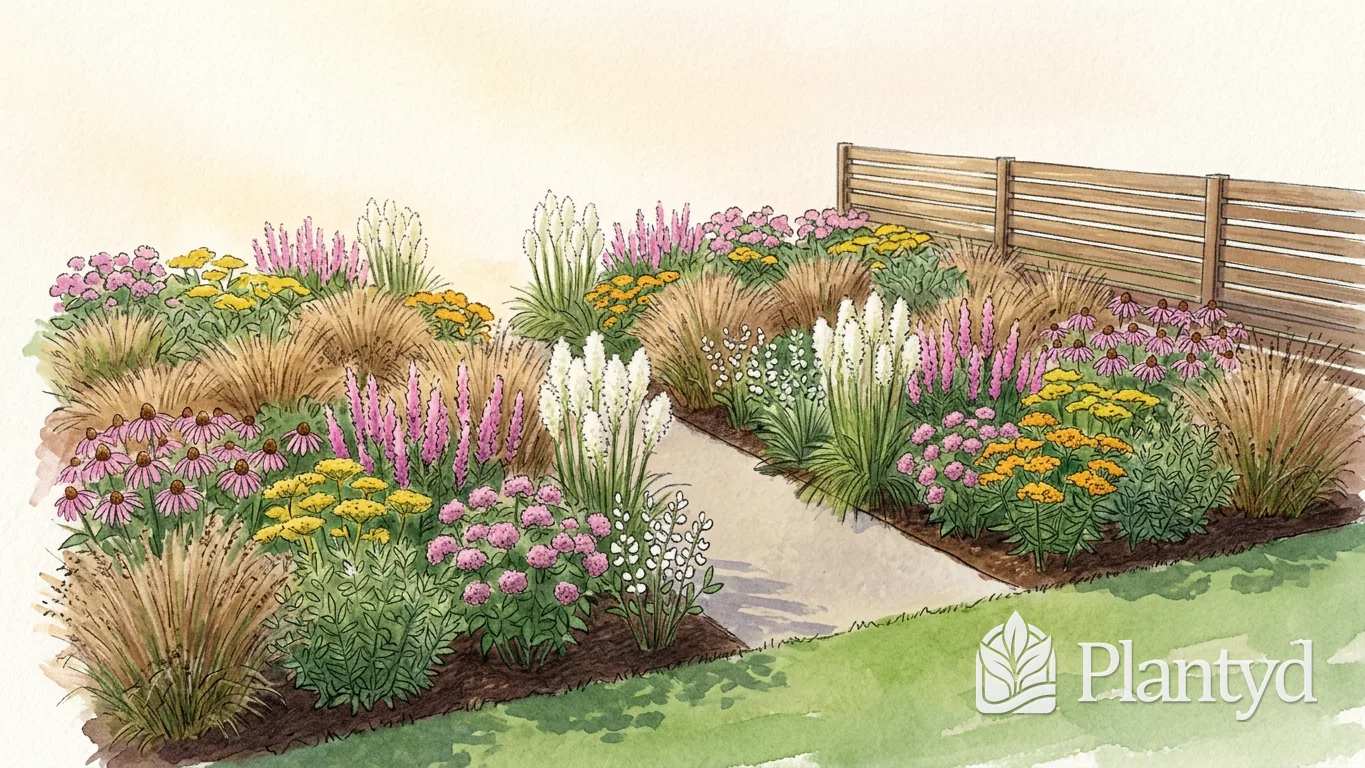 Prairie Garden Design: A Backyard Meadow You Plant in Modules
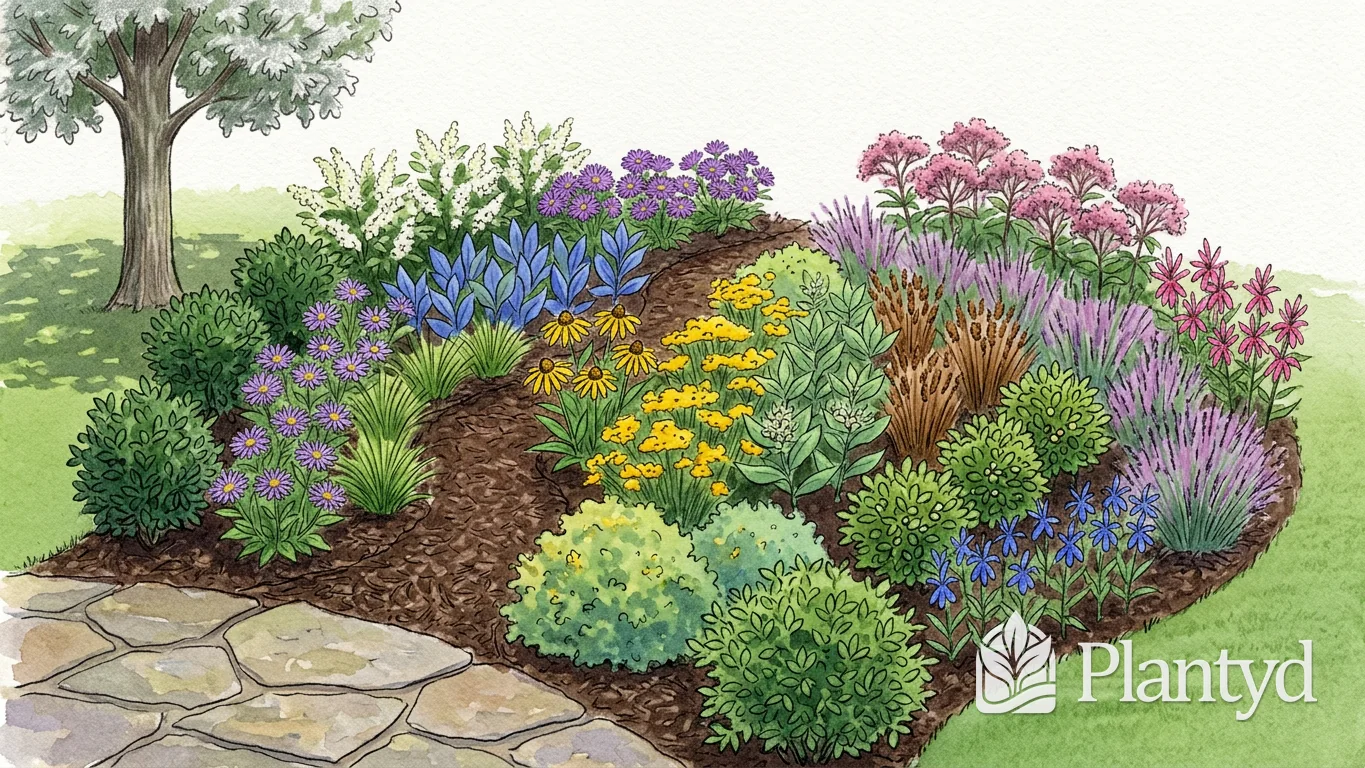 Rain Garden Design: Sized to One Downspout
From the collection Native Plant Garden Design: Six Plans for Sun, Shade and Wet Ground
Plan the edge before you buy a shrub
Sign up, draw your back lawn and the trees behind it on the satellite photo, and check how many hours of summer sun reach each spot along the edge.
Start designing freeNo credit card required · Free tier is free forever