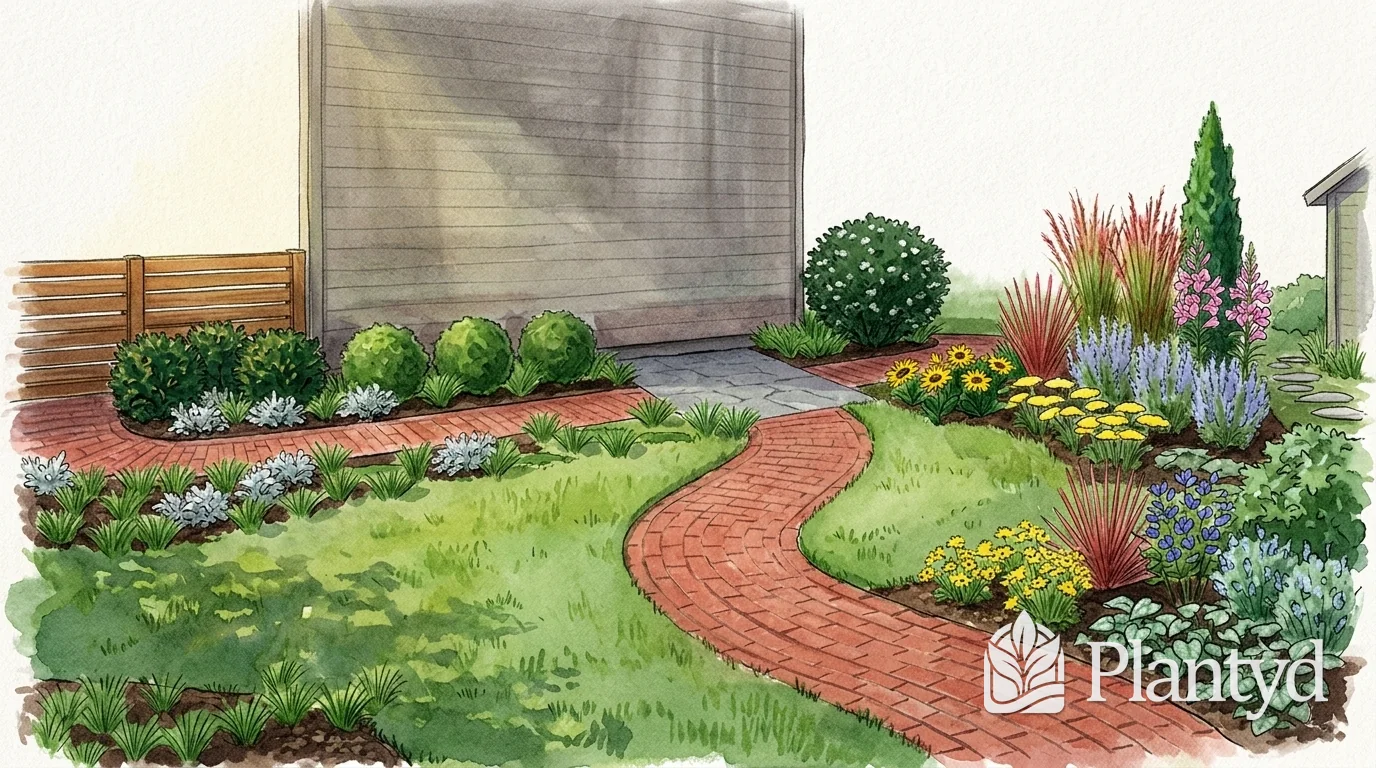
Winter in central Minnesota runs from November into March. By February the snow has usually been down since December, the perennials are under it, and what you see from the front window is whatever was tall enough to stick out. In a lot of Minnesota front yards, that is a lawn-shaped drift and a mailbox. A front yard planted only for summer sits empty for nearly half the year.
This zone 4 front yard landscaping plan is for a story-and-a-half house in St. Cloud, zone 4b, with a front yard 58 feet across and 36 feet deep. The house faces east, and an iron fence with a gate runs along the sidewalk. The plan starts with the February view: arborvitae along the north side, red dogwood stems near the street, and grasses and seed pods left standing. The summer garden goes in around that. Bluebells and anemones flower in spring under a native mountain ash in the south corner, a July border flowers in yellow, white and blue, and the strip outside the fence is planted in blocks of low plants that keep their leaves through winter.
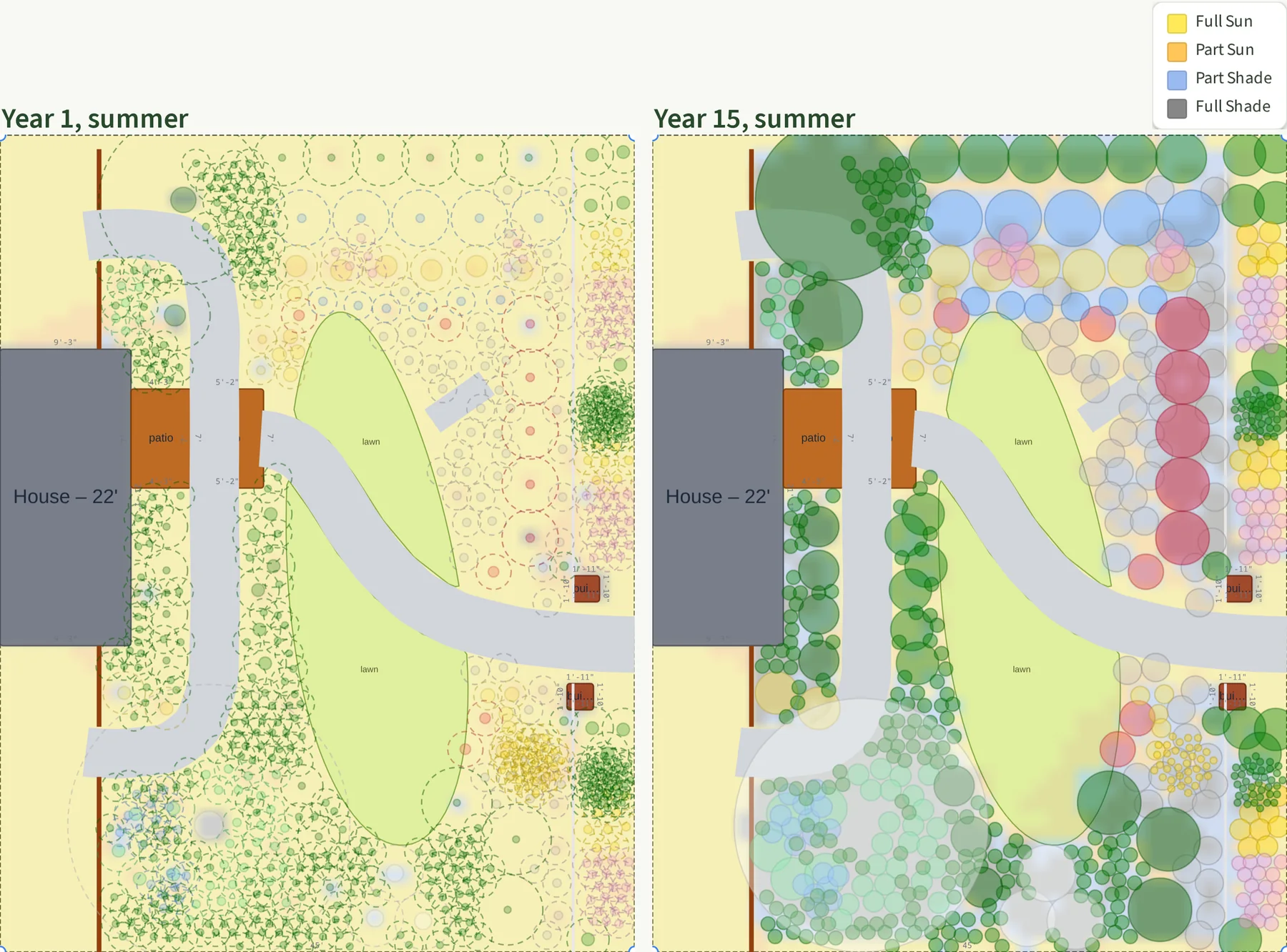
We built the plan as a real project in Plantyd, and Plantyd's sun analysis decided where the summer plants went. By year fifteen the mountain ash turns the south corner to shade, so that is where the spring garden goes. You can download the plan sheet as a PDF further down the page.
| Yard | 58 feet across, 36 feet from the house to the sidewalk |
|---|---|
| House | A story-and-a-half facing east, with an iron fence and gate at the sidewalk |
| Where | St. Cloud, Minnesota, USDA zone 4b |
| Faces | East, with a mountain ash shading the south side |
| Built for | A garden that still looks like something in February |
| Plants | 28 kinds, 651 plants, most of them small perennials and bulbs |
| Paving | An S-curve brick walk from the gate, a 7 by 5 foot landing, a brick path around the house |
| Upkeep | Leave the grasses and seed heads up all winter, cut them back in April, and take the oldest dogwood stems out each spring |
An evergreen hedge and red stems make the February view
The north side of the yard gets a row of 'Smaragd' arborvitae, twelve feet tall and four feet wide. The hedge takes some of the north wind off the border and gives the July flowers something dark to stand in front of. In January it is the only green thing above the snow.
The hedge starts past the crabapple's canopy, not behind it. A twelve-foot crabapple in front of a twelve-foot hedge would fight it for the same space by year ten. So the crabapple, 'Sparkling Sprite', has its corner to itself. It flowers white in May, and its gold fruit hangs on into March.
Three red-twig dogwoods stand in a group at the south edge. Their stems color poorly in shade, but out at the edge they get full sun, and you see them from the sidewalk all winter. Five clumps of feather reed grass are spread through the sunny beds. They stay upright until you cut them back in April.
The spring garden goes where the shade will be
The south corner belongs to a native American mountain ash, and the spring garden grows under it: Virginia bluebells, white wood anemones, a few lady ferns and a carpet of Pennsylvania sedge. The sedge is a native plant that handles dry shade under trees better than grass does.
A young ash casts very little shade. At year five, Plantyd still gives the bluebells, anemones and ferns up to nearly twelve hours of summer sun, and years one to seven are sunny there. Either hold that layer back until the ash closes over it, or plant it small, mulch it and water it through every dry spell until the shade arrives. The bluebells mind the least, because they flower in May and are dormant by midsummer.
Your yard has its own version of that ash: a neighbor's maple, a garage, or a fence that throws more shade than you would think. Trace them in Plantyd, and it shows how many hours of sun each spot gets, this year and as the trees grow. To see where your yard stands now, read how much sun your yard gets.
The July border keeps to yellow, white and blue
The sunny border runs along the hedge and keeps to three colors. Catmint, false sunflower, 'Moonshine' yarrow and fragrant white regal lilies fill it, with pale yellow coreopsis along the front. The blue spires of false indigo come a month earlier. From the street, three colors against dark green read as one planting, where a dozen would look like the picture on a seed packet.
Two 'The Rocket' ligularias go at the south end of the foundation bed, where the house and the side fence hold them to about four hours of sun. Ligularia wilts in afternoon sun, but in that pocket it stays upright.
The sidewalk strip is planted in blocks, not a mix
Outside the front fence, a strip of ground runs between the fence and the sidewalk. It is planted in alternating five-foot blocks of moss phlox, evergreen candytuft and 'Firewitch' cheddar pinks, with two patches of grape hyacinths among them. All three keep their leaves through winter, so the strip turns green as soon as the snow comes off it.
Seen from the sidewalk, a mix of three low plants looks like speckles. Five-foot blocks give the strip a rhythm, and moss phlox inside the fence ties the strip to the beds.
Behind the fence, the dwarf Korean lilacs stand five feet apart and three feet back from it, so they can grow to full width without leaning on it. A shrub needs at least half its width between it and a fence (see how far apart to plant trees and shrubs), and three feet gives the lilacs a little more room.
Three old northern standbys are left out
Three plants that fill older Minnesota yards are missing here, because Minnesota's noxious weed list now covers them. The non-native bush honeysuckles are restricted noxious weeds, so the low shrub by the house is the native northern bush honeysuckle.
The mountain ash is the native one, too. Minnesota is phasing the European rowan out of nurseries because it is escaping into the woods around Duluth. And the hedge is arborvitae, because Siberian peashrub is on the restricted list as well.
How to change the plan for your zone, your lot and your deer
In zones 5 and 6 the plan works as drawn. Warmer than zone 6, the mountain ash struggles in the summer heat, so swap it for a small native tree that takes the heat, such as downy serviceberry. One zone colder, check every tag. The crabapple, the clematis, the regal lily and the rose are rated to zone 4 and no colder, so in zone 3 they are the first to go.
On a smaller lot, keep the three parts that carry the plan: the evergreen north side, a shade corner under one tree, and the sunny border. Make the border shorter rather than thinning it out.
Deer are the bigger risk. Arborvitae is what they go for in winter, and Rutgers' ratings of deer-resistant plants put it among the plants deer most often damage badly. If deer come through your neighborhood, net or fence the hedge from late fall to spring. Or plant a spruce, which deer seldom touch, and give it the extra width it needs.
Buy the sedge as plugs, by the flat
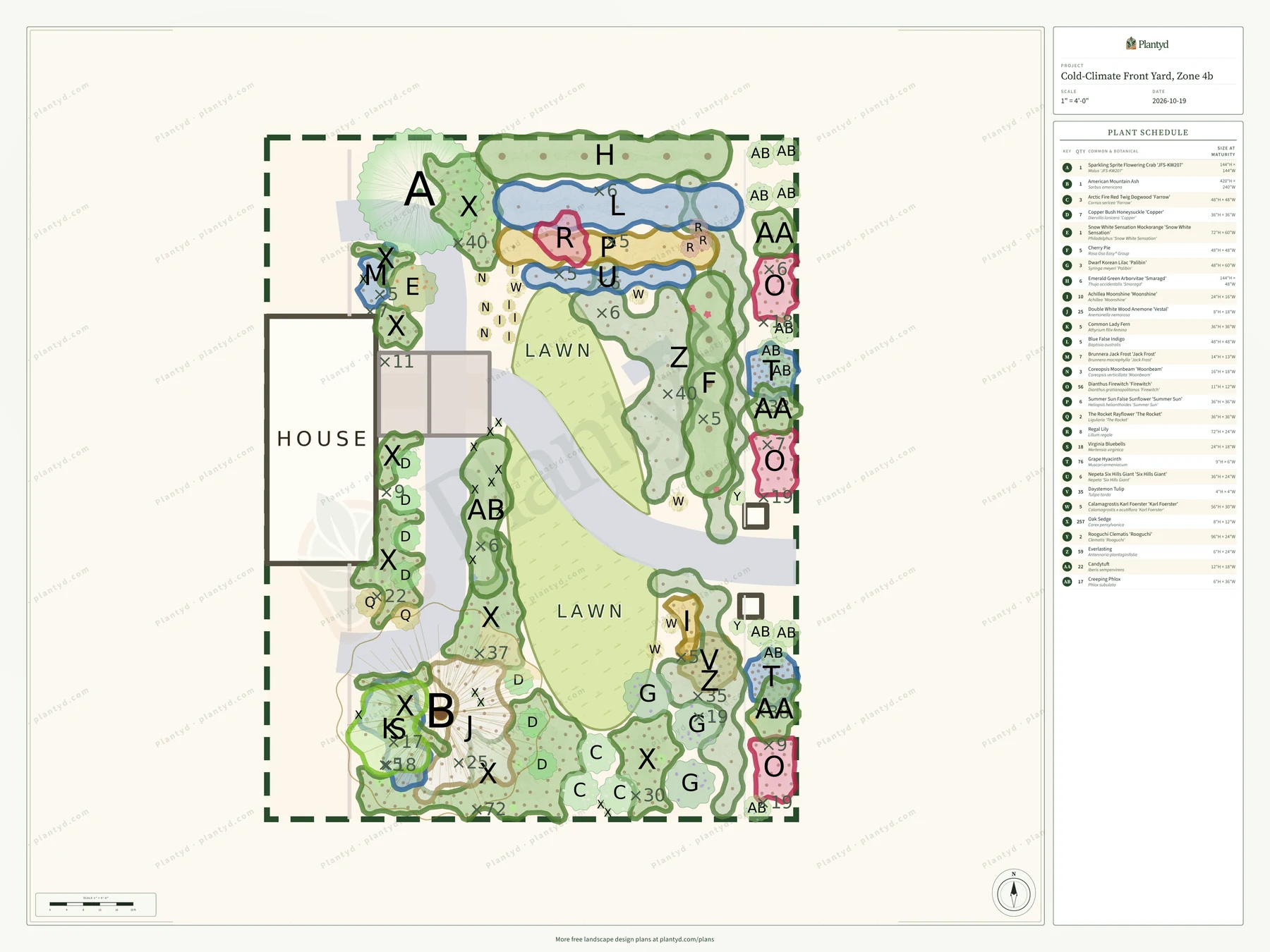
The letters match the plan sheet. Of the 651 plants, 257 are Pennsylvania sedge, so buy it as plugs by the flat. It doesn't grow well from seed. Every plant here is rated to zone 4 or colder in Plantyd's plant library.
| Key | Qty | Plant | Size at maturity | Its job in the plan |
|---|---|---|---|---|
| A | 1 | Crabapple 'Sparkling Sprite' Malus 'JFS-KW207' | 12 ft tall, 12 ft wide | Northwest corner tree. White May flowers, gold fruit that hangs on into March |
| B | 1 | American mountain ash Sorbus americana | 35 ft tall, 20 ft wide | Small native tree for the south side. White May flowers, orange fruit for birds, and the shade the spring garden needs |
| C | 3 | Red-twig dogwood 'Arctic Fire' Cornus sericea 'Farrow' | 4 ft tall, 4 ft wide | Red winter stems, in sun at the south edge where the street sees them |
| D | 7 | Northern bush honeysuckle 'Copper' Diervilla lonicera 'Copper' | 3 ft tall, 3 ft wide | Low shrub by the house and under the ash. Copper new leaves, yellow early-summer flowers |
| E | 1 | Mock orange 'Snow White Sensation' Philadelphus 'Snow White Sensation' | 6 ft tall, 5 ft wide | Fragrant white June flowers by the steps |
| F | 5 | Shrub rose 'Cherry Pie' Rosa Oso Easy 'Cherry Pie' | 4 ft tall, 4 ft wide | Cherry-red roses all summer along the front fence, north of the gate. 'Cherry Pie' is no longer sold, so use any cherry-red shrub rose hardy to zone 4 |
| G | 3 | Dwarf Korean lilac 'Palibin' Syringa meyeri 'Palibin' | 4 ft tall, 5 ft wide | Along the front fence, five feet apart. Fragrant pink-lilac in late May |
| H | 6 | Arborvitae 'Smaragd' Thuja occidentalis 'Smaragd' | 12 ft tall, 4 ft wide | Evergreen wall on the north side and the border's winter backdrop |
| I | 10 | Yarrow 'Moonshine' Achillea 'Moonshine' | 2 ft tall, 16 in wide | Pale yellow flat heads in the July border |
| J | 25 | Wood anemone 'Vestal' Anemone nemorosa 'Vestal' | 8 in tall, 18 in wide | White double flowers in the spring garden under the ash |
| K | 5 | Lady fern Athyrium filix-femina | 3 ft tall, 3 ft wide | Fern that takes over the bluebells' ground for the summer |
| L | 5 | Blue false indigo Baptisia australis | 4 ft tall, 4 ft wide | Blue spires in June, black seed pods all winter |
| M | 7 | Siberian bugloss 'Jack Frost' Brunnera macrophylla 'Jack Frost' | 14 in tall, 13 in wide | Blue May flowers over silver leaves in the shade |
| N | 3 | Threadleaf coreopsis 'Moonbeam' Coreopsis verticillata 'Moonbeam' | 16 in tall, 18 in wide | Pale yellow front edge of the July border |
| O | 56 | Cheddar pink 'Firewitch' Dianthus gratianopolitanus 'Firewitch' | 11 in tall, 12 in wide | Blue-gray evergreen tufts and magenta June flowers in the sidewalk strip |
| P | 6 | False sunflower 'Summer Sun' Heliopsis helianthoides 'Summer Sun' | 3 ft tall, 3 ft wide | Yellow daisies, the back of the July border |
| Q | 2 | Ligularia 'The Rocket' Ligularia 'The Rocket' | 3 ft tall, 3 ft wide | Yellow spires where the house and fence give it afternoon shade |
| R | 8 | Regal lily Lilium regale | 6 ft tall, 2 ft wide | Fragrant white trumpets in July |
| S | 18 | Virginia bluebells Mertensia virginica | 2 ft tall, 18 in wide | Native spring ephemeral under the ash |
| T | 76 | Grape hyacinth Muscari armeniacum | 9 in tall, 6 in wide | Blue spring bulbs in two patches in the sidewalk strip |
| U | 6 | Catmint 'Six Hills Giant' Nepeta 'Six Hills Giant' | 3 ft tall, 2 ft wide | Lavender-blue through summer in the July border |
| V | 35 | Species tulip Tulipa tarda | 4 in tall, 4 in wide | Yellow and white April stars in the sun by the gate |
| W | 5 | Feather reed grass 'Karl Foerster' Calamagrostis x acutiflora 'Karl Foerster' | 4.5 ft tall, 2.5 ft wide | Five upright clumps through the sunny beds, standing all winter |
| X | 257 | Pennsylvania sedge Carex pensylvanica | 8 in tall, 12 in wide | Native groundcover under the ash and the crabapple, and by the steps |
| Y | 2 | Clematis 'Rooguchi' Clematis 'Rooguchi' | 8 ft tall, 2 ft wide | Purple bells leaning on the two gate pillars |
| Z | 59 | Pussytoes Antennaria plantaginifolia | 6 in tall, 2 ft wide | Low gray-leaved mat for the driest, leanest ground |
| AA | 22 | Evergreen candytuft Iberis sempervirens | 12 in tall, 18 in wide | White May flowers, leaves kept through winter, in the sidewalk strip |
| AB | 17 | Moss phlox Phlox subulata | 6 in tall, 3 ft wide | Blocks of spring color in the sidewalk strip |
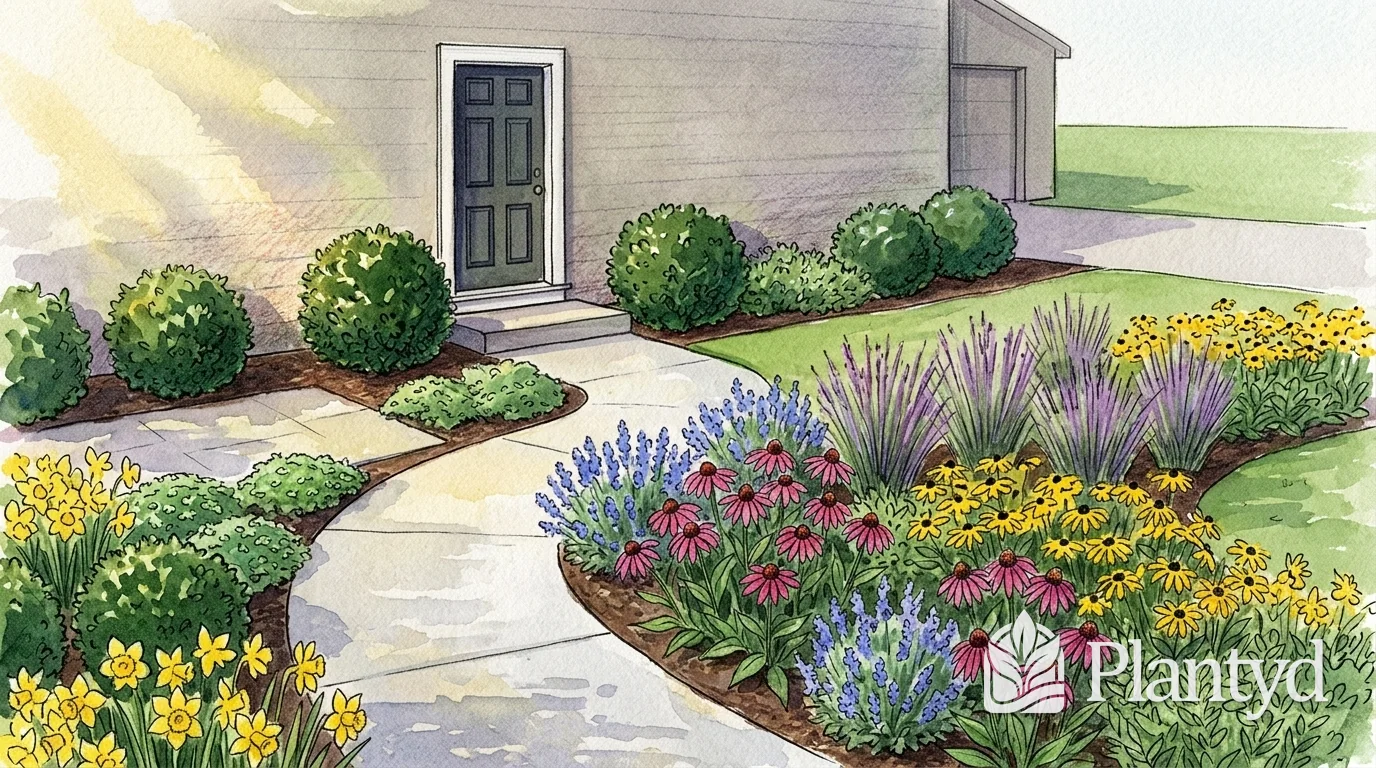
Any yard has something to show in July. This plan starts with what you see from the front window on a February morning, and fits the summer around it.
Common questions
What can I plant in a zone 4 front yard?
This plan uses a native mountain ash, a small crabapple, arborvitae, red-twig dogwood, dwarf Korean lilac and hardy shrub roses for structure. Check the zone on every plant, and give the ones at the edge of their range, like ligularia, a spot out of the wind.
What grows under a tree in a cold climate?
Plant spring ephemerals such as Virginia bluebells, which flower before the tree leafs out, and add ferns and a native sedge for the rest of the year. Plant each kind in a drift of its own, and water them until the tree's canopy fills in.
What can I plant instead of a honeysuckle hedge in Minnesota?
Minnesota lists the non-native bush honeysuckles, including Tatarian, Morrow's, Amur and Bell's, as restricted noxious weeds, so nurseries can't sell them. Northern bush honeysuckle (Diervilla lonicera) is a native shrub about three feet tall, with small yellow flowers in early summer. For a taller screen, use arborvitae or a native viburnum.
More plans like this
 Cheap, Simple Front Yard Landscaping: Keep the Lawn, Buy the Plants Small
 Front Yard Landscaping for a Ranch House Without Hiding the Windows
 Front Yard Native Plant Garden Design That Still Looks Cared For
From the collection Front Yard Landscaping Ideas: 8 Plans, Drawn to Scale
Plan your yard for all twelve months
Sign up, trace your yard on its satellite photo, and see where the sun falls on it in every season, now and fifteen years from now.
Start designing freeNo credit card required · Free tier is free forever