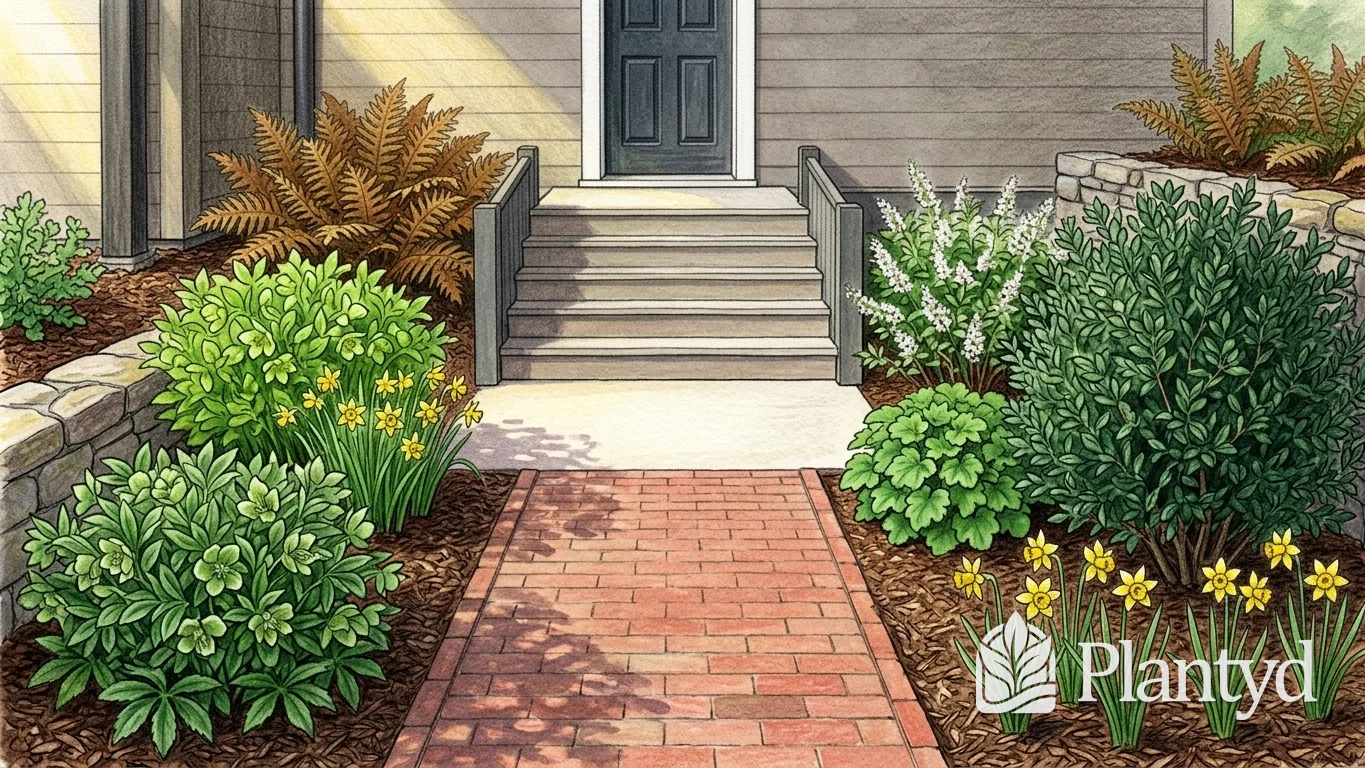
Plenty of rowhouse fronts end up carpeted in English ivy or vinca, and on a north-facing street it is easy to see why. The strip between the house and the sidewalk is bright well into the evening in June, but from fall to spring it never gets out of the house's shadow. It is the same thirteen feet of ground in both seasons, and whatever you plant there has to put up with both.
This narrow front yard landscaping plan is for a three-story brick rowhouse in Philadelphia, zone 7b, with a marble stoop and a front yard 18 feet wide and 13 feet deep that faces north. A brick walk four feet wide leads to the stoop, and a brick knee wall 18 inches tall, with a gate, closes the yard in. Eight kinds of plants fill the beds: hellebores by the door, Christmas ferns in the two darkest corners, and one narrow serviceberry at the sidewalk corner. The hellebores flower from February, the serviceberry in April and the summersweet in July and August, and two inkberries keep the gate green all winter.
We drew this front in Plantyd, with the house, its neighbors and the stoop, and checked the sun on it season by season. For most of the year the house is thirty feet of brick between the bed and the sun. In June, though, the sun rises and sets so far north that it shines on the front of the house, and on the bed, for three hours or so after sunrise and again before sunset. So the plan uses shade plants that won't mind the June sun. You can download the plan sheet near the bottom of the page.
| Yard | 18 feet wide and 13 feet from the house to the sidewalk |
|---|---|
| House | Three-story brick rowhouse, 30 feet tall, with a marble stoop |
| Where | Philadelphia, USDA zone 7b |
| Faces | North: sun in June, the house's shadow from fall to spring |
| Built for | A bright entry that survives the shady months |
| Plants | 8 kinds, 49 plants (21 of them miniature daffodils); 6 of the kinds are native |
| Paving | A 4-foot brick walk to the stoop, an 18-inch brick knee wall with a gate |
| Upkeep | Cut back the hellebores' old leaves in late winter, cut out serviceberry suckers once a year, trim the inkberry if it crowds the gate |
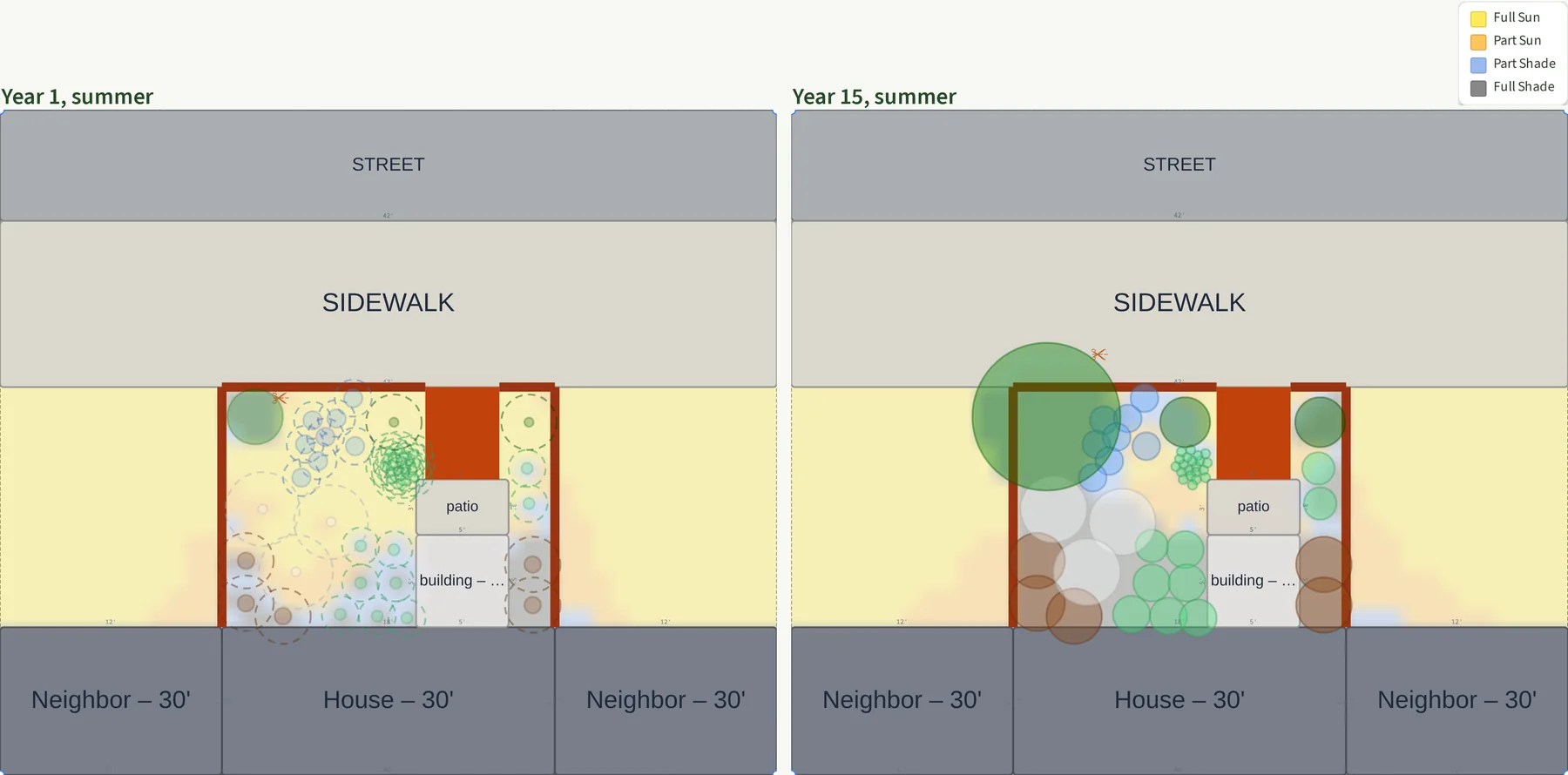
The bed is sunny in June and shaded the rest of the year
At midsummer, Plantyd's sun analysis puts most of the front two-thirds of the bed in six hours of sun or more. At noon the house's shadow reaches about nine feet out from the wall, most of the way to the sidewalk, and the low morning and evening sun comes in from across the street.
From fall to spring the bed is a different garden. By the start of fall the house shades nearly all of it for nearly all of the day, and by December all of it is in full shade, which means less than two hours of sun. Plants that need full sun would struggle for most of the year, and plants for deep shade would scorch in summer.
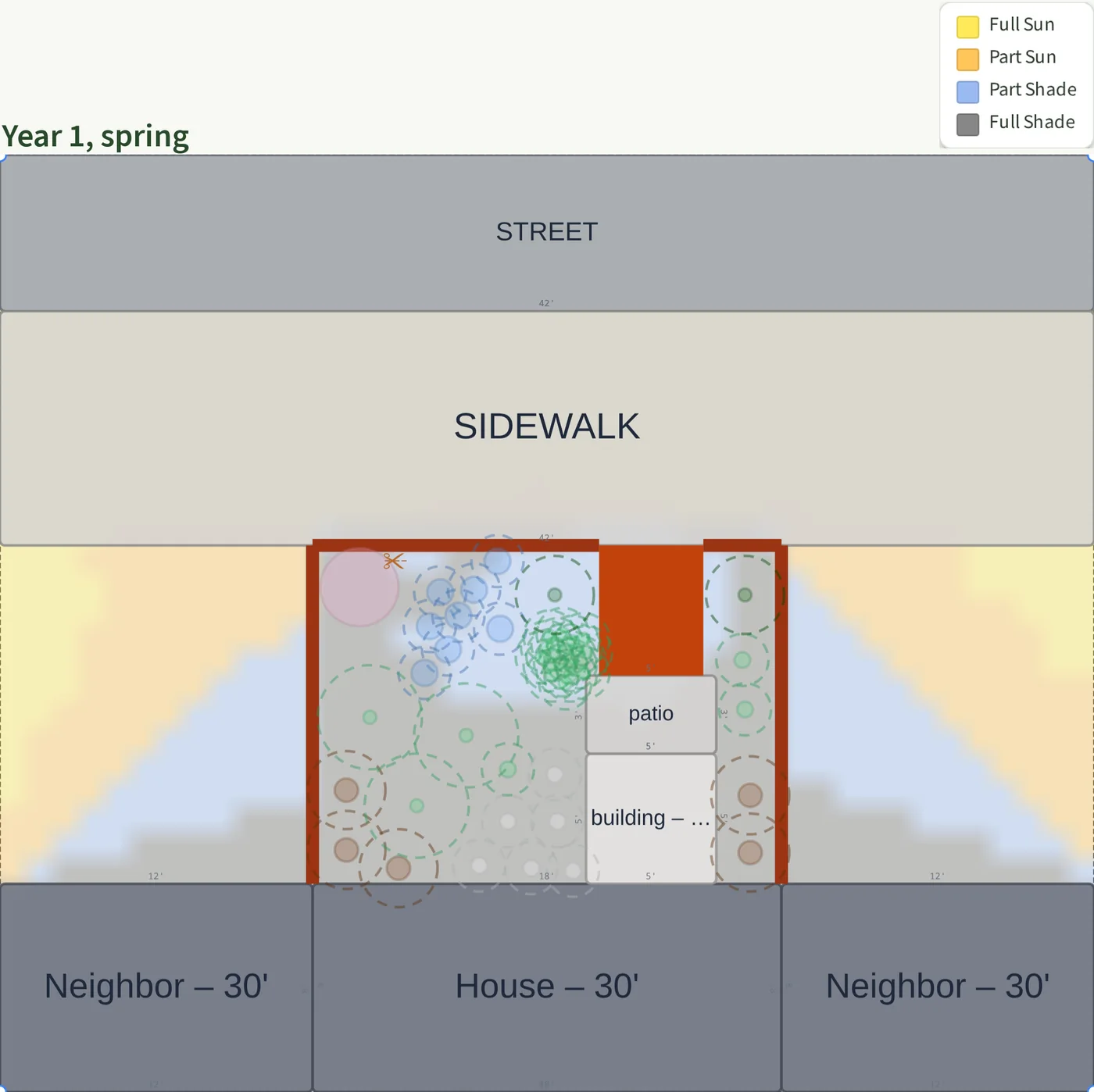
Standing on the stoop in June won't show you what the bed is like in November. In Plantyd you draw the house, the houses on either side and anything else that casts a shadow, and it counts the hours of sun on each spot of the bed. If you have never measured your own, start with how much sun your yard gets.
Christmas ferns go in the corners that stay shaded in June
Christmas fern is the obvious choice for a rowhouse front. In the middle of this bed, though, it would get five to seven hours of June sun, which is more than it wants. So the ferns go in the two corners against the house, where the knee walls, the stoop and the summersweet keep the sun under four hours even at midsummer.
The shaded strip beside the stoop belongs to the hellebores. 'Walberton's Rosemary' has pink flowers from February, when hardly anything else on the block is in bloom, and its leaves stay green all winter.
Hairy alumroot 'Autumn Bride' is native to the Appalachians south of here. It has big lime-green leaves and white flowers in fall, and it is one of the heucheras that copes best with a hot city summer.
The stoop casts a shadow too
A Philadelphia stoop is a solid block of masonry, so we drew it in Plantyd as a building a little over two feet tall. With the stoop on one side and the grown summersweet on the other, a heuchera planted right beside the steps got less than an hour and a half of summer sun by year fifteen. That spot went to a sixth hellebore instead. When you plan your own bed, look at what stands beside each planting hole, not only at what stands south of it.
The serviceberry stays at the corner, with the shrubs out from under it
The serviceberry stands at the sidewalk corner and stays about eight feet wide. At midday its shadow falls on the sidewalk. On June evenings, with the sun low in the northwest, its shadow reaches back across the front of the bed.
In our first draft, one summersweet sat under the tree's canopy, and by year fifteen Plantyd's sun analysis showed it in full shade. So the group of summersweets moved south, out from under the tree.
Beside the tree, the light drops from full sun at year one to as little as an hour and a half by year fifteen. The groundcover there is native creeping phlox, a woodland plant that prefers part shade. Water it through the first few summers, before the tree is big enough to shade it. If you want blue flowers, buy a named blue-violet form such as 'Sherwood Purple'.
English ivy and vinca are both on Pennsylvania's invasive plant list, so this plan leaves them out and uses creeping phlox to cover the ground instead.
Something by the door looks good in every season
Summersweet scents the walk in July and August, and the 'Minnow' daffodils give a smaller dose of scent by the gate in April. Before either, the hellebores flower from February, and the two 'Nordic' inkberries keep the gate green all winter.
The plant list: buy a columnar serviceberry
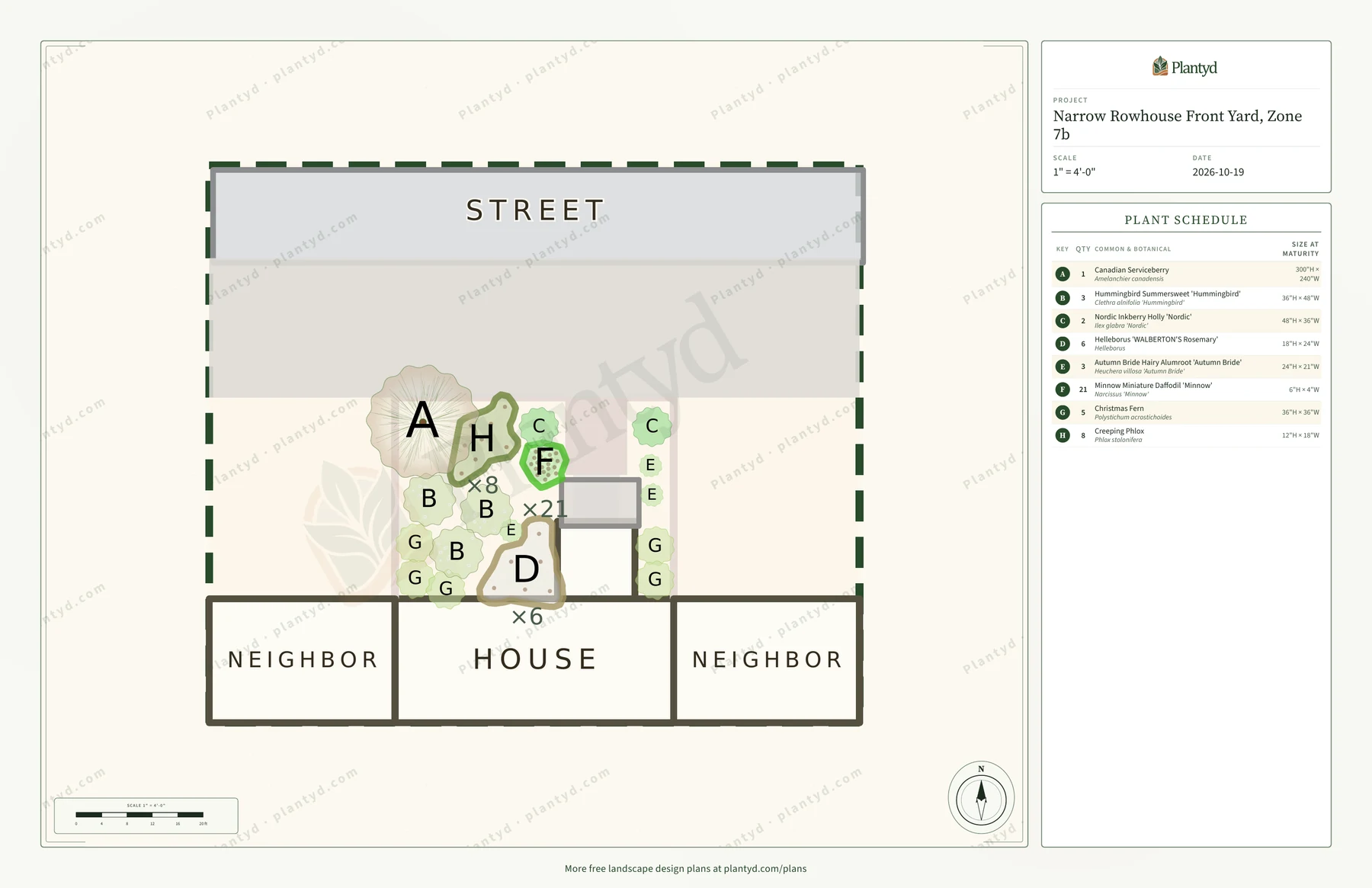
Buy a columnar form of serviceberry, such as 'Rainbow Pillar'. The species grows two or three times as wide. The letters in the list match the plan sheet. The sizes are grown sizes, so space the plants by them, as explained in how far apart to plant trees and shrubs.
Every plant here is hardy in zones much colder than 7b, so the list works from Boston to Baltimore. The sun on your street won't be the same as on this one, so check your own front before you buy.
| Key | Qty | Plant | Size at maturity | Its job in the plan |
|---|---|---|---|---|
| A | 1 | Serviceberry, columnar form Amelanchier canadensis | 18 ft tall, 8 ft wide | The one tree, at the sidewalk corner. White April flowers, berries in June. Buy a columnar form such as 'Rainbow Pillar' |
| B | 3 | Summersweet 'Hummingbird' Clethra alnifolia 'Hummingbird' | 3 ft tall, 4 ft wide | Fragrant white spikes in July and August, a few feet from the steps |
| C | 2 | Inkberry 'Nordic' Ilex glabra 'Nordic' | 4 ft tall, 3 ft wide | Evergreen pair either side of the gate |
| D | 6 | Hellebore 'Walberton's Rosemary' Helleborus 'Walberton's Rosemary' | 18 in tall, 2 ft wide | Pink flowers from February by the door, evergreen leaves |
| E | 3 | Hairy alumroot 'Autumn Bride' Heuchera villosa 'Autumn Bride' | 2 ft tall, 21 in wide | Big lime-green leaves, white flowers in fall. An Appalachian native that takes heat |
| F | 21 | Miniature daffodil 'Minnow' Narcissus 'Minnow' | 6 in tall, 4 in wide | Small, scented cream and yellow daffodils in April, just inside the gate |
| G | 5 | Christmas fern Polystichum acrostichoides | 2 ft tall, 2.5 ft wide | Evergreen fern in the two shadiest corners against the house |
| H | 8 | Creeping phlox Phlox stolonifera | 12 in tall, 18 in wide | Native groundcover beside the serviceberry. Lavender to blue-violet in April and May |
Plant the bed for the shade of November, choose plants that can also take the June sun, and the thirteen feet in front of your rowhouse stay green all year, with flowers from February into fall.
Common questions
What grows in a north-facing front yard?
Choose shade plants that can take some summer sun. In June the sun rises and sets far enough north to light a north-facing yard for hours, and from fall to spring the house shades it. Hellebores, native heuchera, summersweet and inkberry handle both. Keep Christmas fern for the corners that stay shaded even in June.
How do you landscape a very narrow front yard?
Keep the walk straight and give the plants the rest of the space. Use a few kinds of plants in groups, one small tree at most, and plants that stay below the windows. A low wall or fence with a gate can turn even a thirteen-foot strip between the house and the sidewalk into a garden.
Can you plant a tree in a rowhouse front yard?
Yes, if it is small and columnar and stands at a corner by the sidewalk. At midday its shade lands on the sidewalk, but on summer evenings it reaches into the bed, so keep shrubs out from under it. In Philadelphia, a tree in the sidewalk itself needs a street-tree permit from Parks & Recreation.
More plans like this
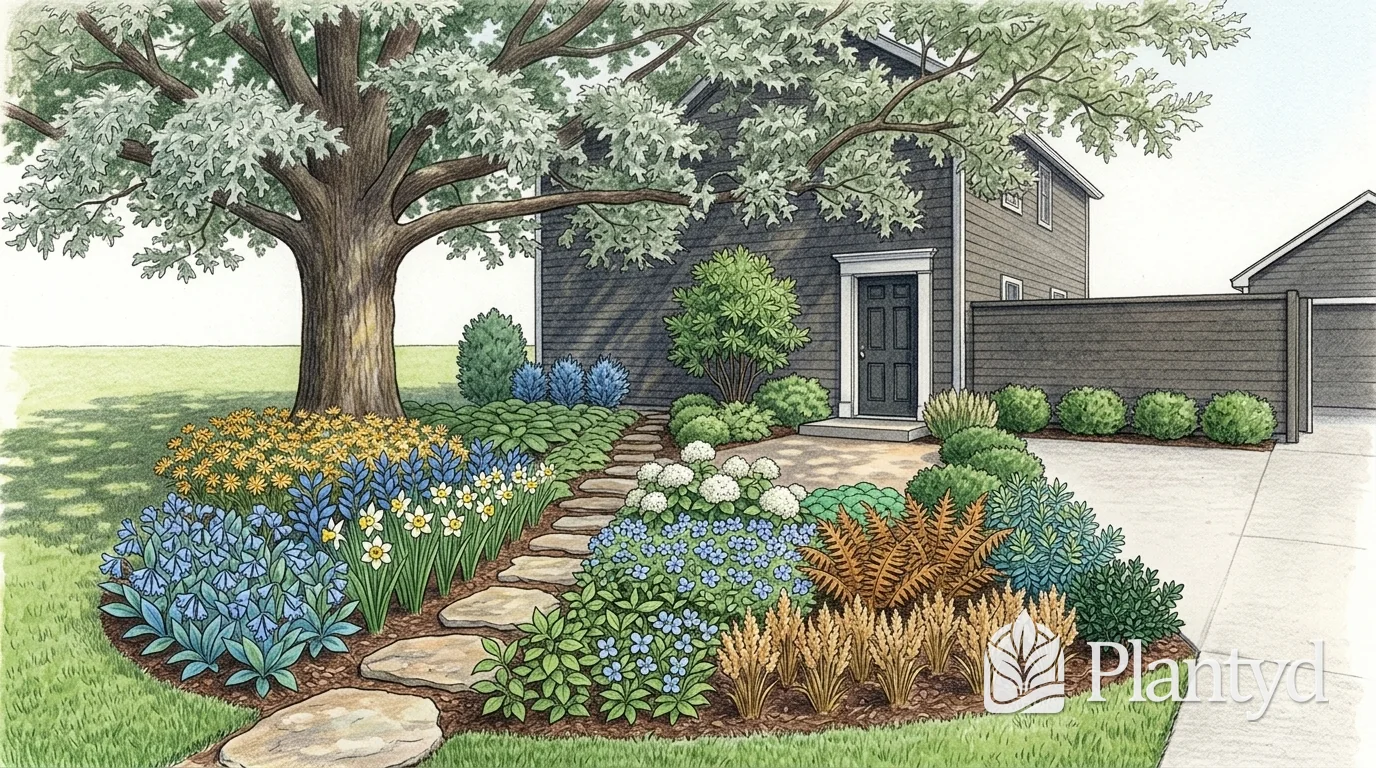 Shade Front Yard Landscaping: What to Plant Under a Big Oak
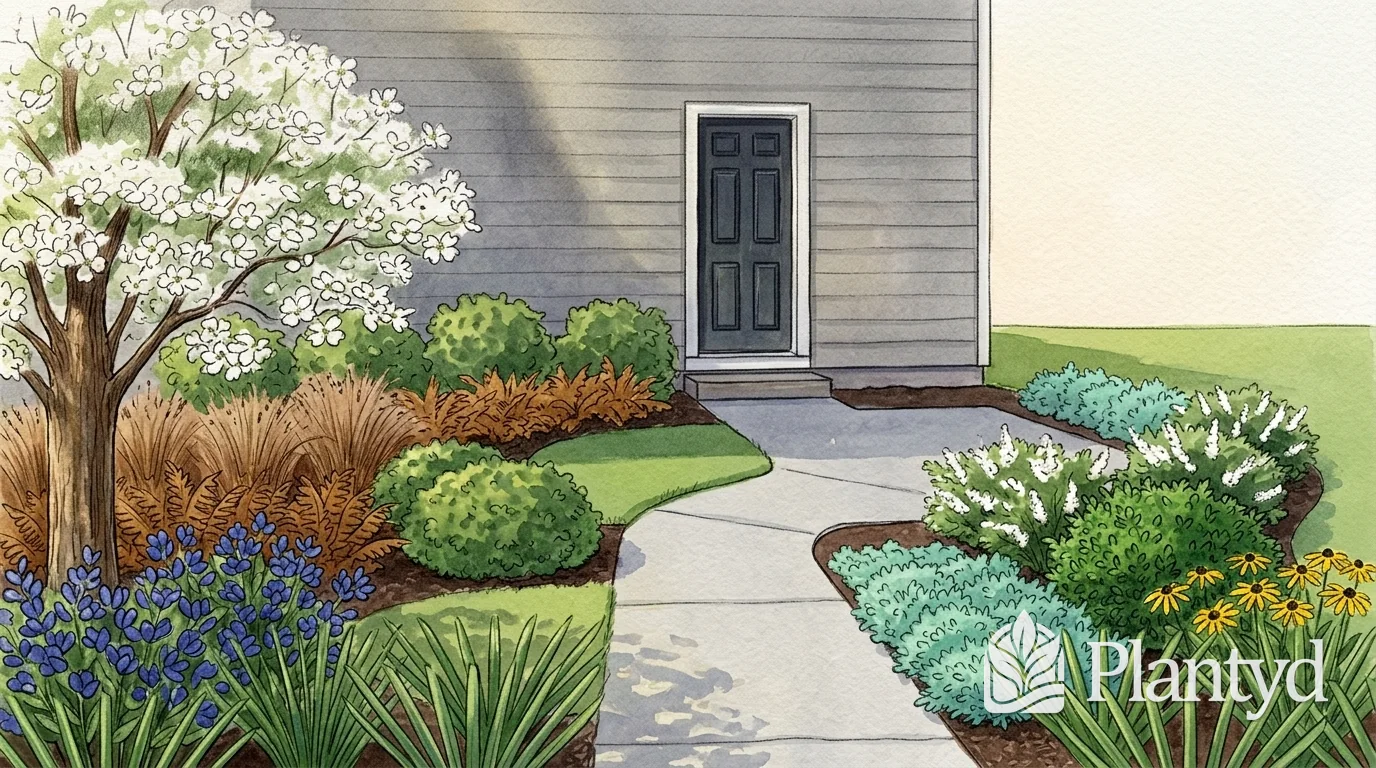 Small Front Yard Landscaping: Let the Paving Do the Work
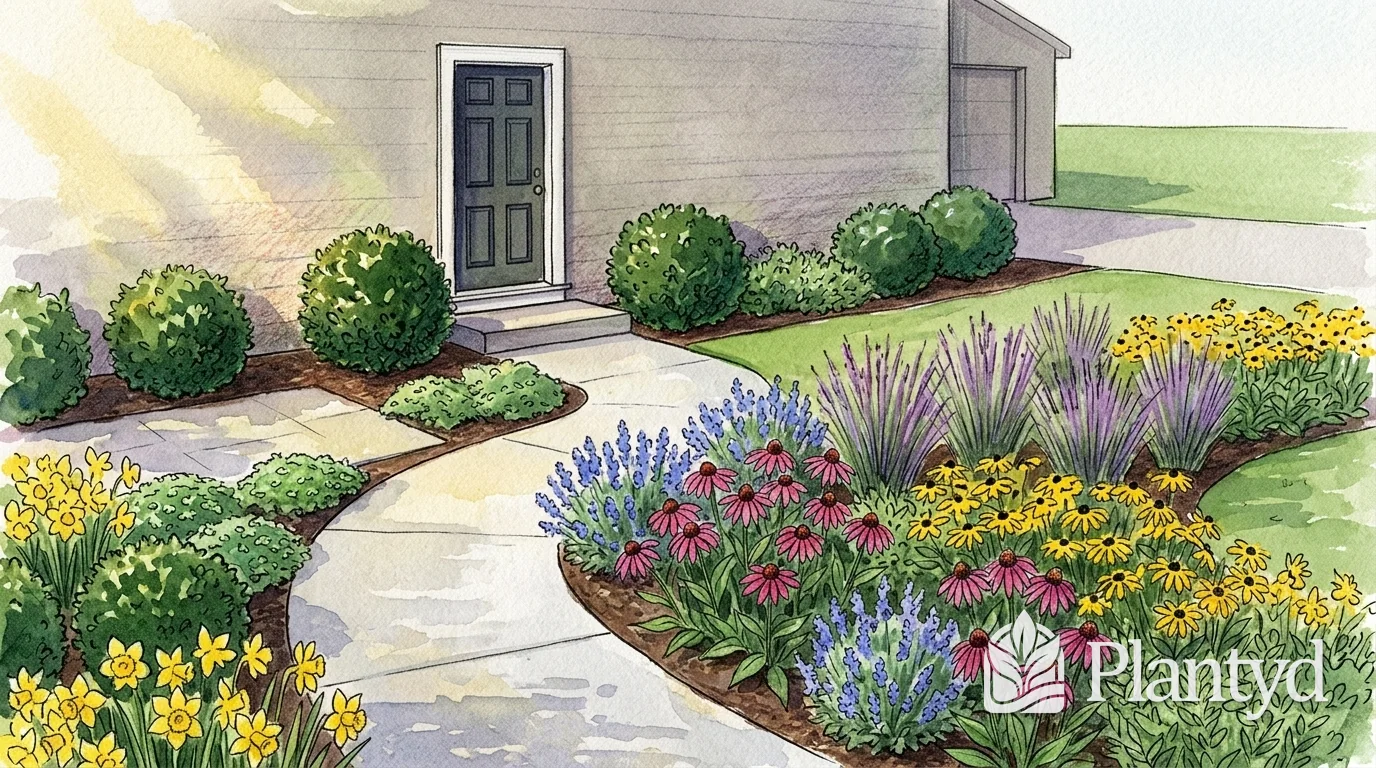 Cheap, Simple Front Yard Landscaping: Keep the Lawn, Buy the Plants Small
From the collection Front Yard Landscaping Ideas: 8 Plans, Drawn to Scale
See where the sun lands on your bed
Sign up, trace your yard on its satellite photo, draw the house and the houses next door, and see how many hours of summer sun each spot of the bed gets.
Start designing freeNo credit card required · Free tier is free forever