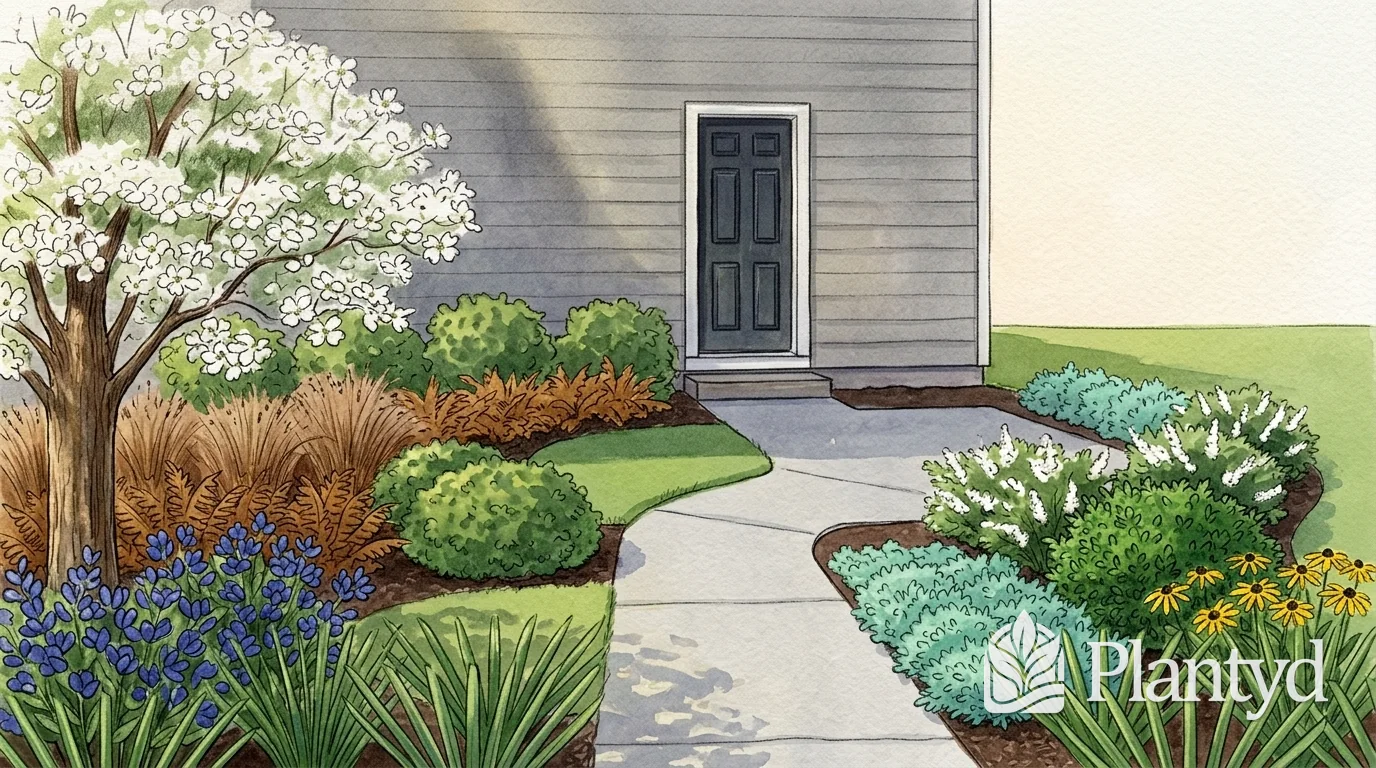
You can cross most small front yards in about ten steps, and most of them are planted the way you would expect: a concrete strip to the door, a shrub on each side of it, and a patch of grass that nobody stands on. In a yard that small, the paving matters more than the plants. Where the walk runs, how wide it is, and whether there is anywhere to stop along it decide how the whole yard feels.
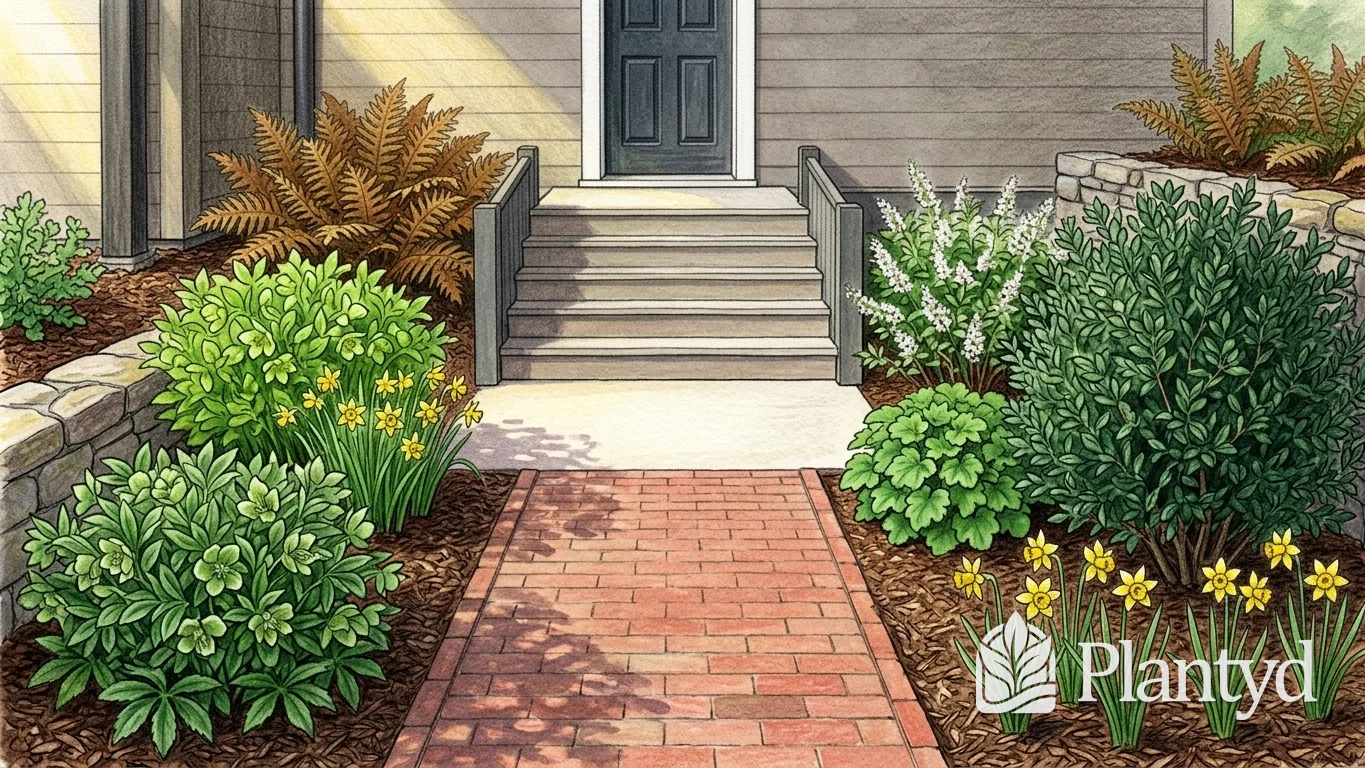
This small front yard landscaping plan is for a two-story brick house in Pittsburgh, with a front yard 34 feet wide and 24 feet deep that faces east. There is no lawn. A straight brick walk runs from the sidewalk to the door, and halfway along it a small brick court holds a bench. One flowering dogwood shades the bench in summer. Around it, eleven kinds of shrubs, perennials and grasses native to eastern North America grow in large groups, with a patch of white daffodils by the steps. Something is in flower or in berry from April into winter.
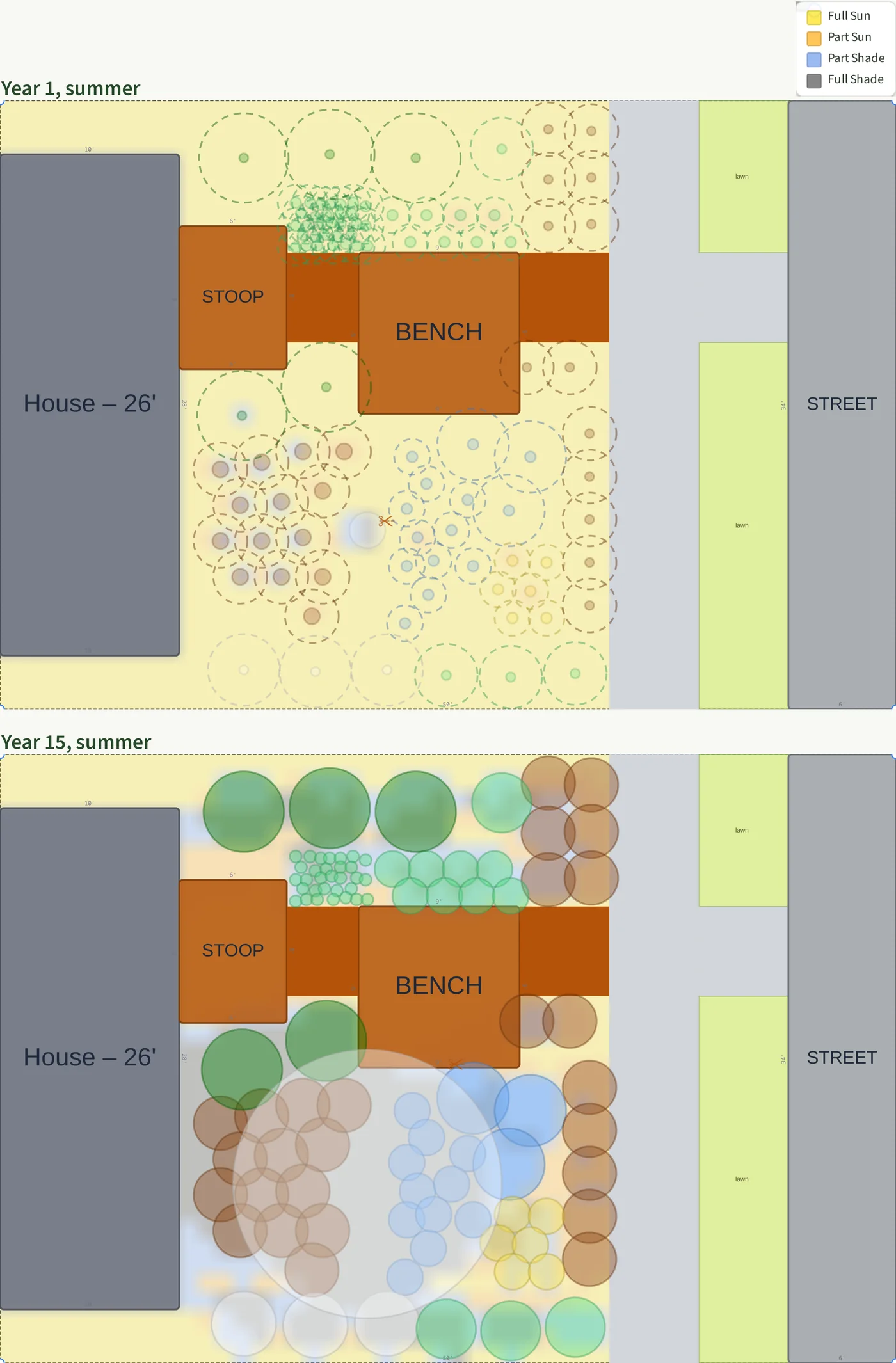
We built the plan as a real project in Plantyd and checked it with Plantyd's sun analysis, which grows the plants on the plan and shows where their shade falls as they get bigger. That check moved the mountain laurels. Along the house, where we first put them, the grown dogwood would leave them in full shade, so they now frame the front door instead. You can download the plan sheet near the bottom of the page.
| Yard | 34 feet wide, 24 feet from the house to the sidewalk, no lawn |
|---|---|
| House | Two-story brick house, no driveway, parking on the street |
| Where | Pittsburgh, Pennsylvania, USDA zone 6b |
| Faces | East: morning sun on the front, the house shading it after midday |
| Built for | A front door you can see from the street, and somewhere to sit |
| Plants | 12 kinds, 99 plants (31 of them daffodil bulbs); 11 of the kinds are native to eastern North America |
| Paving | A straight 5-foot brick walk, a 6 by 8 foot stoop, a 9 by 9 foot bench court |
| Upkeep | Cut back perennials and grass in early spring, mulch, no mowing |
A straight walk and a bench court make the entry
The walk runs straight from the door to the sidewalk. It is five feet wide and laid in brick to match the house. A curved walk can look softer on paper, but in 24 feet a curve only shortens the beds and hides the door. With a straight walk, the door is the first thing you see from the street.
Halfway to the door, a brick court nine feet square opens off the south side of the walk. It has room for a bench, so you or a guest can stop and sit. At the curb, a five-foot concrete crossing runs through the grass strip, so someone who parks out front steps onto paving instead of mud.
Together, the stoop, walk and court come to about 175 square feet of brick. On a lot this small, that much paving is what makes the entry feel generous.
One dogwood shades the bench
The only tree is a flowering dogwood called 'Appalachian Spring'. It is a selection of the native dogwood that resists anthracnose, a leaf disease that has killed many wild dogwoods. It flowers white in late April and May, and its leaves turn red in fall. The tree stands just south of the court, about ten feet from the house, where its midday shade falls on the bench in summer.
The plan shows the dogwood fifteen feet wide, which is the low end for this tree. Some grow twenty feet wide. A canopy that size would cover more than a third of the beds and shade the flowers east of it, so the yard has room for only one tree.
The mountain laurels go where the shade won't reach
Our first draft had seven mountain laurels, five of them along the front of the house and partly under the dogwood. Plantyd's sun analysis showed that by year fifteen, those five would get about an hour and a half of summer sun at most. That is full shade. Mountain laurel lives in full shade, but it hardly flowers there.
So the laurels moved to the ground by the door, which the tree barely reaches. Three stand in the north bed beside the stoop and two on the stoop's south side. That puts Pennsylvania's state flower right at the front door. The two on the south side still sit at the edge of the dogwood's shade and get a little over two hours of sun, so expect them to flower less than the three across the walk.
You could not see this problem standing in the yard in year one, when the dogwood is a stick and the whole yard is in sun. Plantyd grows the trees on your plan and reruns the sun as they get bigger. To find out where your own yard stands now, start with how much sun your yard gets.
Ferns grow under the tree, and flowers grow in the sun beside it
By year fifteen, the ground under the dogwood gets one to three hours of sun. Christmas fern covers it between the trunk and the house, and Allegheny spurge covers the east half of the ground under the canopy. The fern stays green all winter. The spurge keeps some of its leaves in Pittsburgh, but by midwinter they often flatten or turn brown, so the fern is what you see from the front windows in winter.
East of the canopy the beds stay sunny, and most of the flowers grow there. Blue false indigo sends up blue spires in late spring, and 'Goldsturm' black-eyed Susan turns the bed gold from July. Across the walk, a row of aromatic aster faces the court. Its lavender-blue flowers open in late September and October, the last of the year.
Along the south edge of the yard, three summersweets near the house carry fragrant white flowers in July and August, and three winterberries hold red berries on their bare stems into winter, until the birds find them. Winterberries need a male plant nearby to set berries, so one male stands across the walk in the north bed. Prairie dropseed, a fine native grass, fills the corners at the street and runs along the sidewalk. It still looks tidy in January.
Plant the shade plants in year two or three
In year one the dogwood is a sapling three or four feet tall, and the ground meant for ferns sits in full sun. The tree won't shade it much for close to ten years. Plant the ferns and spurge in year two or three, and water them through every dry summer until the canopy fills in. Christmas fern can take sun as long as its roots stay damp.
The beds will look sparse for the first couple of years. Fill the gaps with annuals the first summer rather than with extra shrubs, which you would only have to dig out later. By year five the perennial groups have filled in, though you will always see some mulch between the shrubs.
To space the shrubs so they don't crowd the walk when they are grown, see how far apart to plant trees and shrubs.
If your house faces another way, move the laurels
Every sun reading in this post is for a front that faces east, with morning sun and the house's shade after midday. If your house faces west, it shades the yard in the morning instead, and the beds by the door get the hottest sun of the day. The sun-loving plants are fine with that. Mountain laurel in hot, open sun tends to turn yellowish, so on a west-facing front, frame the door with inkberry instead.
If your house faces north, it shades the beds nearest to it for much of the day. The laurels, fern and spurge will do well there. The false indigo, black-eyed Susan, aster and dropseed need full sun, so keep them out by the sidewalk, and check how many hours of sun your yard gets before you buy.
Whichever way your house faces, mountain laurel needs acid soil, so test your soil before you buy them. Plant the laurels at least three and a half feet from the brick, too. Mortar can make the soil right next to a wall less acid.
If deer come down your street, most of the plan will hold up. Rutgers' ratings of deer-resistant plants list the daffodils, Christmas fern, Allegheny spurge and false indigo as rarely damaged, and the winterberry, summersweet, aster and black-eyed Susan as seldom badly damaged. Deer browse the laurel and the dogwood more often, so protect the laurels with netting or a repellent.
The plant list: twelve kinds, most in groups of three or more
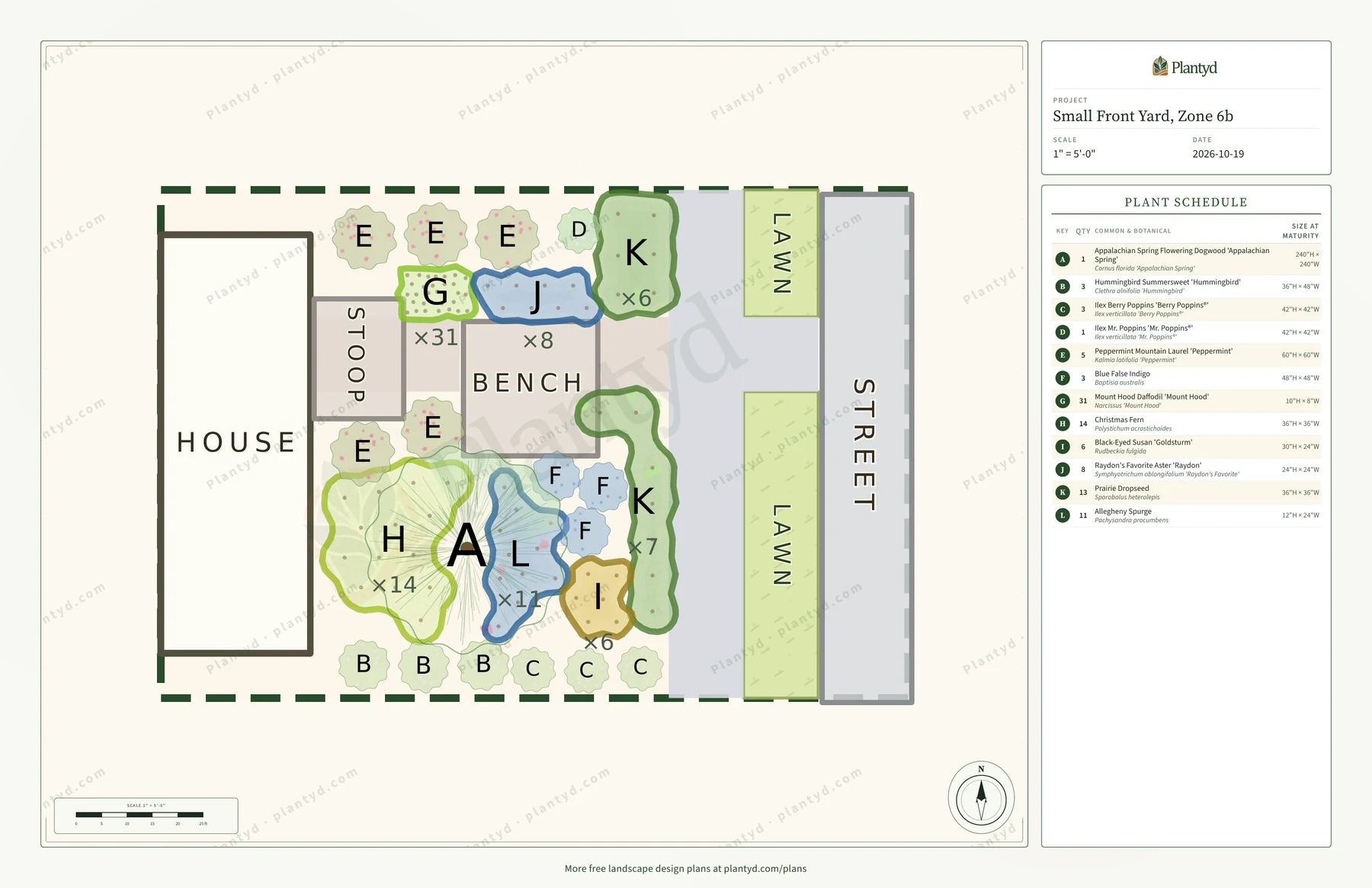
Every plant here is hardy to zone 5 and grows well in zone 7, so the list works from Pittsburgh to Philadelphia and through most of the Ohio Valley. The letters match the plan sheet.
| Key | Qty | Plant | Size at maturity | Its job in the plan |
|---|---|---|---|---|
| A | 1 | Flowering dogwood 'Appalachian Spring' Cornus florida 'Appalachian Spring' | 18 ft tall, 15 ft wide | The one tree, south of the court. White bracts in late April and May, red fall color |
| B | 3 | Summersweet 'Hummingbird' Clethra alnifolia 'Hummingbird' | 3 ft tall, 4 ft wide | Fragrant white spikes in July and August, along the south line by the house |
| C | 3 | Winterberry 'Berry Poppins' Ilex verticillata 'Berry Poppins' | 3.5 ft tall, 3.5 ft wide | Red berries on bare stems into winter, until the birds find them |
| D | 1 | Winterberry 'Mr. Poppins' Ilex verticillata 'Mr. Poppins' | 3.5 ft tall, 3.5 ft wide | The male that pollinates the three berrying plants |
| E | 5 | Mountain laurel 'Peppermint' Kalmia latifolia 'Peppermint' | 5 ft tall, 5 ft wide | Evergreen by the stoop, red-striped flowers in June. Poisonous if eaten |
| F | 3 | Blue false indigo Baptisia australis | 4 ft tall, 4 ft wide | Blue spires in late spring, in the sun east of the tree |
| G | 31 | Daffodil 'Mount Hood' Narcissus 'Mount Hood' | 16 in tall, 8 in wide | White trumpets in April, in their own patch by the stoop |
| H | 14 | Christmas fern Polystichum acrostichoides | 2 ft tall, 2.5 ft wide | Evergreen fern floor between the dogwood and the house |
| I | 6 | Black-eyed Susan 'Goldsturm' Rudbeckia fulgida | 2.5 ft tall, 2 ft wide | Gold from July, seed heads for winter |
| J | 8 | Aromatic aster 'Raydon's Favorite' Symphyotrichum oblongifolium 'Raydon's Favorite' | 2 ft tall, 2 ft wide | Lavender-blue in late September and October, the last flowers in the plan |
| K | 13 | Prairie dropseed Sporobolus heterolepis | 3 ft tall, 3 ft wide | Fine-textured grass at the street corners and down the sidewalk edge |
| L | 11 | Allegheny spurge Pachysandra procumbens | 12 in tall, 2 ft wide | Mottled groundcover under the east half of the canopy |
Lay the brick first and fit the plants around it, and the short walk from the sidewalk to your door gets a place to stop and something to look at in every season.
Common questions
How do you landscape a very small front yard?
Decide how you get to the door before you buy a plant. Make the walk wide and direct so the door is easy to see, and add one place to stop or sit. Then plant around them with one small tree and a few kinds of plants in large groups. Keep everything at the sidewalk low.
Should a small front yard have grass?
Not if it's this small. A strip of lawn a few feet wide is a chore to mow and adds nothing. Beds of low shrubs, perennials and groundcover cover the ground, give you something in every season and need no mower.
What is a good tree for a small front yard?
One that tops out around twenty feet and earns its place in more than one season. Flowering dogwood gives white spring bracts, red fall color and red fruit for birds. Fringetree and the smaller serviceberries do similar jobs. Put it where you want shade, such as over a bench.
Is mountain laurel safe near a front door?
It's a native evergreen and a fine shrub, but every part of it is poisonous if eaten. If you have toddlers or pets that chew on plants, swap it for inkberry 'Shamrock', a native evergreen holly of about the same size. Its black berries can still upset a stomach, but holly is far less dangerous than laurel.
More plans like this
 Narrow Front Yard Landscaping for a North-Facing Rowhouse
 Cheap, Simple Front Yard Landscaping: Keep the Lawn, Buy the Plants Small
 Front Yard Landscaping for a Ranch House Without Hiding the Windows
From the collection Front Yard Landscaping Ideas: 8 Plans, Drawn to Scale
Draw your own front yard
Sign up, trace your yard on its satellite photo, and see where the sun falls on it now and fifteen years from now, before the first shrub goes in.
Start designing freeNo credit card required · Free tier is free forever