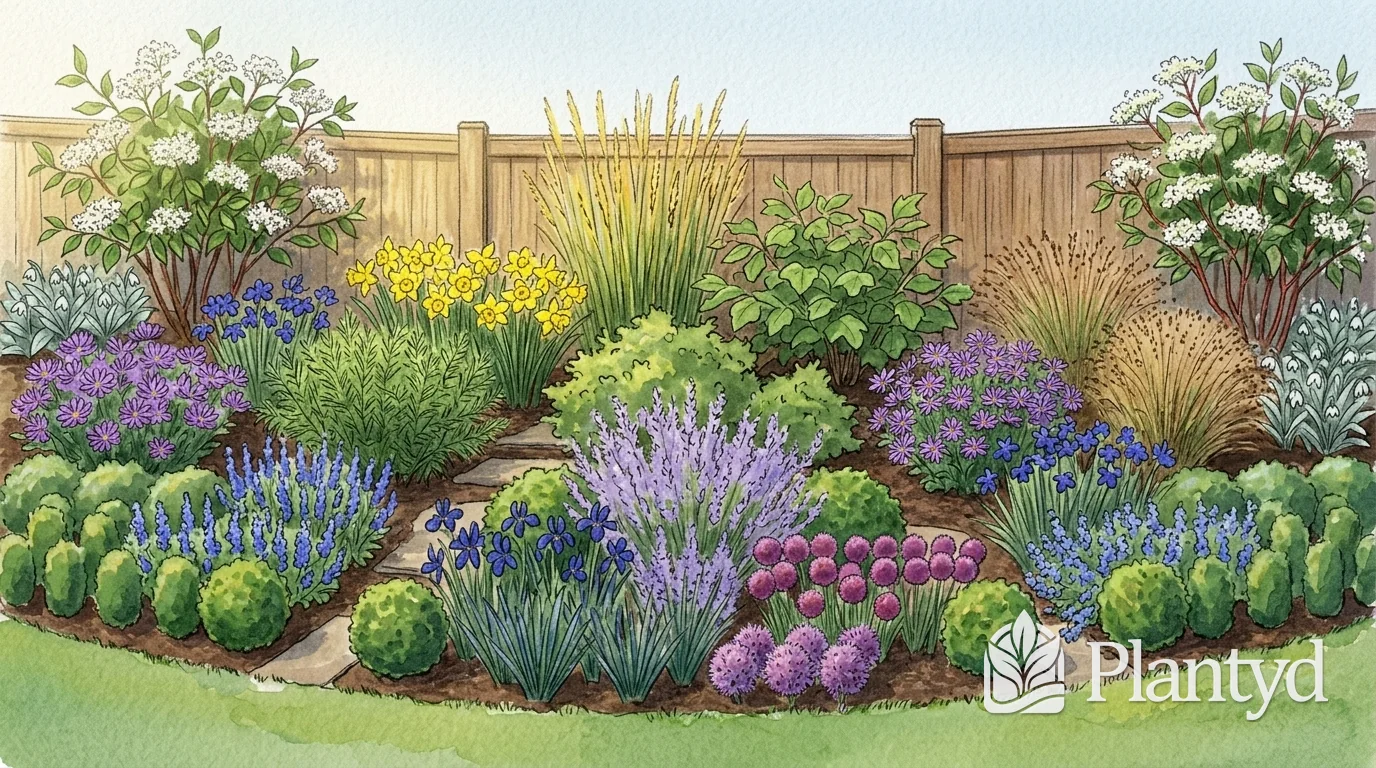
You sit on the patio and look across the yard, and the view ends at six feet of brown boards. In July a few plants lean against the fence, and in January you see only the fence. For something that fills so much of the view from the house, it gets very little planting.
This perennial garden plan treats landscaping along a privacy fence as one long border. It is for a yard in Lewisburg, West Virginia, in zone 6b, where an existing 6-foot board fence runs along the north property line and faces south toward the house. The border runs 60 feet along the fence and 15 feet deep, in three tiers. Behind it, a strip of stepping stones lets you reach the boards to stain them. Most of the 14 kinds of plants are perennials, with shrubs and grasses that hold the view in winter, so there is something to look at in every month.
We drew the yard as a Plantyd project. Before planting it, we stood test plants in front of both faces of a 6-foot fence to see which side to use. In June the north face, the one you would call shady, came out ahead: two feet out, it got fourteen and a half hours of sun, and the south face got nine and a half. Early fall and December told the opposite story, so the border faces south. You can download the plan sheet near the bottom of the page.
| Yard | 70 feet wide. The border runs 60 feet along the back fence and is 15 feet deep, from the boards to the lawn |
|---|---|
| Fence | An existing 6-foot board privacy fence on the north line. The border's front edge is 32 feet of lawn from the patio |
| Where | Lewisburg, West Virginia, USDA zone 6b |
| Sun | Full sun. The border faces south, toward the house |
| Built for | Something to look at in every month, mostly perennials, and a way to reach the fence to stain it |
| Plants | 169 plants of 14 kinds: 9 kinds of perennials and grasses, 3 of shrubs, 2 of bulbs |
| Paving | A 2-foot stepping-stone strip along the fence, and two crossings from the lawn |
| Upkeep | Cut the perennials and grasses back in March, thin the dogwoods, shear the catmint after its first flush |
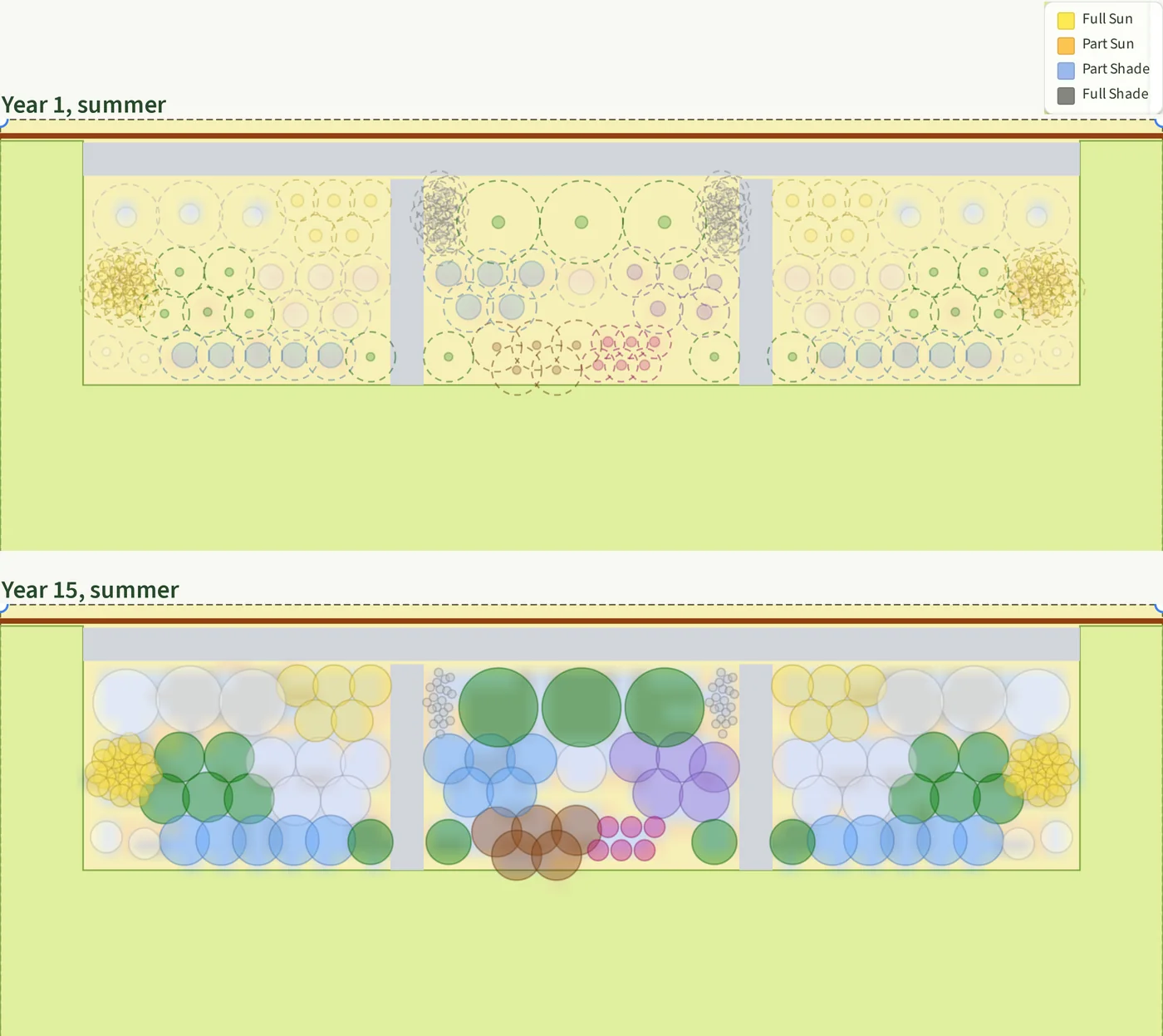
Plant the fence's south face, even though June favors the north
In midsummer the sun rises well north of east and sets well north of west. It lights the north side of a fence that runs east to west early and late in the day, and at noon it is so high that the fence's shadow is barely a foot and a half long. That is why the north face looked sunnier in June. The narrow front yard plan ran into the same thing on a north-facing house.
When we ran the same test for early spring and early fall, the first four feet in front of the north face got two hours of sun or less. That is the whole back row of a border. In December the north face was in full shade, under two hours, as far as eleven feet out. The south face kept twelve hours of sun in spring and fall and full sun all winter, which is when the red stems and witch hazel flowers are the view.
So in this plan the fence is on the north line, and the border faces the house. If your fence faces the other way, see the last section.
Keep the back row under the top of the fence
A border along a fence works like a stage set. It is tall at the back, short at the front, and seen from one side only. Here the back row tops out around five feet, so the top of the fence still shows above it as a backdrop. Switchgrass 'Northwind' and witch hazel 'Little Suzie' reach about five feet, and the red-twig dogwoods about four. The middle tier is three to four feet tall, with blue star, Russian sage, Siberian iris and aromatic aster. The front stays at three feet or under.
Even on the sunny face, the fence takes some sun. In the first June, the switchgrass by the stepping stones got about eleven hours of sun, two or three hours fewer than the plants along the lawn, because the boards block the sun early and late. That is still full sun, so the back row is made of sun plants too.
Plantyd maps the hours of sun across the yard you draw, and its growth view draws each plant at its spread in year fifteen. You can see the catmint spilling onto the lawn before you buy a pot.
Leave two feet behind the border so you can reach the fence
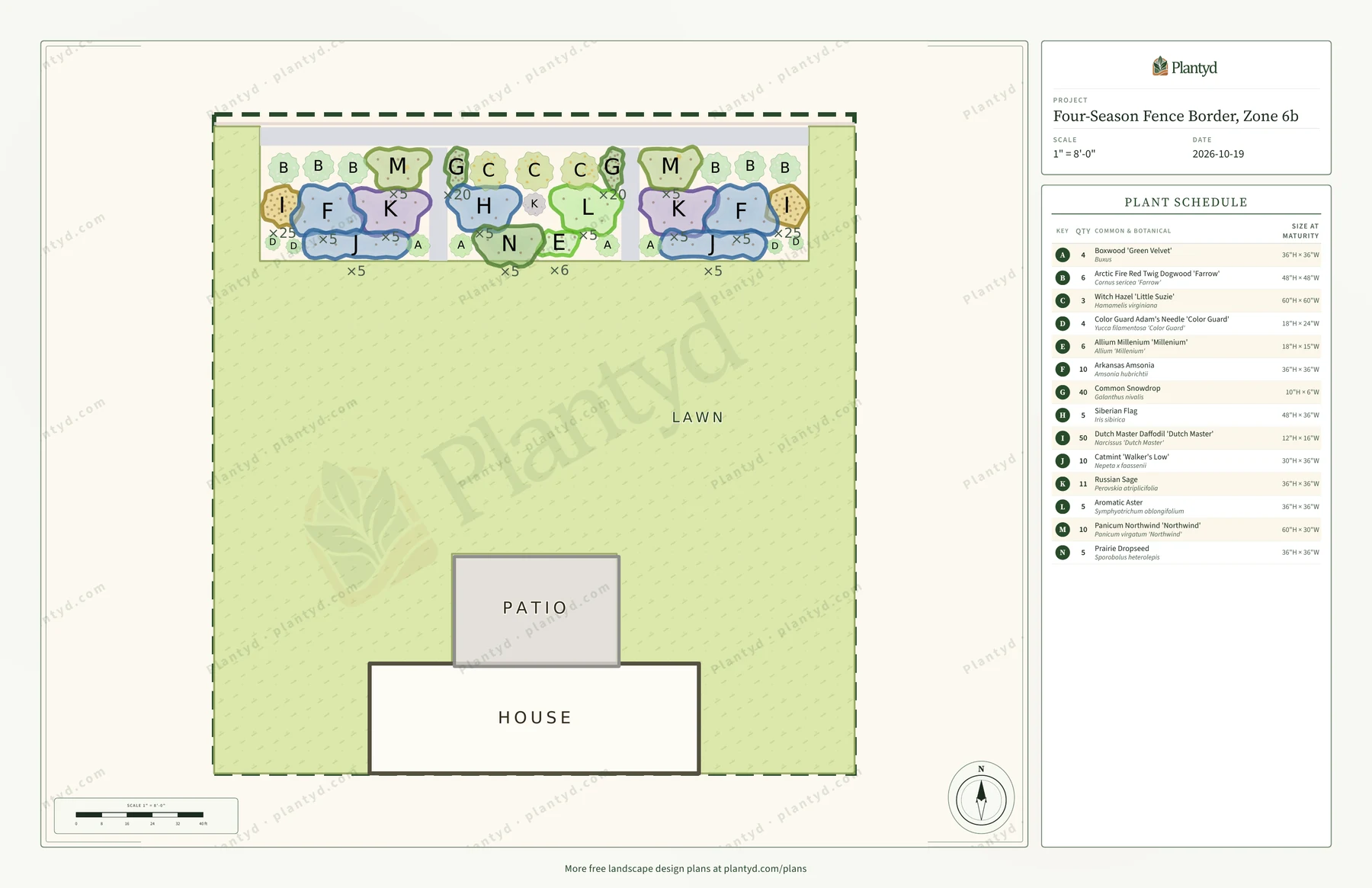
A wooden fence needs stain every few years and a repair now and then, and you can't do either from the lawn. So a 2-foot strip of stepping stones runs the full length of the fence, between the boards and the planting. The grown edge of the back row stays about two and a half feet off the fence. The setback rule is in how far apart to plant trees and shrubs.
Two more stepping-stone crossings run from the lawn to that strip. They split the 60 feet into three bays of about 19 feet each, so you can reach the back without walking through the planting. There are no vines on the fence, because vines hold damp against the wood and have to come down every time it is stained.
The two end bays match, and the middle bay is different
Sixty feet of border needs a pattern, or it reads as one long smear of plants. This perennial garden layout runs end, middle, end along the fence. The two end bays match. Each has three red-twig dogwoods at its outer end, a block of five switchgrass by the crossing, blue star and Russian sage in the middle, and an edge of catmint.
The middle bay has three witch hazels across the back, then Siberian iris, one Russian sage and aromatic aster, with prairie dropseed and ornamental onions at the front. Repeated plants tie the bays together. A boxwood globe stands on each side of both crossings, like gateposts. Two yuccas mark each outer corner, and Russian sage turns up in all three bays.
Red stems and tan grass carry the border through winter
In winter most border perennials are brown stalks or nothing at all, so the view from the patio comes from the few plants that hold up. The dogwood stems turn red as their leaves drop in November. The switchgrass stands as tan columns, the boxwoods and yuccas stay green, and the Russian sage keeps its silver stems. The witch hazels flower yellow in November, as their leaves come down.
After that come the snowdrops in February, in the back corners of the middle bay, and the daffodils in March at both ends, in front of the red stems. Blue star, iris and catmint follow in May. The plant list below has the rest of the year.
The perennials fill in by the third summer, and the witch hazels take ten years
Plant the daffodils and snowdrops in fall, before the ground freezes. In spring, set out the perennials from quart pots, the grasses from 1-gallon pots and the shrubs from 3-gallon pots. At first they cover about a quarter of each bay. Catmint, Russian sage and the onions flower the first summer. Water in dry weeks until fall.
By the third summer, the groups of perennials meet and the switchgrass reaches full height. The witch hazels grow slowly and take about ten years to reach full size. By then the middle shrub in each group of three gets about six hours of June sun, because its neighbors take the early and late light. That suits witch hazel and red-twig dogwood, so don't put a shrub that needs more sun in the middle.
Every March, cut a third of the oldest dogwood stems to the ground. The new stems have the best color, and the plant stays open.
How to change the plan for your own fence
If the planting side of your fence faces north, give up the first four or five feet. That strip gets June sun all day and almost none in spring or fall, so make it a wider stepping-stone path and start the sun plants beyond it. The winter view will still sit in the fence's shadow. A fence that runs north to south shades one side in the morning and the other in the afternoon. How much sun your yard gets shows how to check yours.
Every plant here is hardy from zone 5b to 7b, about a zone on either side of Lewisburg. For a shorter fence, drop the middle bay and keep the two matching end bays. For a longer one, add a second middle bay between them, behind a third crossing.
In Greenbrier County, plan for deer. Rutgers' ratings of deer-resistant plants list boxwood, yucca, switchgrass, Russian sage, catmint, iris, ornamental onions, daffodils and snowdrops as rarely damaged. Red-twig dogwood, witch hazel and asters are seldom severely damaged. Showy sedum, a common border plant, is rated occasionally severely damaged, which is why this plan leaves it out.
The plant list: 169 plants, more than half of them bulbs
Each letter below matches the plan sheet.
| Key | Qty | Plant | Size at maturity | Its job in the plan |
|---|---|---|---|---|
| A | 4 | Boxwood 'Green Velvet' Buxus 'Green Velvet' | 3 ft tall, 3 ft wide | Evergreen globes, one each side of both crossings |
| B | 6 | Red-twig dogwood 'Arctic Fire' Cornus sericea 'Farrow' | 4 ft tall, 4 ft wide | Three at each end of the back row. Red stems from November to March |
| C | 3 | Witch hazel 'Little Suzie' Hamamelis virginiana 'Little Suzie' | 5 ft tall, 5 ft wide | The back of the middle bay. Yellow flowers in November, as the leaves fall |
| D | 4 | Adam's needle 'Color Guard' Yucca filamentosa 'Color Guard' | 18 in tall, 2 ft wide | Gold-striped evergreen swords, two at each outer front corner |
| E | 6 | Ornamental onion 'Millenium' Allium 'Millenium' | 18 in tall, 15 in wide | Rose-purple globes in July and August, front of the middle bay |
| F | 10 | Arkansas blue star Amsonia hubrichtii | 3 ft tall, 3 ft wide | Pale blue in May, butter-yellow in October |
| G | 40 | Snowdrop Galanthus nivalis | 10 in tall, 6 in wide | February, in the two back corners of the middle bay |
| H | 5 | Siberian iris Iris sibirica | 4 ft tall, 3 ft wide | Violet-blue in late May; upright leaves and seed pods after |
| I | 50 | Daffodil 'Dutch Master' Narcissus 'Dutch Master' | 12 in tall, 16 in wide | Yellow in March and April at both ends, by the red stems |
| J | 10 | Catmint 'Walker's Low' Nepeta x faassenii 'Walker's Low' | 2.5 ft tall, 3 ft wide | Lavender-blue front edge of both end bays, May to September |
| K | 11 | Russian sage Perovskia atriplicifolia | 3 ft tall, 3 ft wide | Lavender haze from July to September, silver stems in winter. In all three bays |
| L | 5 | Aromatic aster Symphyotrichum oblongifolium | 3 ft tall, 3 ft wide | Violet daisies in September and October |
| M | 10 | Switchgrass 'Northwind' Panicum virgatum 'Northwind' | 5 ft tall, 2.5 ft wide | Upright blocks flanking the middle bay, tan columns all winter |
| N | 5 | Prairie dropseed Sporobolus heterolepis | 3 ft tall, 3 ft wide | Fine fountains at the front of the middle bay, orange in fall |
The fence is still six feet of brown boards, but now it is the back of a border with something to show in every month, and in January the red stems are the first thing you see.
Common questions
What can I plant along a privacy fence?
On the sunny side, almost any border perennial will do. Keep the tallest plants a little under the top of the fence so the boards stay a backdrop, and add a few shrubs and grasses that stand up in winter. Along a north-facing fence, give the first four or five feet to a path.
How deep should a perennial border be?
A full mixed border usually has ten to fourteen feet of planting. This plan is 15 feet deep: 2 feet of stepping stones at the back, then about 12 feet of planting in three tiers of plants three to five feet tall. A border six to eight feet deep holds two tiers.
How far from a fence should I plant?
Keep the grown edge of the back row two to three feet off the boards. That way the fence dries out after rain, nothing has to be cut off it, and you have room for a ladder and a brush. In this plan the centers of the back-row plants stand about four to five feet from the fence.
More plans like this
 Pollinator Garden Plan: An Island Bed That Flowers From April to November
 Prairie Garden Design: A Backyard Meadow You Plant in Modules
 Rain Garden Design: Sized to One Downspout
Lay out your own fence border
Sign up, trace your fence and the beds in front of it on your yard's satellite photo, and see how big each plant gets by year fifteen before you buy it.
Start designing freeNo credit card required · Free tier is free forever